
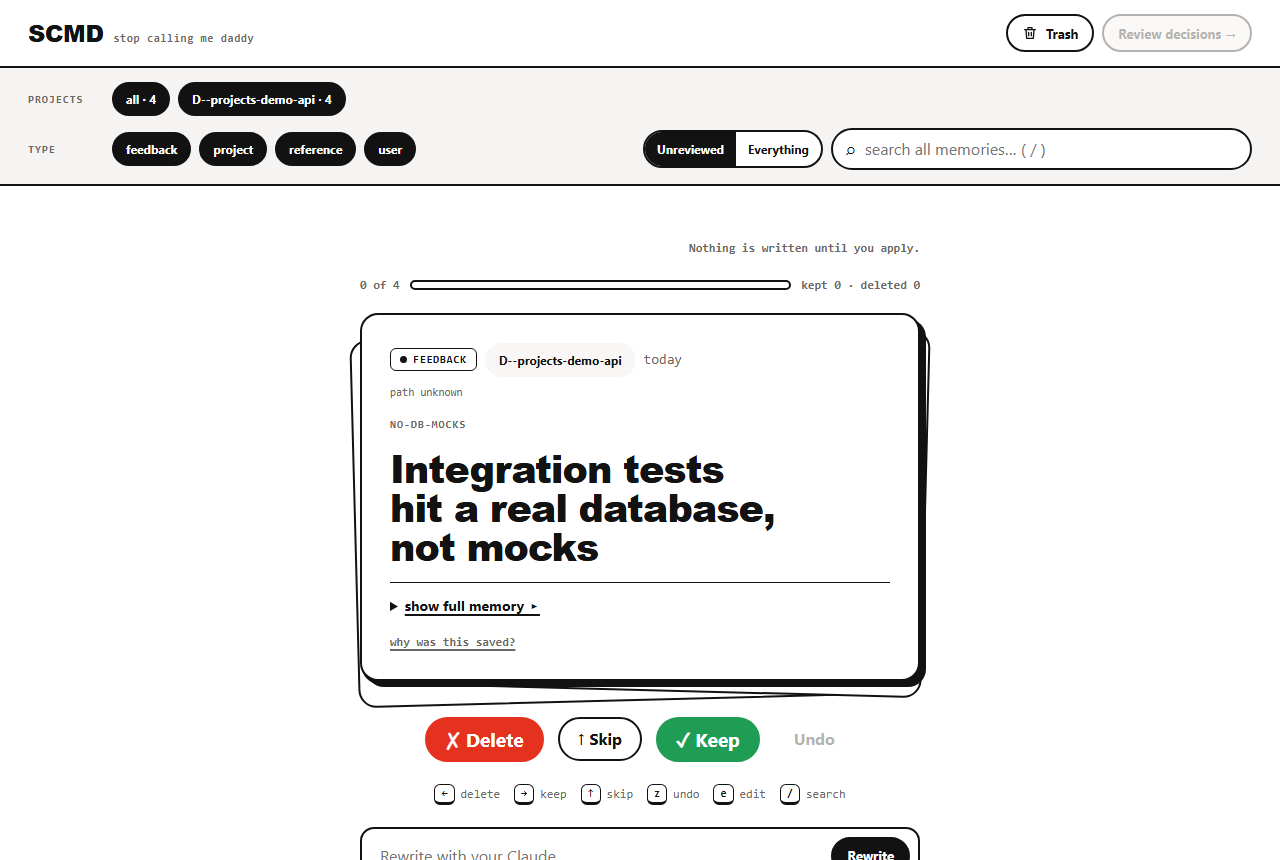
Claude Code writes persistent memories as markdown files under ~/.claude/projects/<project>/memory/ and reads them back at the start of later sessions. They accumulate. Some go stale, and some record things you never meant to keep. SCMD, which ranked 7th on Product Hunt today, is a local review deck for that pile: one card per memory, with keep, delete, skip, undo and edit, and nothing written until you confirm a batch.
It is a single Node file plus a single HTML page, MIT licensed, with no npm dependencies. I cloned it, ran its test suite, and drove the real server against synthetic memory directories. The write path is more careful than I expected. One edge in how it rewrites MEMORY.md is not, and that is the part worth knowing before you point it at a real memory directory.
What I ran
- Repository:
nelsonjohnsolo/scmd - Pinned commit:
c4c493ab6f43b358d80b53982ed8cb25fe59ff7c(@nelsonjohnsolo/scmd0.1.1) - Environment: Windows 11 Pro, Node.js v24.11.1, built from source, not from the npm tarball
- Size:
server.jsis 5,841 lines,index.htmlabout 157 KB, no runtime dependencies
The project's own suite is node --test test/*.test.js, 387 tests. On a default Windows checkout (git core.autocrlf=true) 340 pass and 21 fail. On an LF checkout of the same commit, 345 pass and 16 fail. The five that disappear are tests that parse README.md and plugin/commands/run.md and choke on CRLF line endings.
I opened a few of the remaining failures. They are Windows assumptions in the tests, not in the server: a spawn EINVAL when a test launches a .cmd shim, a restore test expecting file mode 0o640 where Windows reports 0o666, fake claude executables written as POSIX scripts, and a path regex that treats backslashes as regex syntax. I did not triage all sixteen. The README says Windows support is best effort and requires Git Bash for the plugin launcher, so none of this is a surprise.
For the rest I wrote a harness in ph-tests/scmd/. scmd.feature describes twelve scenarios and scmd.test.mjs runs them as 15 test cases (one scenario has four examples). Each case spawns the real server.js with --root and --state-dir pointing into a temp directory, then talks to its HTTP API. No real ~/.claude is read, and the only traffic is loopback.
git clone --depth 1 https://github.com/nelsonjohnsolo/scmd.git scmd-src   # c4c493a
node --test scmd.test.mjs     # 15 pass, 0 fail
node shots.mjs                # headless Edge capture of the deck
What held up
Reviewing writes nothing. I hashed the whole memory tree before and after listing projects, reading a card and opening the trash. The hash is identical, and --state-dir still does not exist. That matches the README's claim that decisions stay staged until Apply.
The API is token and Host gated. Without the launch token, /api/projects and /api/apply return 401. With the token but Host: evil.example, 403. A rejected POST /api/apply left the memory file's SHA-256 unchanged.
Stale decisions are refused. Every decision carries the content hash the card was loaded with. I appended a line to a memory after loading its card and then applied a delete with the old hash. The result was skipped: changed-since-read, the file survived, and the trash stayed empty.
Ids cannot leave the tree. I sent delete decisions for ../../outside.md, <project>/../../outside.md, C:\outside.md and /outside.md, each with the correct hash of a real file outside the memory root. All four came back error and the file was untouched.
Delete and restore round-trip exactly. With a CRLF MEMORY.md indexing three memories, deleting the middle one moved it to the trash run, removed only its index line, and left the other two lines with their CRLF endings. Restoring it put back the memory file and the MEMORY.md bytes identical to the originals. That is the part of a cleanup tool people actually worry about, and it is done properly.
Both frontmatter layouts parse. Memory files with a top-level type: and with type: nested under metadata: both produce cards with the right type. Keep is stored by content hash in reviewed.json: it counts as reviewed, and returns to unreviewed as soon as the file changes. Keep never touches the memory file.
Origin lookup copes with Windows transcripts. A session .jsonl whose Write tool call records a backslash path (D:\...\memory\project_note.md) resolved to the originating session and the project's real path. This is the "why was this saved?" link on the card.
The README says "no telemetry". I checked the source: the only http use is the server, there is no client, and spawn appears only for the browser opener and the optional Claude rewrite. That fits the claim.
Where it gets rough
Edits append to hyphen-style index lines
When you accept an edit, SCMD rewrites the matching line in MEMORY.md so the hook reflects the new description. Here is the logic, from server.js:
// server.js:2988
const link = matchIndexLine(content);
const separatorAt = link ? content.indexOf(' \u2014 ', link.raw.length) : -1;
const prefix = Buffer.from(separatorAt >= 0
  ? content.slice(0, separatorAt + 3)
  : `${content} \u2014 `);
It only recognises a spaced em dash as the separator between link and hook. If it finds one, it replaces everything after it. If it does not, it appends the separator and the new description to whatever is already there.
My test index had one line of each style, and I edited both memories' descriptions:
before:  - [A](a.md) <em dash> old A
         - [B](b.md) - old B
after:   - [A](a.md) <em dash> NEW A
         - [B](b.md) - old B <em dash> NEW B
The em dash line is replaced cleanly. The hyphen line keeps its old hook and gains the new text after it, with an em dash that no other line in the file uses. Run a few edits over an index written with hyphens and the lines grow a chain of hooks. CRLF is preserved in both cases. A neighbouring function, appendIndexLine, writes new lines in the em dash form too, so an index with mixed separators is where this ends up.
This only matters if your index uses hyphens, but that is a normal way to write one. The README says an accepted edit writes "its matching MEMORY.md line" and does not mention the separator convention.
./file.md links are invisible to the index logic
An index line written as - [B](./b.md) - hook is not matched to b.md. The project reports b.md as unindexed. Deleting the memory then leaves the line in MEMORY.md, and the project's dangling list stays empty, so the stale entry is never flagged either. Claude Code itself writes plain file.md links, so I would call this an edge. It bites if you or another tool hand-wrote the index.
Memory-to-memory [[links]] are not tracked
I made memory a reference memory b with [[b]] and deleted b. The apply result contains action, id and status and nothing else. No warning, no dangling count, and a still points at b. The trash makes this recoverable, so it is a missing guard rather than data loss. If your memories link to each other, check the survivors by hand after a big cleanup.
The server leaves quickly if no page connects
Started with --no-open and never visited, the process exited by itself 10.0 seconds later with code 0. That matches NO_CLIENT_EXIT_MS = 10_000 in the source. For the intended flow, where the plugin or npx opens your browser, this is a sensible cleanup. If your browser is slow to open or you script SCMD, it can disappear from under you.
What I did not test
- Rewrite with Claude. It shells out to the local Claude Code CLI under a logged-in account. I did not point it at one. The upstream rewrite tests are among the ones that fail on Windows, so I have no evidence either way.
- The published package and the plugin. I ran from a source clone. I did not install the npm tarball, diff it against the repo, or run
/plugin marketplace add. - The deck beyond one render. I captured the page with headless Edge from our run, but I did not click through keep, delete and undo in the browser. The API behaviour above is tested; the UI wiring on top of it is not.
- Real data at scale. Synthetic directories of two to four memories, no symlinks, no thousand-file corpora.
The verdict
SCMD does the part that has to be right. Review is read-only, mutations are hash-guarded, ids are confined to the tree, deletes are restorable down to the byte, and the code makes no outbound requests. For its stated job it is a better way to prune Claude Code memory than opening files one at a time.
Three practical notes:
- Before editing, look at your
MEMORY.md. If it uses hyphens between link and hook, edit memories by hand and let SCMD handle keep and delete. Or normalise the index to the em dash form first. - Use plain
file.mdlinks in the index, or SCMD will not know which lines belong to which memory. - After deleting memories that others link to, grep for
[[name]]yourself.
On Windows, expect the plugin launcher to need Git Bash and a good share of the upstream suite to fail for reasons that are about the tests, not the tool.