
Running several Claude Code sessions at once is easy. Knowing which one is waiting on you, what each has cost, and which branch it is touching is the hard part. devpit, which ranked 8th on Product Hunt today, is a native desktop app for that. It puts a terminal per project next to a kanban board whose columns run steps: an agent turn, a session, or your own command. Each card gets its own git worktree, and each agent call gets a spending cap and a recorded cost.
It is a Tauri app with about 43,000 lines of Rust in nine library crates (tests included), Apache-2.0. I built it from source on Windows, drove the real window through a sandboxed home with a stubbed claude, and ran its Rust test suite plus a harness against the crates that carry its main claims. I came away impressed by how carefully it is built, and the board mechanics are solid. The Windows edges are where it shows: the first command typed into a fresh terminal lost its first character in every run, a local clone path with backslashes is refused, and a built-in price table is two models behind.
What I ran
- Repository:
jholhewres/devpit - Pinned commit:
e4bacf1840354c4aacd936e0b591471a518fc49d(0.1.35, committed 2026-10-04). The working tree differs from it only by line endings - Environment: Windows 11 Pro, Rust 1.93.0 (the repo's
rust-toolchain.toml), Node 24.11.1, WebView2 runtime, debug build from source. Not the installer - Build:
pnpm install --frozen-lockfile(48.6 s),cargo install psmux --version 3.3.8 --locked --root target/psmux(what the repo'smake windows-bindoes), thentauri build --debug --no-bundle, which finished in 4 min 15 s with the library crates already compiled. No patches.makeand a workingpnpmshim were not on this machine, so I called the same steps by hand
The real window was driven by ph-tests/devpit/drive.mjs. It launches devpit-desktop.exe with HOME, USERPROFILE and DEVPIT_HOME pointing into a sandbox, a claude.exe first on PATH that runs upstream's own end-to-end stub (e2e/stub/claude.mjs, no network, no account), and the account origin pointed at a closed port. It talks to WebView2 over the DevTools protocol, seeds the board through the app's own commands the way upstream's e2e does, and saves screenshots. The harness for the crates is harness/tests/devpit.rs, with devpit.feature describing the scenarios. No real ~/.claude or ~/.devpit was read.
git clone --depth 1 https://github.com/jholhewres/devpit.git devpit-src   # e4bacf1
node drive.mjs                                                            # real window, sandbox home
cd harness && CARGO_TARGET_DIR=../devpit-src/target cargo test -- --nocapture --test-threads=1   # 13 tests
What held up in the real app
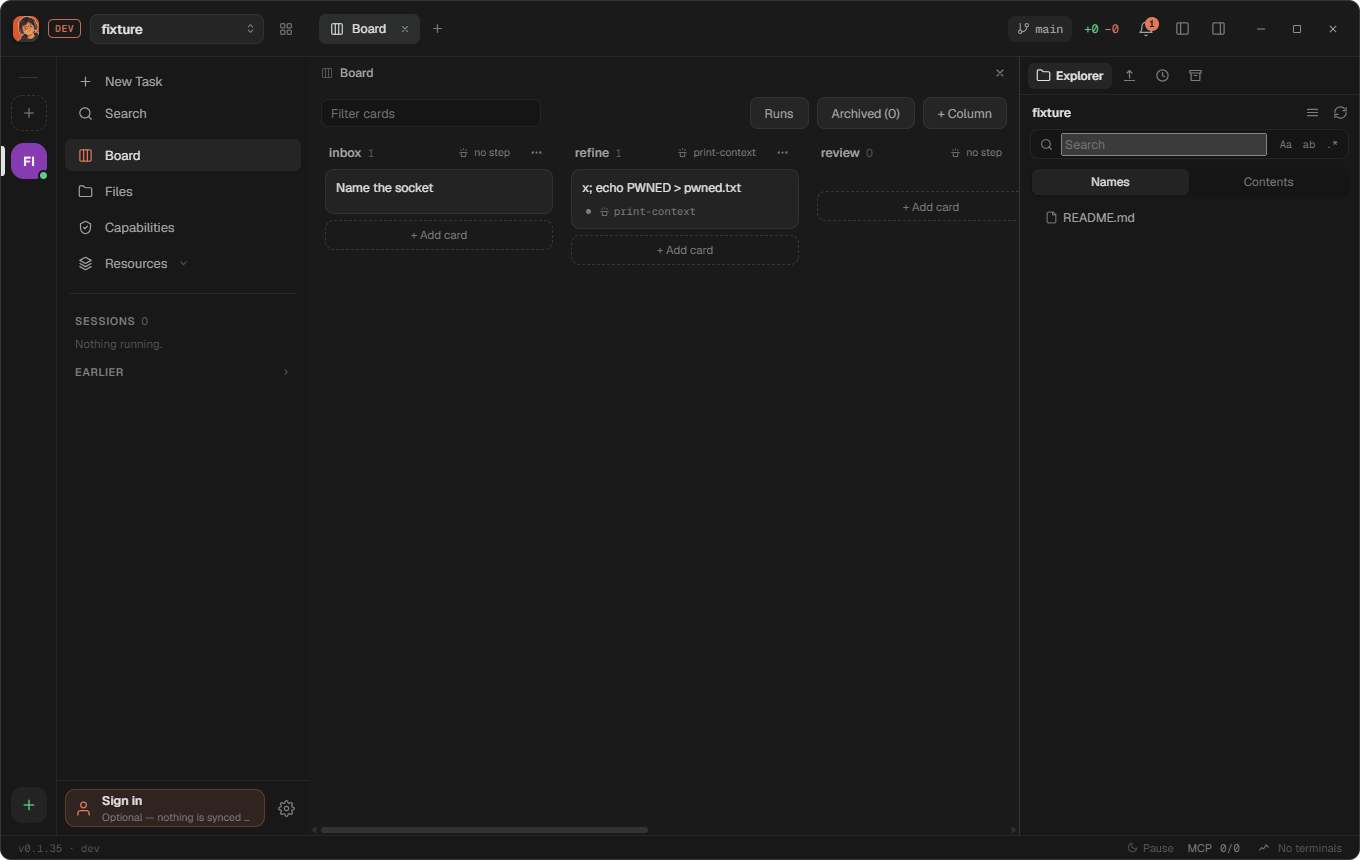
A command step gets its context through the environment. I made a card titled x; echo PWNED > pwned.txt, put it in a lane running printf "title=[%s] branch=[%s]\n" "$DEVPIT_CARD_TITLE" "$DEVPIT_BRANCH", and moved it in. The run finished ok with exit code 0 in 26 ms:
title=[x; echo PWNED > pwned.txt] branch=[devpit/x-echo-pwned-pwned-txt-dw2wj2xm]
err-line
.../.devpit/worktrees/prj_01M468.../card_01M468CQ13E2D3VTKGDW2WJ2XM
The title arrived verbatim and no pwned.txt exists anywhere in the sandbox, in the project or in the card's checkout. The working directory of the run was a worktree under the app's home, not inside the repository. It was made when the card moved into a lane with a step, which matches the README's "a git worktree per card, made when a step needs one". The same behaviour reproduced against the crates directly in the harness.
Worktrees do what the docs say. In the harness, create recorded the SHA of main as the base, and after I committed to main the card's merge-base stayed put. It refuses the main checkout and an existing path. remove refused a dirty worktree (2 file(s) and 3 line(s) are not committed), and a forced remove deleted the folder and left the branch.
Terminals open and run commands. Ctrl+T opened "Terminal 1" on the bundled psmux 3.3.8: a tmux.exe server named devpit_prj_<id> running a PowerShell pane in the project folder. A second command typed into it ran in 40 ms and printed its output as a block. Closing the app leaves that server running, as designed ("sessions that outlive the window"), so anything that scripts the app has to stop it afterwards. I used tmux kill-server against the sandbox home, which shut it down cleanly.
The ceilings hold. In the harness a loop printing 50,000 lines was cut at 34,379 lines and 2,097,119 text bytes with output_cut: true, a 20,000 character line was cut at 8,192, a one second timeout against sleep 20 returned in 1.09 s, and manifests naming an unknown {{key}} are refused by name.
Branch names survive awkward titles. Unicode, ../../etc/passwd, backslashes, emoji, an empty title, --force, x.lock, a..b and a 200 character title all passed git check-ref-format --branch. The branch is the title slug plus the last eight alphanumerics of the card id, so two same-titled cards whose ids share that tail would collide. I do not know what real ids look like.
What I liked
Most of what I enjoyed is not in the feature list.
It is easy to try safely. By the Makefile's own description, a debug build keeps its state in ~/.devpit-dev instead of ~/.devpit, so a development copy cannot touch the installed one. I set DEVPIT_HOME myself, so I did not exercise that default. DEVPIT_HOME, an account origin override and a pluggable update feed are environment variables, and I used all three. The repo ships an end-to-end stub of the claude CLI that answers from recorded fixtures with no network and no account, and its e2e runner is written to refuse the real home. I reused the stub but did not run their runner. That is why I could drive the whole app on a laptop with no plan attached, and it is the reason a review like this one is practical at all.
It builds from a clean clone. Locked JS dependencies installed in under a minute, the pinned psmux built with one command the Makefile documents, and the app compiled in 4 min 15 s with no patches and no errors on Windows. For a project at 0.1.35 that is not a given.
The design is written down, and the code agrees with it. docs/the-model.md names seven objects and says "if something is not one of these, it does not get in". The comments say why, not what: worktrees live outside the repo because inside they would show up in the file tree and in every watcher, the base is stored as a SHA so a card's diff cannot change on its own, and branches carry a devpit/ prefix so a bulk delete cannot catch something you made by hand. I checked the first two against the running behaviour and they hold.
Windows is a real target, not an afterthought. The installer carries psmux, the hook on Windows is the app's own binary instead of a curl that is not there, and the terminal gets a PowerShell pane in the project folder. I found rough edges, below, but the terminals, the board, the step runner and the worktrees all worked on a platform most tools in this category skip.
It is quick and it stays out of the way. A command step finished in 26 ms and a terminal command in 40 ms. Sign-in is offered as "free, and optional", the README says plainly that the project is early, and everything lives in a folder you own.
The release discipline shows. Version 0.1.35 was committed the day before I cloned it, with a changelog written for users and a contributor guide that describes thirteen architecture guards enforced by cargo xtask check. I read the guard list but did not run it.
Where it gets rough
The first command in a new terminal loses its first character
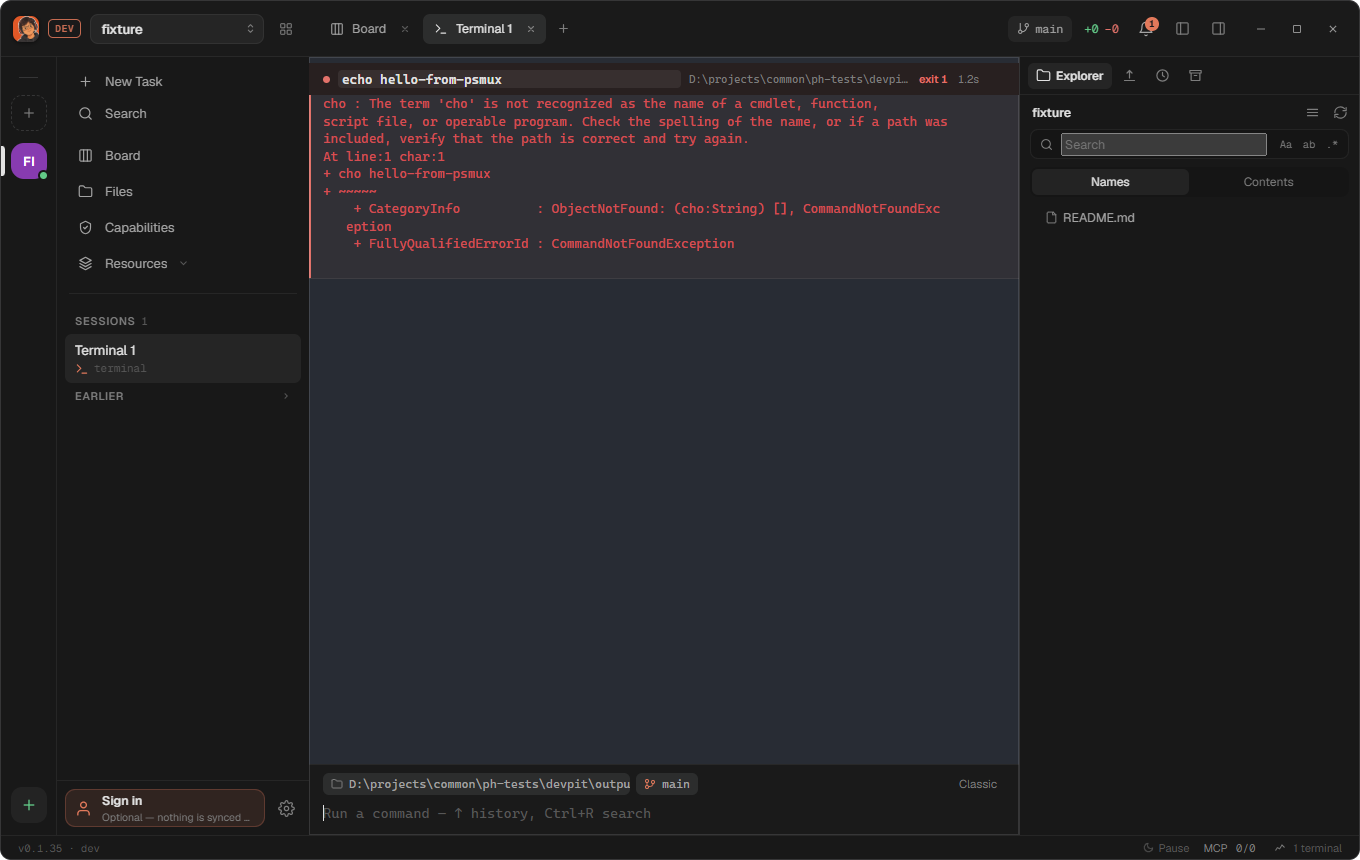
I typed echo hello-from-psmux into the new terminal's input and pressed Enter. The block header shows the full command. PowerShell received cho hello-from-psmux:
cho : The term 'cho' is not recognized as the name of a cmdlet, function, script file, or operable program.It happened on three runs out of three, with an 8 second, an 8 second and a 25 second wait after opening the terminal, so it is not a plain startup race. The second command in the same terminal, echo second-command, arrived intact. The app evidently had the whole line, since the block header is correct, so the character goes missing between the input box and the shell. I did not isolate which layer drops it: the app's first write, psmux, or PowerShell's line editor.
The caveat is that my input was synthetic. I used DevTools Input.insertText followed by an Enter key event, not a keyboard. A person typing a first command may not hit this. A scripted or pasted first command might.
folder_for rejects a Windows path
Cloning from a local path goes through folder_for in crates/git/src/clone.rs, which splits on / and : and then refuses any name containing a backslash. The upstream test that clones a local repository fails here:
clone: Unreadable { command: "clone", detail: "no folder name can be taken from
C:\Users\alext\AppData\Local\Temp\.tmp2ru7W6\origin" }
and the harness confirms the function, not the test, is at fault:
https://github.com/o/repo.git -> Some("repo")
git@github.com:o/repo.git     -> Some("repo")
C:/Users/me/origin            -> Some("origin")
C:\Users\me\origin            -> None
Remote URLs are unaffected. I did not click through the clone dialog.
stdout and stderr are not kept in order
The runner's comment says merging both streams keeps the order a person would have seen in a terminal. It reads each pipe on its own thread and merges them through one channel. For echo out; echo err 1>&2, 100 runs through the crate gave 94 in order and 6 swapped. One of my own runs of the real app showed err-line before the title= line for a command that prints them the other way round. For test output you read later this is harmless. For a log you diff, it is not stable.
The price table is behind two models
The spend history screen prices transcripts from a table built into spend_prices.rs. I compared it with Anthropic's pricing page, fetched today. Seven of nine models I checked match. Two do not:
| Model | devpit input / output / cache read | Published |
|---|---|---|
claude-opus-5-5 | $5 / $25 / $0.50 | $4 / $20 / $0.20 |
claude-fable-5-1 | $10 / $50 / $1.00 | $10 / $50 / $0.25 |
Prefix matching is the cause: names("opus-5") accepts opus-5-5 because the next character is a hyphen, not a digit, so Opus 5.5 gets Opus 5 prices, and Fable 5.1 lands on the Fable 5 row. The published cache-read rate is 0.05x of input for Opus 5.5 and 0.025x for Fable 5.1, where the table assumes 0.1x for everything.
It is bounded. The cost on a card comes from the CLI's own total_cost_usd (driver.rs:113, headless_stream.rs), not from this table. Only the Spend history screen uses it. I did not measure how large the error is on real transcripts. The one thing I would expect is that cache reads, usually the biggest token bucket in a long agent session, are where it shows.
The upstream test suite is written for Linux and macOS
cargo test --no-fail-fast --workspace --exclude devpit-desktop --exclude xtaskdevpit-core's tests do not compile on Windows: crates/core/src/tree_tests.rs:81 calls std::os::unix::fs::symlink unguarded, in the test that checks a symlink out of the project is refused. Two agentcli tests then hang. a_hook_says_which_pane_it_fired_in runs the generated hook through sh -c and blocks on listener.accept(). On Windows the hook is deliberately <current exe> hook --wait ..., and under the test harness the current exe is the test binary, so nothing posts and accept() has no timeout.
With devpit-core excluded and those two skipped, 626 pass and 21 fail. Eighteen are POSIX assumptions: curl in the hook text, echo, cat and sh -c spawned as programs, /w/bash/rcfile paths, : as the PATH separator, / in transcript paths, and \n against \r\n after autocrlf. One is the folder_for bug above, one is a pty test expecting a child to exit without being force-killed, and one, a_colon_in_the_path_does_not_swallow_the_line_number, I did not open. A compile error and two hangs suggest the Rust suite is not run on Windows upstream. I did not look at their CI configuration.
spend_scan counts lines, and the dedupe is a layer up
The module comment says a message is counted once. records_in returned three records for three transcript lines of one message, all with key msg1:req1. The dedupe is seen.insert(record.key.clone()) in apps/desktop/src/spend_history.rs:191, which I read but did not run. One synthetic message priced at $0.05325 on Sonnet 4.5, which matches the hand sum.
What I did not test
- A real agent. The
claudewas upstream's stub. No real turn ran, so cost recording, the spending cap in practice, agent steps, chat and the orchestrator are untested. The harness only checks that--max-budget-usd 0.5reaches the argument line. - Dragging cards. I moved the card with the app's own command, not the mouse. I saw the board render the result.
- The installer, updater and release build. I ran a debug build from source.
- Real keyboard input in the terminal, and anything beyond the first two commands.
- Telemetry and the account flow. The README says local first with an optional account. I pointed the account origin at a closed port and did not audit outbound requests.
- Linux, macOS and WSL.
The verdict
devpit is a thoughtful, honestly described tool made by someone who cares about the details, and the problems I found are the kind a young Windows port has, not signs of a shaky core. On Windows the product I could drive is real and mostly sound. The context-through-environment rule holds in the running app, worktrees are made outside the repo from a pinned SHA and refuse to throw away uncommitted work, terminals come up on the bundled psmux, and the output ceilings are real. Whether it keeps a fleet of Claude Code agents legible is the part I did not test, because I never ran a real agent.
Practical notes:
- On Windows, send a throwaway first command to a new terminal, or check what the shell received. A first line that loses a character fails with a confusing "command not found" for the wrong name.
- Cloning from a local backslash path will fail until
folder_forhandles\. Use a URL or forward slashes. - Treat the Spend history screen as an estimate for Opus 5.5 and Fable 5.1. Card costs come from the CLI.
- Do not rely on stdout and stderr order in a command step's output.
- Run the Rust tests under WSL, where the README says the Linux build runs.