DEV·TV puts developer news in a television frame. Pick a channel, let stories advance, glance back at it when something catches your eye. It was #5 on Product Hunt's September 25 board when I checked. The maker's suggested setup is a spare office screen or a remote team's always-on tab, where a story becomes something people can point at together.
The app is a single HTML file with a public MIT repository. I cloned it, opened the unmodified page in Chrome, and drove it with a browser harness that supplied synthetic feed data and recorded every request. The TV is a real interface rather than a mockup: channel switching, the reader, playback controls, error states, and cached stories all worked in the paths I exercised. The surprising part is what the controls do not control. Disabling a channel removes it from the screen, but the page still fetches it. Powering off the screen also leaves refreshes running.
The channels are ten different bets on what is worth seeing
The live site is both landing page and app. I fetched it successfully and found ten channel definitions. There is no build step, account, or DEV·TV server; the browser calls the source APIs directly. The repository's pinned index.html is 102,089 bytes, including CSS and JavaScript. No npm dependencies hide behind the one-file pitch.
The source table in the README spells out each channel. They are not ten views of one aggregate feed:
| Channel | What the page requests | What that means |
|---|---|---|
| GitHub | Repository search, created in the last two days, sorted by total stars | New repositories with high total stars, not star growth or GitHub Trending |
| Hacker News | Current top-story IDs, then each story | A front-page snapshot, with another request for every selected story |
| DEV | The site's top articles for today | A daily ranking supplied by DEV |
| Hugging Face | Models sorted by its trending score | The platform's own momentum measure |
| Releases | Latest release for React, Vue, TypeScript, Node.js, Python, and Rust | A six-project shortlist, not all releases |
| AI Papers / Latest Papers | Hugging Face daily papers / OpenAlex works by publication date | Community attention versus recency |
| CVE | Recent entries from NVD | A seven-day vulnerability window |
| HN Video / AI Video | Two HN Algolia searches for YouTube links | HN-voted videos; the AI channel adds a title-keyword filter |
That design is more thoughtful than just putting RSS in a CRT skin. AI Papers can keep showing a paper people are still discussing; Latest Papers can show one too new to have a discussion. The video channels use Hacker News votes instead of YouTube recommendations. The tradeoff is mechanical: the AI-video keyword list will miss an AI talk with an ordinary title, and GitHub's sort=stars does not tell you how fast a repository is growing. Those limits are visible in the fetchers, not guesses about the feeds.
An older Product Hunt subpage says seven channels. The current listing and both copies of the page I checked say ten. For this launch, ten is the number to use.
How I ran it
I pinned shouvik12/devtv at commit 71eea19356d070fc44703f2d9e3aededa8b93b05 and opened index.html in Chrome 153 on Windows 11. The test harness lives locally in ph-tests/devtv/: node browser-test.mjs starts Chrome with a fresh profile, intercepts HTTPS through Chrome DevTools, and logs request URLs. It gives GitHub a fabricated repository and README, Hacker News two fabricated stories and one comment, and HN Algolia a fabricated YouTube link. Other feeds return HTTP 503. No account, credential, personal browsing data, or real source API is involved in that run.
The first visible channel showed the synthetic GitHub repository. The bottom buttons selected channels without losing playback mode. STOP froze the current preview; switching channels kept it stopped. WATCH and STOP do not automatically change channels: they control story advancement within the selected channel. That is more like a television remote than a news carousel pretending to be one. The source sets a seven-second story interval at 1×, with 2×, 3×, and 0.5× choices.
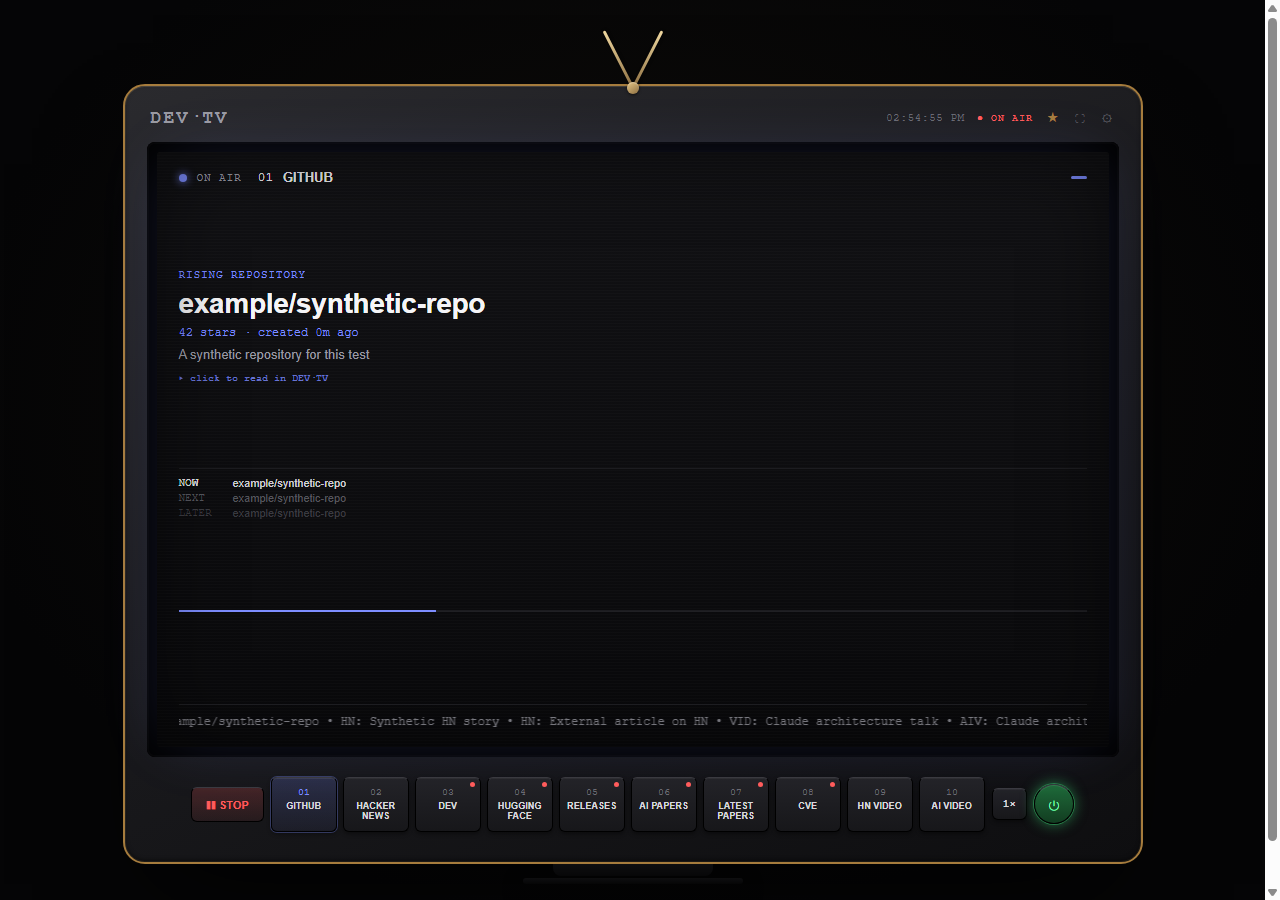
The screenshots here show the real product code with synthetic source data. They do not show live GitHub or Hacker News results. The harness recorded 45 intercepted requests over the whole expanded run, including the initial load, reader requests, explicit refreshes, and one blocked thumbnail image request. That count is a test trace, not an estimate of normal daily traffic.
The reader earns its place on the screen
Clicking the GitHub story fetched its README and opened it in the TV. A second open did not make a second README request: the page reused the browser cache. The README cache is fresh for one hour and can be used as a fallback for up to a day if a later request fails. I aged the cached copy to 61 minutes, returned a synthetic GitHub 403 with rate-limit headers, and reopened the story. The page retried the request, then showed the cached README. It used the headers to identify the failure as a rate limit instead of treating every 403 as one.
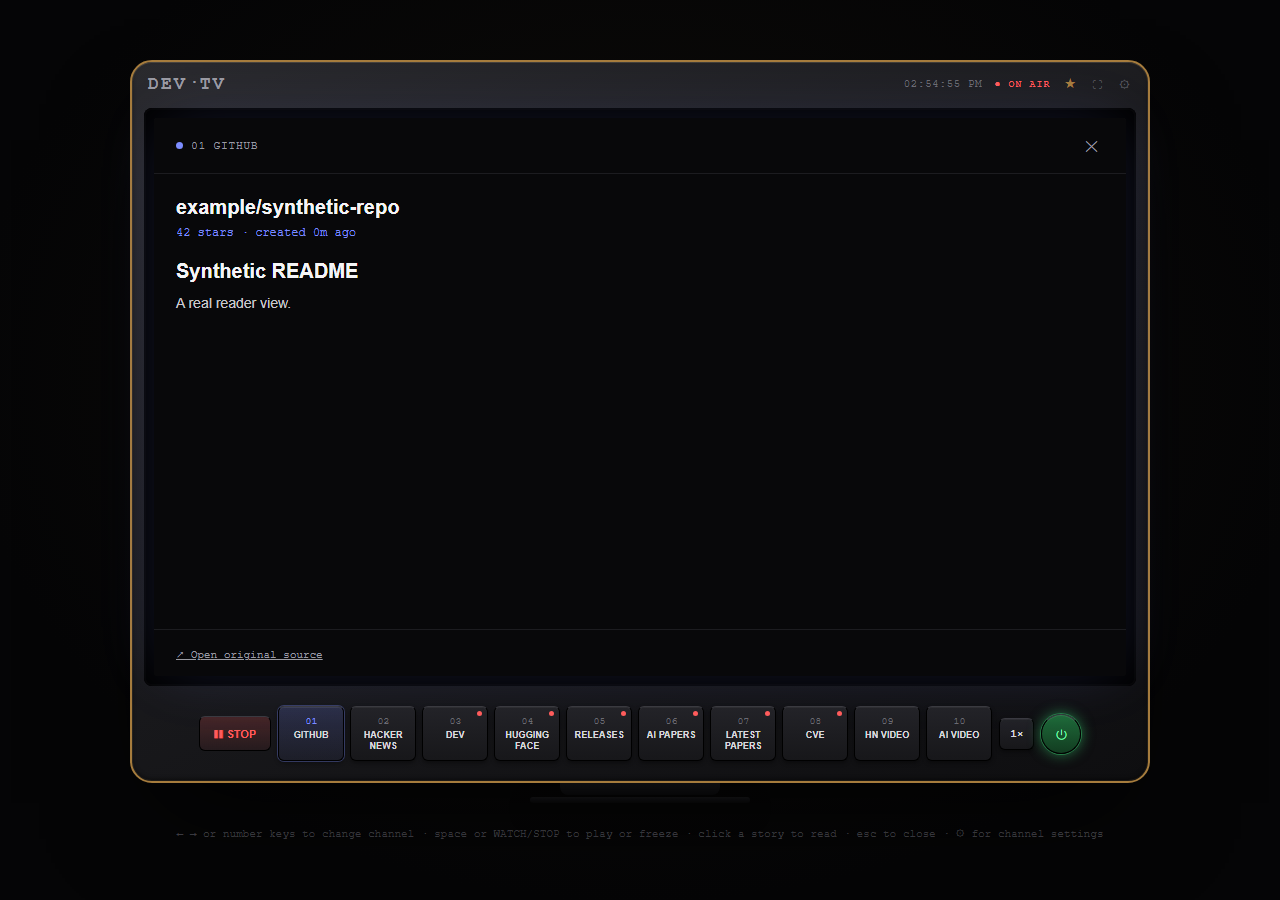
The Hacker News reader has two distinct behaviors, and I tried both. A self-post showed its own text inside the TV. An external-link story opened with a notice that the article lives on example.com, a direct link to it, and the top HN comment below. That is an honest answer to a common reader problem: Hacker News does not hold the linked article's body, so a reader cannot simply display it without scraping another site.
I put an onerror image handler in the fabricated README, self-post, and HN comment. It did not execute in these browser checks. The README renderer escaped the input and did not leave an image element with that handler; the HN path stripped raw HTML before formatting the text. This is evidence for those three payloads and reader paths, not a claim that every markdown or HTML input is safe. The source also validates video IDs against the eleven-character YouTube format; the test accepted youtu.be/abcdefghijk and rejected youtube.com.evil.test.
For the video channel, I supplied a fabricated HN story linking to YouTube. Both HN Video and AI Video accepted its clearly AI-related title. Because the page was opened as a local file: URL, the reader showed a clickable thumbnail link instead of creating a YouTube iframe. That matches the README's warning that embedded playback needs a hosted page with a web origin. I did not test whether YouTube actually plays on the hosted site; individual uploaders can also disable embedding.
Cache, failure, and the cost of leaving it on
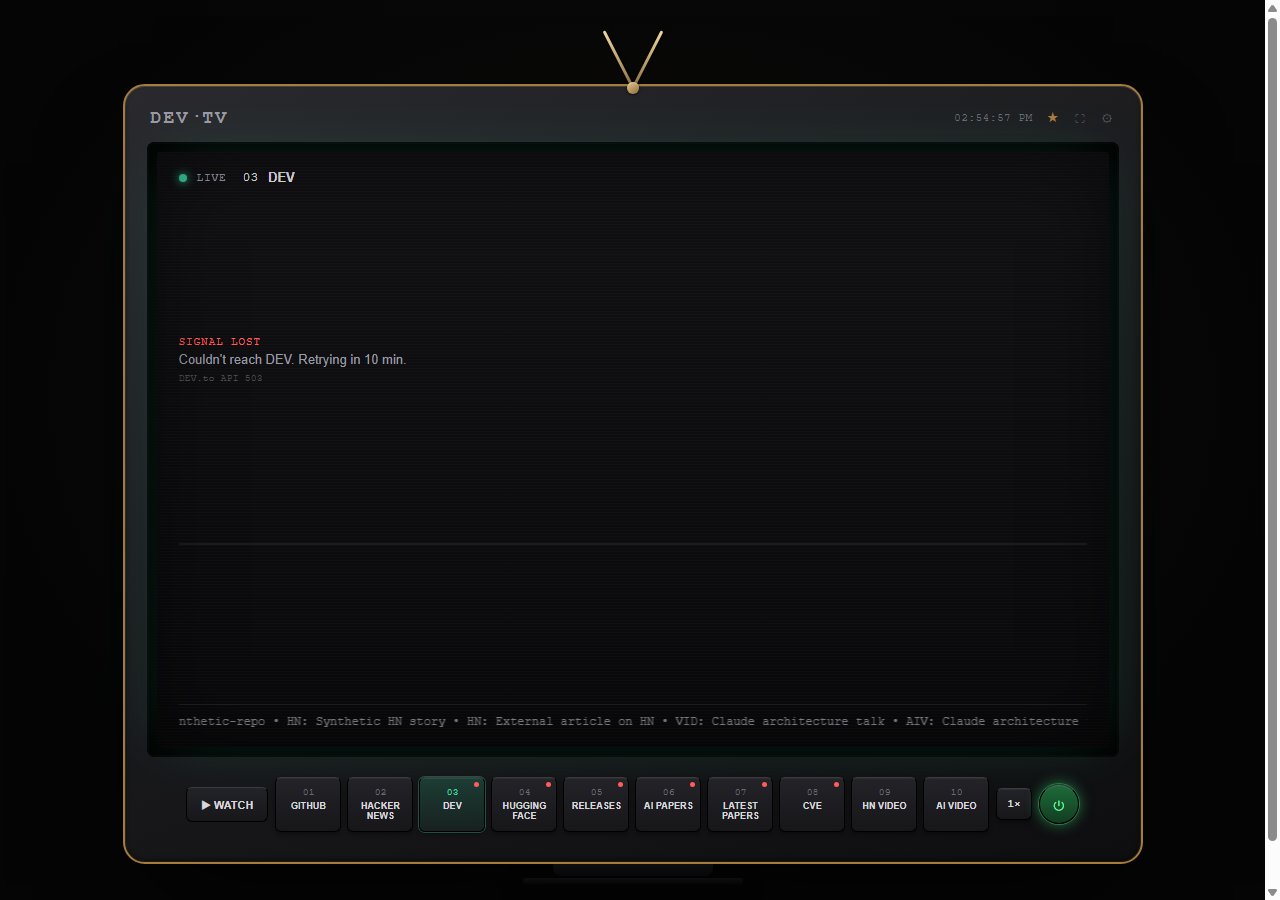
Each channel stores its last successful stories in localStorage. The fresh window ends 30 seconds before the ten-minute refresh interval; the copy stays available for up to 24 hours as a fallback. After the first load, I invoked the page's normal loadAll() while the GitHub and HN responses were still fresh. Neither endpoint was requested again. DEV, which had failed with 503 and had no good cache, was requested again. The TV showed SIGNAL LOST for DEV while the other channels remained usable.
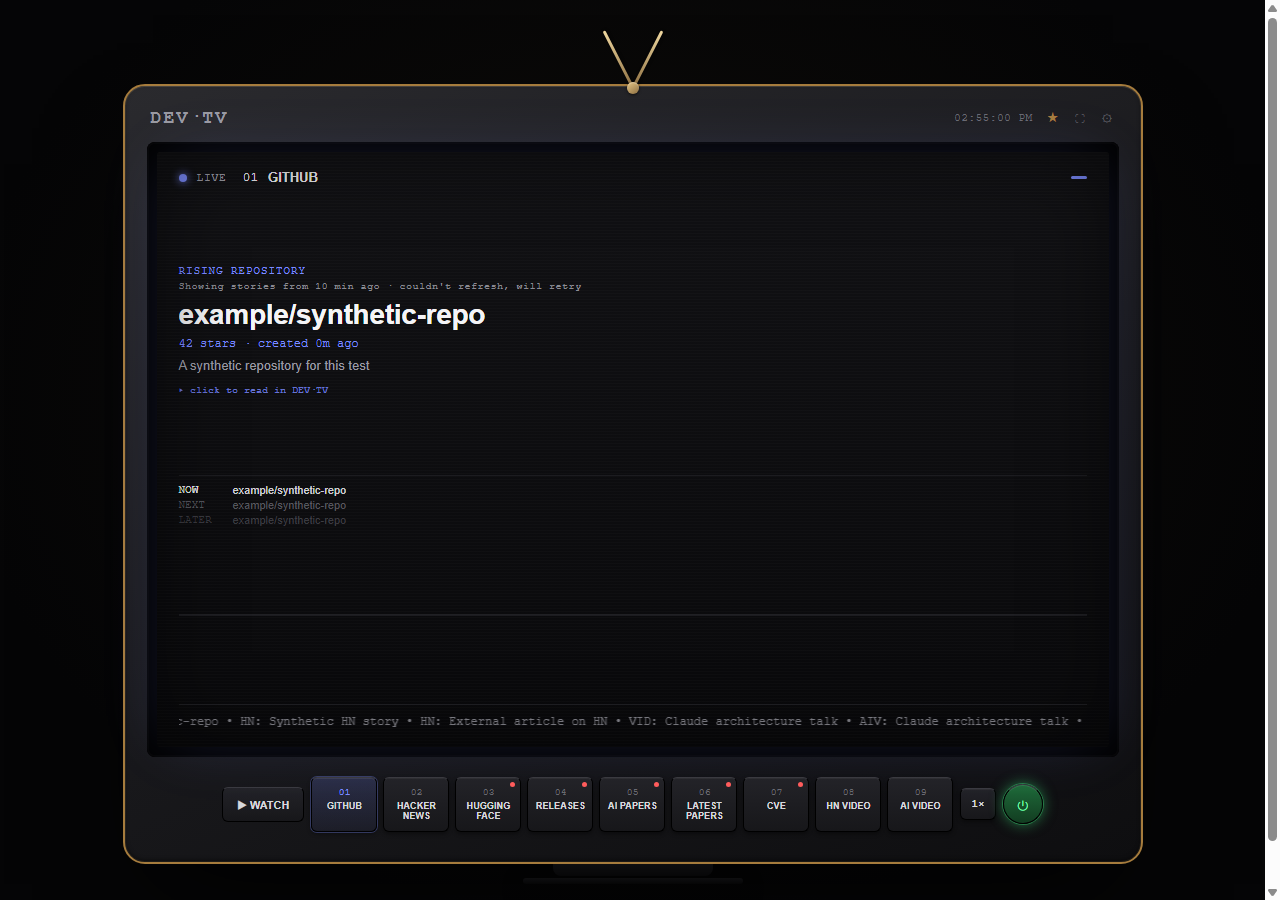
I then aged the GitHub story cache past its fresh window and returned a synthetic rate-limit response. The channel retried GitHub, kept the last good story, and labeled it as old with a retry notice. That is better than replacing the screen with an error when the API has a temporary problem. It also makes the limitation visible: the repository on screen may be from the last successful fetch, not from this refresh.
The README's rate-limit math needs one correction. It counts seven GitHub requests per ten-minute refresh, then treats all 42 per hour as spending the unauthenticated 60-per-hour core allowance. The six release requests are core requests, so they amount to 36 per hour before README reads and other activity on the same IP. The repository search is governed by GitHub's separate search counter. GitHub's rate-limit documentation explicitly separates core and search; the response headers tell you which counter governed a real request. The project is right that an office sharing one public IP can run out of allowance, but its seven-into-sixty calculation combines two different buckets. I did not measure a live GitHub quota in this test.
The switches only change what you see
The settings panel lists all ten channels with ON/OFF labels. I turned DEV off and confirmed that devto was absent from both the in-memory enabled list and the persisted setting. I then called the normal loadAll() refresh. Another request went to dev.to/api/articles. In the pinned source, getChannels() filters the visible rotation by enabledIds; loadAll() loops over ALL_CHANNELS. The loader never checks the enabled list.
The same separation applies to the TV's power button. I turned the screen off, invoked loadAll(), and observed another DEV request. The timed refresh is also wired to loadAll() without a power-state guard. A powered-off TV can therefore keep polling; a hidden channel can keep polling. Fresh successful caches may suppress a particular request, but the setting itself does not.
That distinction matters in two ways. If a channel was disabled because you do not want to contact that source, the setting does not provide that guarantee. If it was disabled to conserve requests, failed feeds still retry and successful feeds resume after their fresh cache expires. It is a product behavior gap, not evidence of a hidden analytics service: the requests in my log went to the named feed hosts, and the app's code is available to inspect.
Where I landed
DEV·TV succeeds at its main idea. It gives familiar developer sources a glanceable shape, handles missing feeds gracefully, and preserves useful stories across a temporary API failure. The built-in reader saves a tab switch for READMEs, HN self-posts, and discussions. The source's lack of a backend also explains its boundaries: it chooses browser-accessible APIs and leaves out a Product Hunt channel because that API needs a private token. The maker said the same thing in the launch discussion.
I would put it on a second screen for ambient discovery. I would change the channel loader so OFF means no fetch, and pause refresh while power is off. I would also correct the README's GitHub quota arithmetic. These are small changes to a convincing one-file product.
I tested the pinned page with controlled API replies. I did not verify the live feeds' current contents, all-day playback, mobile Safari, or video playback on the hosted origin. The live site loaded when checked, but the hands-on findings above come from the isolated browser run.