Entropy addons build UI by calling Entropy.UI.Widget.* once per widget from TypeScript - a label here, a button there, entropy_gui renders whatever the addon called this frame. This post adds a second way to describe that same UI: hand it a raw HTML string, with <style> blocks and inline style= attributes, and get the same entropy_gui widgets back, laid out by something closer to how a real page actually flows.
It is not a browser. There's no JavaScript execution, no text wrapping, and no real font metrics behind the text sizing - all three are explicit non-goals, stated in the module doc comments before a line of layout code runs. What it does have is real HTML parsing, a real (if source-order-only) CSS cascade, and a real flexbox/block layout solver computing actual positions - three components that don't already know about each other, wired together for the first time in this codebase. The interesting part of a post like this was never "does it compile" - it's where a "basics-only" engine stops matching a real page, and Entropy fetching example.com live found three separate, unglamorous ways that happens.
What we're building
Entropy.UI.Widget.html(windowId, html, { baseUrl?, width? }) is one op, op_ui_render_html, backed by two new modules:
src/deno/html_css.rsparses<style>blocks and inlinestyle=into aHashMap<NodeId, ComputedStyle>. Selector matching is real - delegated toscraper, which is itself "an interface to Servo'shtml5everandselectorscrates, for browser-grade parsing and querying" (docs.rs's own description of the crate).cargo tree -p scraperconfirms this repo pulls inselectors 0.38.0transitively, so.card > p:first-childand friends work today. What's simplified is the cascade itself: source-order only, no specificity scoring, inlinestyle=always wins last - no!importantbeyond stripping the token, no media queries, no pseudo-classes with runtime state.src/deno/html_layout.rswalks the parsed tree, resolves each element'sComputedStyle, and builds ataffy::TaffyTree- Block layout by default, Flex opt-in viadisplay: flex, matching real CSS defaults.taffy::TaffyTree::compute_layoutproduces absolute positions, which get flattened into a flatVec<LayoutBox>and returned as oneUiWidget::LayoutCanvas.addon_engine.rs's render arm paints thatLayoutCanvasin one pass: backgrounds and borders go straight through egui's raw painter, and anything interactive - button, checkbox, text input, hyperlink, dropdown - goes throughui.child_ui_at(rect, ...)so it gets entropy_gui's actual widget behavior (click, focus, typing, popups) at a taffy-computed rect instead of hand-rolled hit-testing.
The demo addon (html_ui_demo_addon.ts) has two modes: hand-authored markup exercising the CSS subset (flex rows, a bordered/padded card, a real <img>), and a free-text URL box that fetches a real page through Entropy.Net.getText and feeds the raw HTML straight into the same Widget.html call.
The work
Getting from HTML text to a taffy tree
resolve_styles in html_css.rs does two passes over the parsed scraper::Html document: collect every <style> block's text and parse it into (Selector, Vec<(prop, value)>) rules, then run each rule's selector against the whole document and accumulate declarations per matched NodeId. A second pass walks every element for an inline style= attribute and appends those declarations last, so they always win regardless of source order - the one specificity-like behavior this cascade bothers to implement.
html_layout::build_node then walks the same tree a second time, converting each surviving element into a taffy::NodeId:
fn to_taffy_style(style: &ComputedStyle) -> taffy::Style {
    let mut s = taffy::Style::default();
    s.display = match style.display {
        Some(DisplayMode::None) => taffy::Display::None,
        Some(DisplayMode::Flex) => taffy::Display::Flex,
        _ => taffy::Display::Block,
    };
    // ...
}
That _ => taffy::Display::Block line is worth pausing on. taffy's own Display enum defaults to Display::Flex (pub const DEFAULT: Display = Display::Flex, per docs.rs) - taffy is a flexbox-first layout library, and treats Block as the opt-in. Real CSS is the other way around: block-level elements are the default, and display: flex is what you opt into. html_layout.rs explicitly overrides taffy's own default on every node rather than relying on it, specifically so a plain <div> with no CSS at all stacks vertically like a real page instead of behaving like a flex container. Worth flagging as exactly the kind of contradiction-check this gate asks for: the library's default and the spec it's being used to approximate disagree, and the code silently resolves it in the spec's favor - so silently that reading html_layout.rs in isolation, you'd have no reason to suspect taffy defaults to something else.
Inheritance and the invisible-text bug that came before this post
color, font-weight, and text-align are real inherited CSS properties - a <p> with no color of its own takes its nearest styled ancestor's, all the way to the root. background and border are not inherited (each box paints only its own, matching spec), but html_layout.rs still threads an ancestor_bg field through its Inherited context anyway, purely so default_text_color_for_bg has something to react to:
fn default_text_color_for_bg(bg: Option<[f32; 4]>) -> Option<[f32; 4]> {
    let bg = bg?;
    let luminance = 0.299 * bg[0] + 0.587 * bg[1] + 0.114 * bg[2];
    Some(if luminance > 0.5 { [0.05, 0.05, 0.05, 1.0] } else { [0.95, 0.95, 0.95, 1.0] })
}
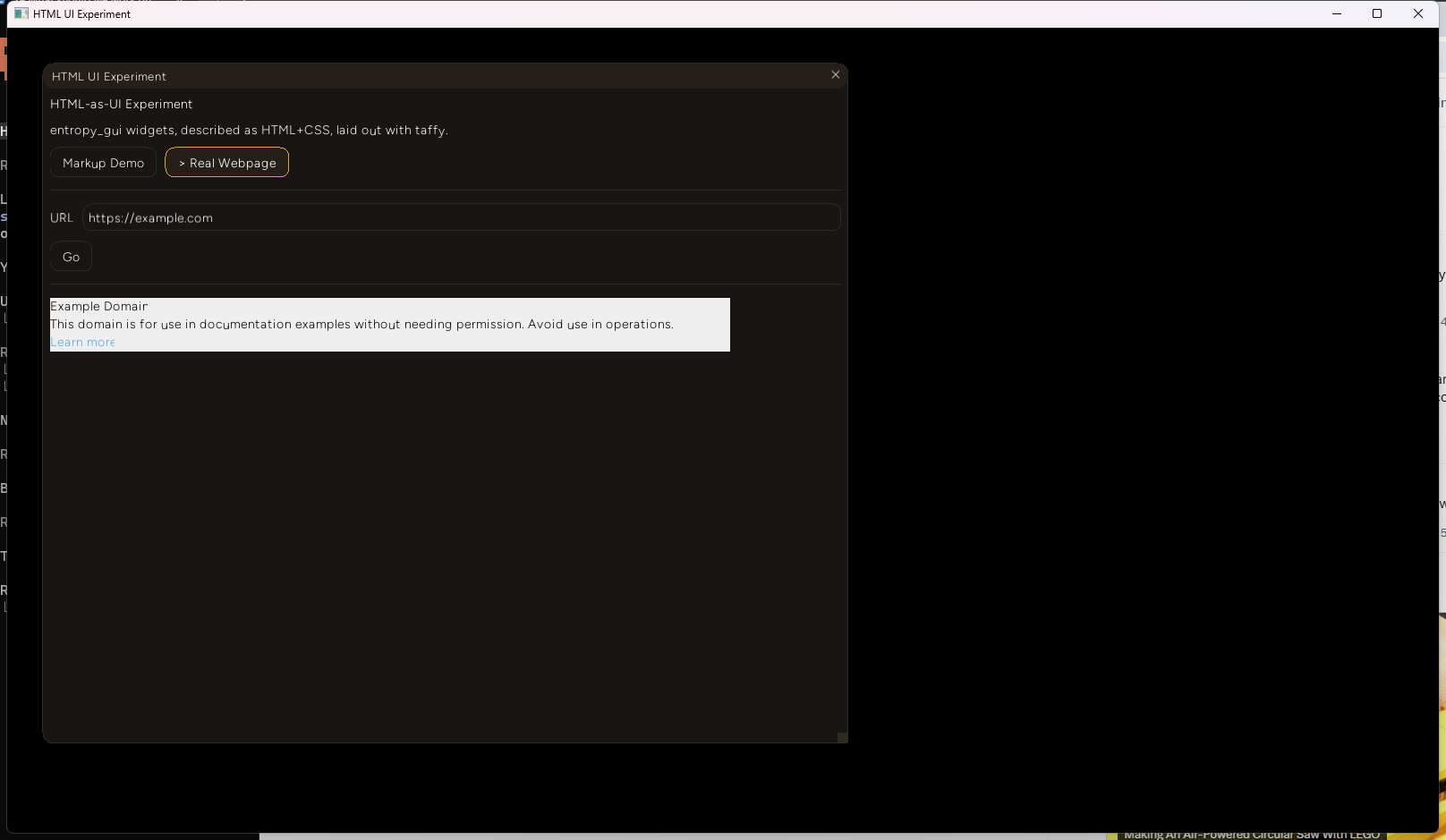
Real browsers don't need this - they always have a real default text color (black). This UI's default is the app's own dark-theme text color, which is fine against the app's own chrome and wrong against a page that sets a light background but never sets color - which is exactly what example.com's own stylesheet does. Without this fallback, fetching example.com renders light text on its own light background: correct layout, invisible content. The luminance check is the fix, and it's the reason the screenshot below shows readable black text against example.com's pale gray background rather than nothing at all.
Images: a real fetch, cached by URL
<img> doesn't fall back to a placeholder unless it has to. fetch_and_cache_image resolves the src against base_url, fetches it with net::blocking_fetch_bytes (a plain std::thread::spawn wrapping reqwest::blocking::get - this codebase's main already runs inside a #[tokio::main] Tokio runtime, and reqwest::blocking panics if constructed from inside one, so every blocking fetch in this module goes through a spawned thread instead), decodes it with image::load_from_memory, and uploads it as a wgpu::Texture - the same register_native_texture + egui_textures cache pattern UiWidget::MiniMap already used elsewhere in this codebase. The cache key is the resolved absolute URL, stored on AddonContext.html_image_dims/html_image_failed, so a page re-rendered every frame (this is immediate-mode UI; Widget.html re-parses the HTML string fresh on every call) doesn't re-fetch or re-decode the same image sixty times a second.
One small, separate fix: scrolling
A one-line commit landed after the CSS work: UI.createWindow's render body wraps its widget list in egui::ScrollArea::vertical(). Before that fix, any window - HTML-rendered or not - whose content exceeded the window's height simply clipped past the bottom with no way to reach it. Small, unrelated to the CSS engine specifically, but it's the reason the screenshots below show the full markup demo instead of a page that stops partway down.
Evidence
Same machine as recent Entropy posts, checked again this session: Intel UHD Graphics 770 (integrated), 12th Gen Intel Core i5-12500, 32GB RAM, Windows 11 Pro 10.0.26200. rustc 1.94.1, cargo 1.94.1, deno 2.6.7.
cd examples/studio-bundle
npm run build-html-ui-demo   # deno bundle -> dist/html_ui_demo.js
Clean bundle (deno's own ⚠️ deno bundle is experimental notice aside - that's deno's warning, not an error).
cargo build --release --bin example
Finished \release` profile [optimized] target(s) in 9.18s` - incremental against an already-built tree, zero warnings.
cargo run --release --bin example -- html-ui-demo
Ran it, brought the real window to the foreground, and screenshotted it with a PowerShell CopyFromScreen (same approach as the stylus and HTML-UI posts before this one) - this environment has no way to drive native Windows clicks through the UI itself, so switching tabs used a synthetic user32.dll mouse_event click at the "Real Webpage" button's on-screen coordinates, not an actual mouse.
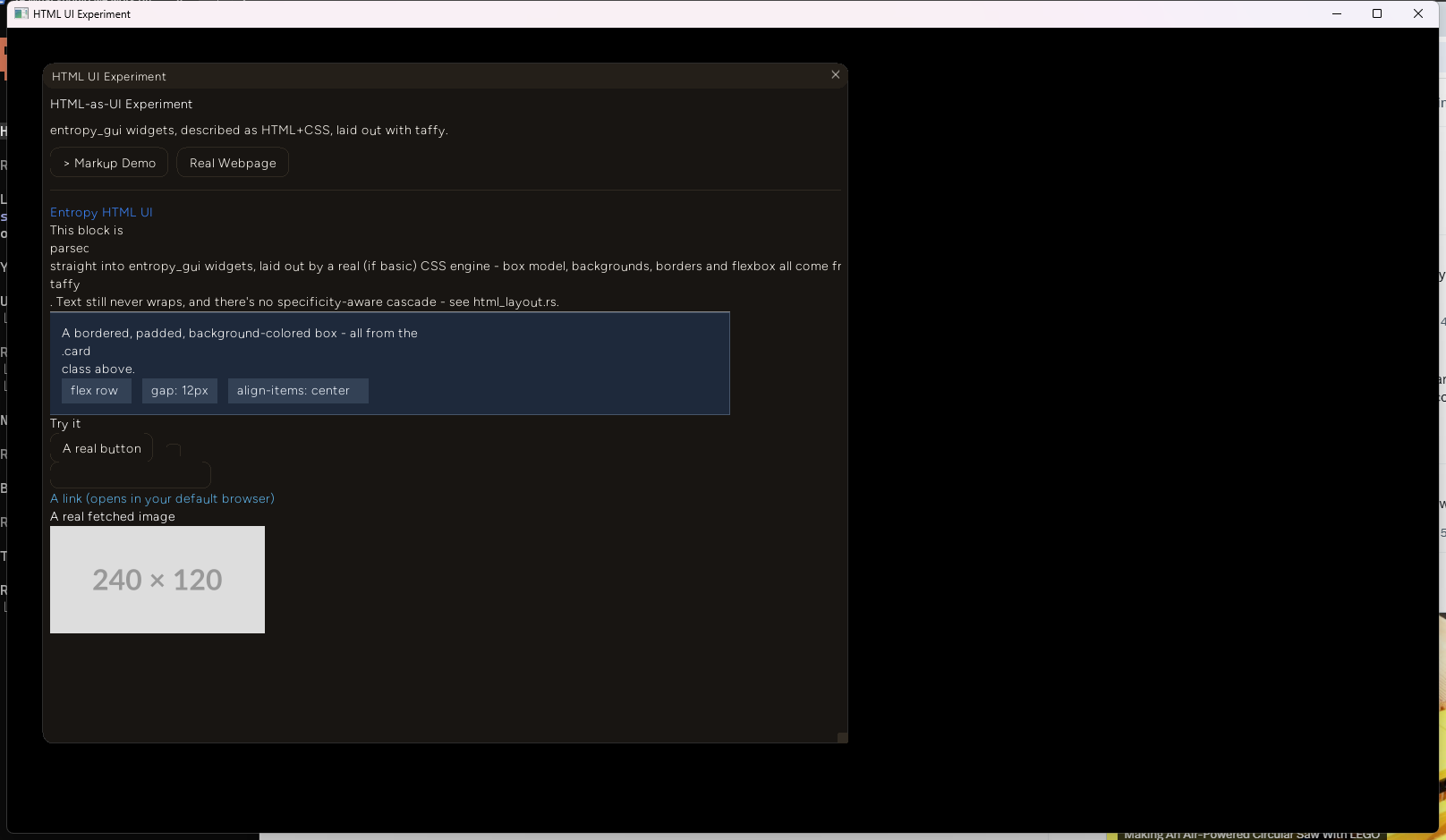
Markup Demo mode, rendering the hand-authored CSS-subset markup - <style>-driven heading color, a bordered/padded .card, a flex row of pills with gap and align-items: center, and a real fetched placehold.co image at the correct 240x120 aspect ratio:
Real Webpage mode, after fetching https://example.com live through Entropy.Net.getText and feeding the raw response into the same Widget.html call - heading, paragraph, and "Learn more" hyperlink all present, dark text correctly chosen against the page's own light background thanks to the luminance fallback above:
Zoomed 3x (nearest-neighbor, no smoothing) on that same screenshot's heading and link text:

"Example Domain" renders as "Example Domair." "Learn more" renders as "Learn mor." Not a screenshot artifact - reproducible on every fetch of the same page. See Failure Notes below for why.
Zoomed 4x on the Markup Demo's checkbox, next to the "A real button" button:

That's not a checkbox. It's a fragment of one, clipped almost entirely out of frame.
First-party diff across the whole arc this post covers (git diff --stat 3cc47dc..c7f6940, from just before this work started through the scroll fix):
 Cargo.toml               |   6 +-
 src/deno/addon_engine.rs | 126 +++++++++-
 src/deno/addon_ops.rs    |  67 ++++++
 src/deno/html_css.rs     | 441 +++++++++++++++++++++++++++++++++++
 src/deno/html_layout.rs  | 586 +++++++++++++++++++++++++++++++++++++++++++++++
 src/deno/mod.rs          |   5 +-
 src/deno/net.rs          |  26 +++
 7 files changed, 1250 insertions(+), 7 deletions(-)
(html_css.rs and html_layout.rs supersede an earlier, CSS-less html_ui.rs from the same arc's first commit - that file is fully deleted as part of this diff, not left behind as dead code.)
Two primary sources checked directly against docs.rs rather than assumed from training data: taffy 0.14.0's Display enum documents pub const DEFAULT: Display = Display::Flex with Block's own doc comment reading "The children will follow the block layout algorithm" - confirming the override in to_taffy_style above is deliberate, not accidental. scraper 0.27.0's crate-level docs state it "provides an interface to Servo's html5ever and selectors crates, for browser-grade parsing and querying" - confirming the selector-matching claim above isn't scraper's own reimplementation.
Decision log
- Real selector matching, simplified cascade. Reimplementing CSS specificity scoring for an addon-facing "basics" renderer wasn't worth it when
scraper/selectorsalready does real matching for free; source-order-plus-inline-wins covers every case the demo andexample.comboth needed, and is stated as a limitation rather than smoothed over. - Fixed average-character-width text sizing, not real font metrics.
op_ui_render_htmlruns before any per-windowentropy_gui::Contextexists, so there is nothing to measure real glyph widths against at layout time. This was a known, accepted tradeoff going in - and it's exactly what produced "Example Domair" below, so the tradeoff's cost is now a measured fact, not a hypothetical. - Override taffy's own
Display::DEFAULTper node instead of relying on it. taffy defaults toFlex; real HTML/CSS defaults to block flow. ForcingBlockunless the page's own CSS says otherwise matches the thing being approximated, not the layout library's own convenience default. - Cache fetched images by resolved URL, reusing
MiniMap's existing texture-cache pattern, rather than inventing a second one.Widget.htmlre-parses its HTML argument fresh every call (immediate-mode, no retained DOM), so caching at the fetch/decode/upload layer is what keeps a static<img>from re-fetching every frame - not caching the parse itself. - Never execute fetched content as code, full stop, for now.
<script>tags are skipped outright - their text is never even read, let alone run through a JS engine - and<style>is parsed as inert data. This is stated as a load-bearing security boundary directly inhtml_layout.rs's doc comment: if a future session adds real remote-script execution, that JS must run with CLI, filesystem, and multithreading access denied by default, gated behind an explicit consent prompt before any of the three is granted. ASECURITY.mdaudit landed in the same arc's last commit, and its own priority-ordered list namesNet.getText- the exact op this feature's live fetch depends on - as the standout unscoped capability today: no per-addon domain allowlist, so a malicious page URL and an internal-network probe cost exactly the same call.
Failure notes
- The fixed-width text estimate clips real proportional-font text.
estimate_text_sizesizes every text leaf aschars().count() as f32 * 7.2px, before any real font exists to measure against. egui's actual font renders most lowercase letters narrower than that flat average and a few (bold text,m,w) wider - so a text leaf sized from the estimate is sometimes too tight for what egui actually draws into it, and the last character or two falls outside the leaf'schild_ui_atrect and never appears. "Example Domain" becomes "Example Domair"; "Learn more" becomes "Learn mor." This reproduces on every fetch, not just once - confirmed by re-running the fetch and re-screenshotting. - The checkbox leaf's fixed 20x20px box is too small for the widget it hosts.
html_layout.rsallocates every<input type="checkbox">a flat 20x20 leaf;addon_engine.rsthen callschild.checkbox(&mut current, "")inside achild_ui_atconstrained to exactly that rect. egui's checkbox needs room for its frame plus interaction padding beyond the bare glyph box, so the widget renders clipped to an unrecognizable curved fragment instead of a checkbox - visible directly in the zoomed screenshot above, not something the doc comments already called out. <input placeholder="...">is silently dropped. The demo markup includes<input type="text" placeholder="Type here" />, buthtml_layout.rs's input-element mapping only reads thevalueattribute (attr(node, "value").unwrap_or("")) -placeholderis never inspected at all. The rendered result is a plain empty text box with no hint text, and nothing in the code path even attempts to read it; it's a gap, not a bug with a visible symptom to chase.
What's next
- Real font metrics for text sizing, which needs either restructuring
Widget.htmlto run after a per-windowentropy_gui::Contextexists, or a standalone font-metrics table independent ofContext- either fixes failure note 1 above. - Size interactive leaves (checkbox, dropdown, button) from their actual egui intrinsic size rather than a fixed guess, which fixes failure note 2.
- Read
placeholder(and whatever elsehtml_layout.rs's attribute handling still ignores) in the input-element mapping. SECURITY.md's own priority list puts a per-addon domain allowlist onNet.getTextfirst - no longer a hypothetical hardening item once a feature (this one) actually depends on that op being reachable from arbitrary addon code.