entropy_gui already had two addon-facing widgets built for a specific domain and then generalized: NodeGraphEditor (behavior-graph editing) and PianoRoll (the DAW). This post adds two more of the same shape, both aimed at the same underlying problem: scrubbing time against something that has state at specific points along it. KeyframeTimeline is a per-property animation-curve editor - rows of draggable keyframe diamonds. TrackView is a multi-track clip editor - lanes of draggable, resizable clips, with an optional waveform for audio. Both are plain, domain-agnostic Rust widgets exposed to addons the same way Snarl/PianoRoll already are, and both showed up together in one demo addon because a real editor wants them sharing a single playhead.
What we're building
entropy_gui::KeyframeTimeline(src/entropy_gui/widgets_keyframe_timeline.rs, new) - a row per animated property, diamond keyframes, drag to retime, right-click a row to add one at the playhead, Delete/Backspace to remove the selected one.entropy_gui::TrackView(src/entropy_gui/widgets_tracks.rs, new) - a lane per track, colored clip blocks with drag-to-move and edge-drag-to-trim, an optional peak-bar waveform inside a clip, right-click to delete.- Three new
Memoryfields (keyframe_drag,clip_drag, and a sharedTimelineView { scroll_x, zoom }slot) - the same live-drag-override trickNodeGraphEditor'snode_drag/link_dragalready use, for the same reason: neither widget gets a&mutinto the caller's data. - Two new
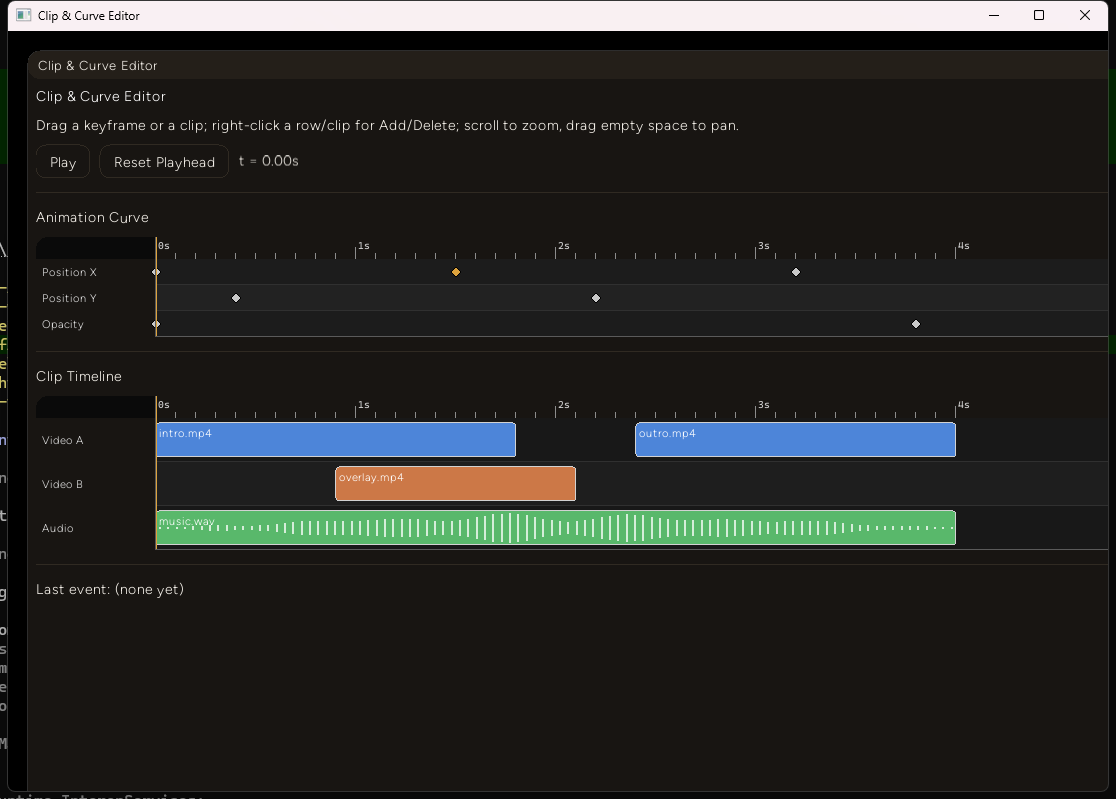
UiWidgetvariants (KeyframeTimeline,Tracks), two new ops (op_ui_widget_keyframe_timeline,op_ui_widget_tracks), and matching render arms inaddon_engine.rs. Entropy.UI.Widget.keyframeTimeline/.tracksinaddon_setup.js, plusaddon.d.tstypes (KeyframeTimelineConfig,TracksConfig).keyframe_tracks_demo_addon.ts- "Clip & Curve Editor," a demo that puts both widgets on one shared playhead: three animated properties above, two video tracks and an audio track (with a synthetic waveform) below.
Generalizing a widget that already existed, again
This engine already had a keyframe-and-clip editor: core::video_timeline_ui::VideoTimeline, roughly 700 lines built directly against Editor/stunts_state for the desktop video-editor app - ruler, ms-per-pixel zoom, clip drag/resize with edge detection, keyframe diamonds on property tracks, a playhead. It's real and it works, but it's wired to four hardcoded object kinds (active_polygons/active_text_items/active_image_items/active_video_items) and an Editor struct an addon has no access to. It was never reachable from the JS side.
That's the exact relationship NodeGraphEditor had to the old Snarl-specific editor code before the node graph editor post. Same move here: pull the interaction model (ruler ticks, ms-per-pixel zoom, drag-to-retime, edge-drag-to-resize, right-click menus) out of the Editor-coupled version and rebuild it against plain structs:
pub struct KeyframeRow {
    pub id: String,
    pub label: String,
    pub keyframes: Vec<Keyframe>,
}

pub enum KeyframeTimelineEvent {
    Seek(i32),
    KeyframeMoved { row: String, keyframe: String, time_ms: i32 },
    KeyframeSelected { row: String, keyframe: String },
    KeyframeAddRequested { row: String, time_ms: i32 },
    KeyframeDeleteRequested { row: String, keyframe: String },
    RowClicked(String),
    BackgroundClicked,
}
pub struct TrackClip {
pub id: String,
pub label: String,
pub start_ms: i32,
pub duration_ms: i32,
pub color: Color32,
/// Normalized (0..1) amplitude peaks drawn as vertical bars - empty means no waveform.
pub peaks: Vec<f32>,
}show() on both widgets takes &[KeyframeRow] / &[Track] - read-only - and returns a Vec<...Event> the caller applies back, exactly the contract NodeGraphEditor established: the addon-relay call site rebuilds its whole data set from JS state every frame, so there's no persistent &mut for the widget to hold between frames. Dragging a keyframe needs the same fix node_drag uses, just 1D:
let kf_id = timeline_id.with(("kf", &row.id, &kf.id));
let live = ctx.memory(|m| m.keyframe_drag).filter(|(id, _)| *id == kf_id).map(|(_, t)| t);
let effective_time = live.unwrap_or(kf.time_ms);
// ...
if resp.drag_started() {
    ctx.memory_mut(|m| m.keyframe_drag = Some((kf_id, kf.time_ms)));
} else if resp.dragged() {
    let delta_time = resp.drag_delta().x * zoom; // zoom = ms per pixel
    let new_time = (effective_time as f32 + delta_time).round() as i32;
    let clamped = new_time.clamp(0, duration_ms);
    ctx.memory_mut(|m| m.keyframe_drag = Some((kf_id, clamped)));
    events.push(KeyframeTimelineEvent::KeyframeMoved { row: row.id.clone(), keyframe: kf.id.clone(), time_ms: clamped });
}TrackView's clip dragging is the same shape, but a clip can also be resized from either edge, so the live override carries a ClipDragKind alongside the (start_ms, duration_ms) pair:
pub enum ClipDragKind { Move, ResizeLeft, ResizeRight }
// ...
let on_left_edge = resp.hovered() && hover_pos.map_or(false, |p| p.x < clip_rect.min.x + EDGE_GRAB);
let on_right_edge = resp.hovered() && hover_pos.map_or(false, |p| p.x > clip_rect.max.x - EDGE_GRAB);
if resp.drag_started() {
    let kind = if on_left_edge { ClipDragKind::ResizeLeft }
        else if on_right_edge { ClipDragKind::ResizeRight }
        else { ClipDragKind::Move };
    ctx.memory_mut(|m| m.clip_drag = Some((clip_id, kind, clip.start_ms, clip.duration_ms)));
}
The edge-threshold-in-pixels approach (EDGE_GRAB = 6.0) is lifted straight from VideoTimeline's existing render_clip closure - it already had this exact trick working, no reason to invent a different one.
Zoom is mouse wheel over the canvas, keeping the time under the cursor fixed on screen - the same code shape as NodeGraphEditor's 2D wheel zoom, just collapsed to one axis:
let scroll = ui.input(|i| i.scroll_delta.y);
if scroll.abs() > 0.0 && over_canvas {
    if let Some(cursor) = pointer_pos {
        let time_at_cursor = (cursor.x - grid_rect.min.x - scroll_x) * zoom;
        let factor = (1.0 + scroll * 0.0015).clamp(0.5, 1.6);
        zoom = (zoom * factor).clamp(MIN_ZOOM, MAX_ZOOM);
        scroll_x = cursor.x - grid_rect.min.x - time_at_cursor / zoom;
    }
}
Wiring to the addon API
Same pattern Snarl/PianoRoll use: a UiWidget enum variant carrying plain, serde-derived config, an #[op2] op that pushes it onto that window's per-frame widget queue, and a render arm in addon_engine.rs that builds the real entropy_gui types from the config and turns returned events into |-delimited strings:
KeyframeTimeline {
    id: String,
    duration_ms: i32,
    playhead_ms: i32,
    rows: Vec<KeyframeRowConfig>,
    selected: Option<(String, String)>,
},crate::entropy_gui::KeyframeTimelineEvent::KeyframeMoved { row, keyframe, time_ms } => {
events_to_push.push(format!("KFTL_KF_MOVED|{}|{}|{}|{}", kftl_id, row, keyframe, time_ms));
}_process_events in addon_setup.js gets one new branch (KFTL_/TRACKS_ route on parts[1], same as the existing SNARL_/PIANOROLL_ entries), and Entropy.UI.Widget.keyframeTimeline/.tracks parse those raw strings back into typed callbacks (onKeyframeMoved, onClipResized, and so on).
Both configs' rows/tracks arrays go through op2's #[serde] parameter path rather than flat positional args. Per deno_core's own op2 docs, #[serde] parameters are documented as slower than the fastcall-eligible plain-numeric or #[string] paths, since they go through a full deserialization pass rather than a direct V8-to-Rust read. That's an accepted tradeoff here, not an oversight: a KeyframeTimeline/Tracks payload is a handful of rows or clips redrawn once per frame, nothing like PianoRoll's per-cell grid, so the difference isn't one this demo can even measure without instrumentation - and no criterion benchmark is included in this post for exactly that reason (see the decision log).
Evidence
The demo addon, "Clip & Curve Editor," puts three animated properties (Position X/Y, Opacity) above a three-track clip timeline (two video, one audio with a synthetic peaks waveform), sharing one playheadMs. All four screenshots below were captured against the actual running example.exe keyframe-tracks-demo, driven by synthetic SetCursorPos/mouse_event input, same verification method as the node graph editor post - not static renders.
Initial state - three keyframe rows, three tracks, Position X's second keyframe pre-selected:
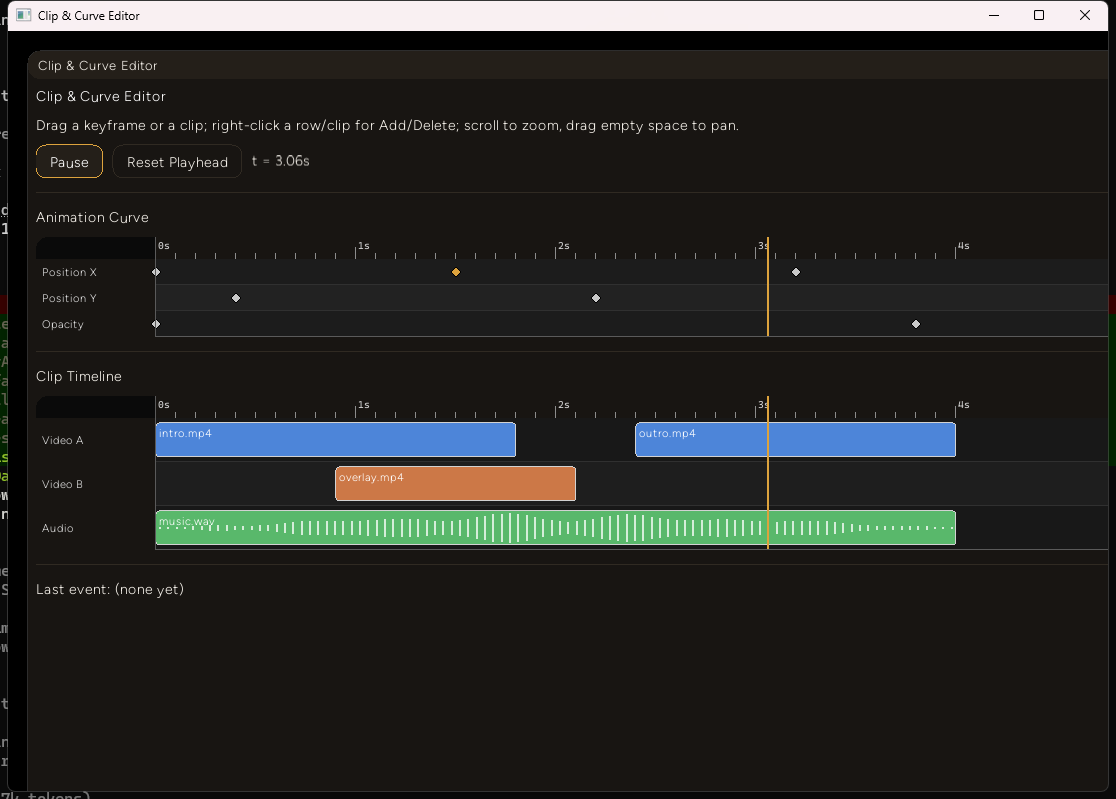
Clicking Play drives playheadMs forward through addon.onUpdatePlus, and the same playhead line moves through both widgets at once - t = 3.06s here, both rulers agreeing:
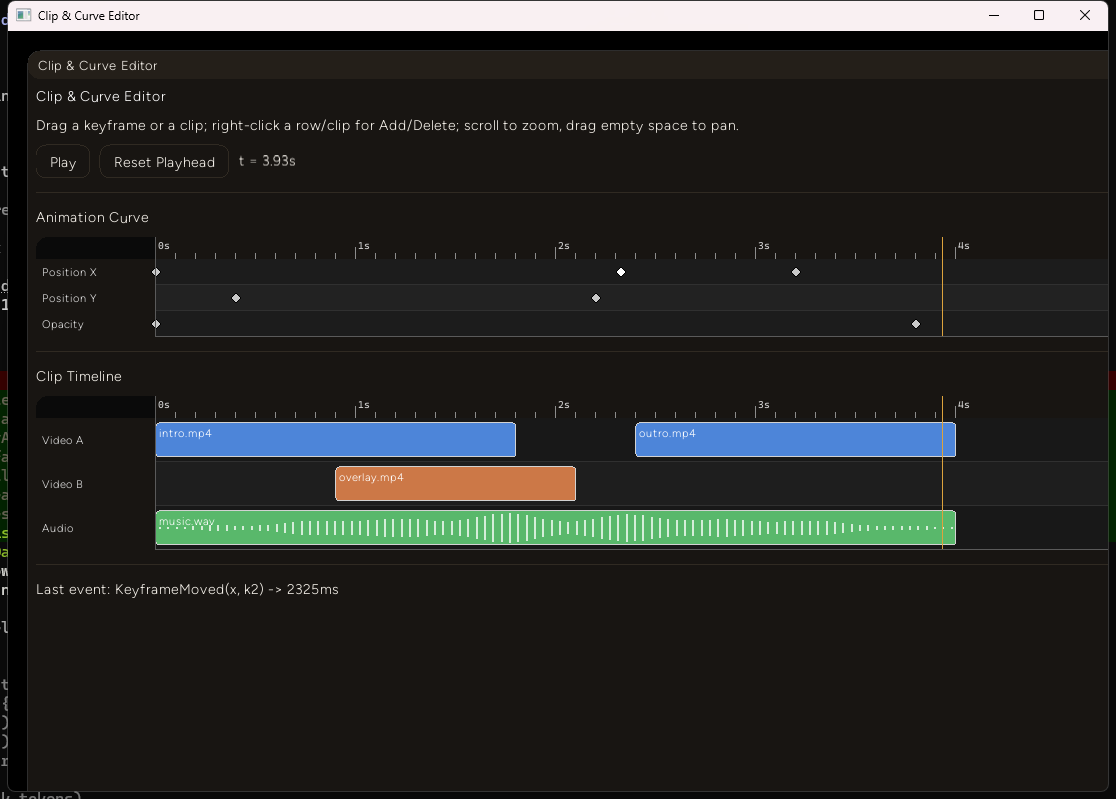
Dragging the Position X keyframe from 1.5s to roughly 2.3s - the diamond moved, and the round trip through the op/event/listener chain is visible in the status label:
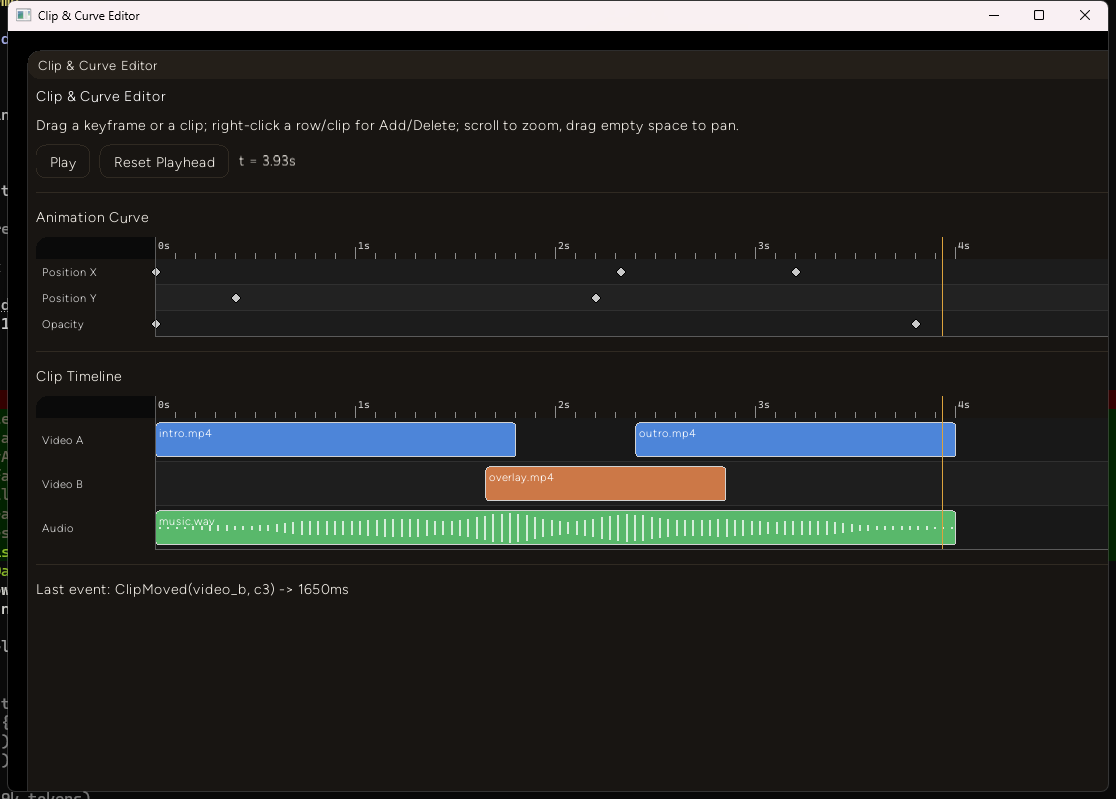
Dragging the overlay.mp4 clip on Video B to the right - same round trip, this time through TrackView:
Decision log
Generalize VideoTimeline's interaction model, don't invent a new one. Ms-per-pixel zoom, the ruler tick-interval thresholds (< 10.0 -> 100ms ticks, < 50.0 -> 500ms, else 1000ms), and the edge-threshold clip-resize trick are all lifted from core::video_timeline_ui.rs verbatim. That file already proved the interaction model works; the only new thing this session builds is making it addressable from plain data instead of Editor/stunts_state.
Events out, live-drag overrides in Memory, same as NodeGraphEditor. Not re-derived here - see the node graph editor post's "who owns a node's position" section for the full reasoning. It applies unchanged to a keyframe's time and a clip's (start_ms, duration_ms).
#[serde] config payloads over positional args, despite the documented cost. Covered above - correct for this widget's actual call frequency (a handful of rows/clips per frame), and keeping the same shape as Snarl's existing BehaviorGraph config was worth more than a marginal, unmeasured speedup.
Synthetic waveform peaks, not real audio decoding. TrackClip::peaks is caller-supplied, normalized 0..1 amplitude data - the demo's fakePeaks() is a couple of summed sine lobes plus jitter, explicitly not decoded audio. Getting from a real .wav/.mp3 to a peaks array is an addon's job (or a future op); this session only proves the rendering and interaction, not an audio pipeline.
No video thumbnails. A thumbnail per clip needs a registered GPU texture the way MiniMap registers its landscape preview - real machinery, but a separate piece of work. A video clip today is a solid color block with its label, same as any other non-audio clip.
No occlusion in hit-testing, same as NodeGraphEditor. Clicking a keyframe or clip also satisfies the background canvas's own click sense (this kit doesn't do z-order-aware input dispatch anywhere), so a caller can see e.g. a ClipSelected and a BackgroundClicked on the same frame. Documented in both widgets' module docs rather than silently inherited.
Failure notes
The playhead wouldn't move, and it wasn't the new widgets' fault. The demo's Play button toggled correctly (its own onClick fired, the label flipped to "Pause") but playheadMs never advanced even after several seconds of wall-clock waiting, confirmed by a screenshot showing t = 0.00s unchanged. The cause was in addon.onUpdate itself, not in anything this session touched: render_addon_frame.rs computes the "current addon name" onUpdate callbacks are filtered against from pipeline.current_workspace, which defaults to Workspace::Global unless Studio's multi-addon shell has set it to Workspace::Addon(name). A plain EntropyApp (this demo's cargo run --bin example) never leaves Workspace::Global, so current_addon_name is always "Global" - and a callback registered under the addon's own name ("Clip & Curve Editor") never matches, so it's filtered out and silently never runs. fft_water_addon.ts already has the workaround (onUpdatePlus("Global", cb), registering explicitly under the name that always matches outside Studio); switching to it fixed the demo immediately, confirmed by a follow-up screenshot showing t = 3.06s and both widgets' playhead lines agreeing. Not a new bug, but a real gotcha worth documenting for the next addon-only (non-Studio) demo written against this engine.
A Button::new(...).show(ui) call that was never going to compile. The first pass at the context-menu code called crate::entropy_gui::widgets::Button::new("...").show(menu_ui), modeled on the wrong widget's API from memory - Button implements the Widget trait's .ui(self, ui), not a .show() method, and there's no inherent .show() on it either. Reading widgets/button.rs before the first cargo build of this session caught it, so it was never actually compiled in that form - fixed by switching to the existing ui.button("...") convenience method instead, the same one core::video_timeline_ui.rs's own context menus already use.
What's next
- Wire
TrackViewinto the actualcore::video_timeline_ui::VideoTimeline-driven editor - this session only proves the addon-facing API via the standalone demo, the same gap the node graph editor post left forSnarl. - Real audio-to-peaks decoding (an op that reads a file and returns a
Vec<f32>), soTracksConfig.peaksdoesn't have to be addon-supplied fiction. - Video thumbnails per clip, once there's a general per-clip texture-registration path.
- Multi-select (marquee-drag multiple keyframes or clips) - both widgets currently track at most one selection, same single-selection limitation
NodeGraphEditorstill has. - "Add Keyframe"/"Add Clip" at an arbitrary clicked time, not only at the current playhead.