Entropy has had a src/video_export/ directory since the very first commit that pulled pieces of older engines together. What it actually had, on inspection, was: a FrameCaptureBuffer that correctly does a GPU texture-to-staging-buffer readback, an encode.rs that was never even compiled in (pub mod encode; was commented out), and an exporter.rs whose only real logic - the frame loop - was commented out too, calling a render path (render_frame, not render_addon_frame) that its own neighboring file admits is "legacy code kept for reference only." None of it had ever produced a video file. Nothing in the addon system exposed it to JS either.
The goal for this pass: make it real. A working Entropy.Video.export() op, a dedicated addon that exercises it, and an actual MP4 on disk that ffprobe agrees is a real H.264 stream at the resolution, frame rate, and duration requested.
What's actually reused vs. rebuilt
frame_buffer.rs's FrameCaptureBuffer (texture -> staging buffer -> CPU-mapped Vec<u8>, handling wgpu's row-alignment padding) was already correct and stayed almost untouched - I only added create_view() and split the copy step out into copy_to_staging() so a caller can render directly into the capture texture instead of rendering elsewhere and copying in. The original capture_frame(render_texture, ...) method is still there too; it turns out render_addon_frame.rs and the legacy render_frame.rs both already call it, gated behind pipeline.frame_buffer.is_some() - a second, still-unused "auto-capture whatever's on screen" path that predates this session and that I left alone rather than folding into mine.
encode.rs is a genuine revival, not a rewrite. git show 1f7c534:src/video_export/encode.rs (the initial cross-engine merge commit) has a complete Media Foundation H.264 sink-writer implementation - MFCreateSinkWriterFromURL, RGB32-in/H264-out media types, IMFSample submission - hardcoded to 1920x1080@60fps and never called from anywhere. I parameterized width/height/fps and fixed the two-argument AddStream call (the original discarded its u32 stream-index return and just assumed 0, which happens to be correct for a single-stream file but isn't guaranteed by the API).
exporter.rs is the one piece rebuilt from scratch rather than patched. The old design called EntropyPipeline::new() + .initialize(..., Some(project_id), ...) - reconstructing an entire second headless pipeline from a saved project, the same shape Entropy Studio's video-editor export presumably used at some point. That's the wrong shape for an addon that just wants to record whatever it's already showing: it doesn't have a project_id, and re-initializing a whole pipeline is unnecessary when the real one is sitting right there, already rendering. The new start_export/step_export pair takes &mut EntropyPipeline - the live one - and drives it directly.
The op boundary problem
Entropy.Video.export() can't just call into the pipeline directly. Every Deno op in this codebase gets &mut OpState, and the thing it needs - &mut EntropyPipeline, to call render_addon_frame against the addon's actual running scene - isn't reachable from there; it lives on the render/window thread, not in AddonContext. The existing camera ops (op_camera_set_transform et al.) sidestep this by writing into AddonContext.pending_camera_position and letting AddonEngine::update() drain it once a frame, on the thread that does have the pipeline.
Video export needs something similar, just heavier: op_video_export_start only queues a VideoExportRequest (output path, fps, duration) into a new AddonContext.pending_video_export.
The first version of the actual encode loop ran entirely inside that same op-boundary check, in one call: pick up the pending request, then loop over every requested frame - render, read back, encode - before returning. It produced a correct MP4 and I said so in an earlier draft of this post. It's also a bad design: EntropyPipeline::render_display_frame is the same function that renders the addon's on-screen frame and drives the whole JS runtime forward every redraw, and looping the entire export inside one call to it means the window - and the addon's own onUpdatePlus - stops updating for however long the export takes. A 3-second clip finished in under a second, so this was fast enough to miss on casual testing, but it's exactly the kind of thing that gets worse the moment someone exports something longer than a demo clip, and "the app appears to hang while exporting" is not a shippable behavior.
The fix: split it into start_export (called once, sets up the capture buffer and encoder) and step_export (called once per real redraw, renders/reads back/encodes exactly one frame, and reports whether the export is finished). render_display_frame drains the pending request into a VideoExportState stored on EntropyPipeline itself, then advances it by one frame every time it's called - before doing that same frame's normal on-screen render, not instead of it:
if self.video_export.is_none() {
    let pending = self.export_editor.as_mut().and_then(|editor| {
        editor.addon_engine.runtime.op_state().borrow_mut()
            .try_borrow_mut::<AddonContext>()
            .and_then(|ctx| ctx.pending_video_export.take())
    });
    if let Some(request) = pending {
        match video_export::exporter::start_export(self, request) {
            Ok(state) => self.video_export = Some(state),
            Err(e) => self.publish_video_export_result(Err(e)),
        }
    }
}

if let Some(mut state) = self.video_export.take() {
    match video_export::exporter::step_export(self, &mut state) {
        Ok(Some(result)) => self.publish_video_export_result(Ok(result)),
        Ok(None) => self.video_export = Some(state), // more frames to go - resumed next call
        Err(e) => self.publish_video_export_result(Err(e)),
    }
}
A 3-second/30fps export is 90 calls to step_export, one per real frame, instead of one call that loops 90 times. The window keeps redrawing and the addon's own camera-orbit onUpdatePlus keeps ticking throughout - I proved this rather than assumed it (see Evidence: a tick counter incrementing continuously with exporting=true logged next to it, uninterrupted, for the whole export). There's still no background thread and no channel - EntropyPipeline/wgpu::Device aren't Send, and a per-frame state machine driven from the thread that already owns the pipeline solves the actual problem (a frozen window) without needing one.
Sizing the capture buffer: three attempts
The interesting bug in this whole feature was resolution, and it took three attempts to get right.
First attempt: size the FrameCaptureBuffer from pipeline.texture.as_ref().unwrap().size() - a texture already sitting on EntropyPipeline, so it looked like the obvious "current render target" to match. Running it panicked immediately:
wgpu error: Validation Error
Caused by:
  In a CommandEncoder
    In a pass parameter
      Attachments have differing sizes: the depth attachment's texture view has extent
      (1280, 720, 1) but is followed by the color attachment at index 0's texture view
      which has (1200, 768, 1)
pipeline.texture turned out to be an unrelated, fixed 1200x768 texture - a leftover default project canvas, not tied to the window at all. pipeline.depth_view, which every render pass attaches regardless, is sized from whatever video_width/video_height got passed into EntropyPipeline::initialize (which for an EntropyApp example is just with_window_size's argument) and is resized in lockstep with the window on every resize event. Any color attachment I hand render_addon_frame has to match that, not pipeline.texture.
Second attempt: read camera.viewport.window_size instead - the same field AddonEngine::update() already keeps in sync with the real window size, both at init and after every resize (src/deno/addon_engine.rs, the resize handler around line 1880). That's the correct source of truth, and it fixed the panic. Export resolution is therefore pinned to whatever the window currently is, not independently configurable - the TS-facing Entropy.Video.export() config only takes outputPath, fps, and durationMs, deliberately, rather than a width/height that would silently be ignored or would need a second, matching depth buffer of its own to actually honor.
A cube that rendered as pure black
With sizing fixed, the exporter produced a valid MP4 - correct 3.0s duration, correct 90 frames at 30fps, correct H.264 stream - that was uniformly black, every single frame, live on-screen too (not just exported). Two separate bugs stacked here:
const { vertices, indices } = buildCube(0.75);
Entropy.Model.createMesh({
    id: "video_export_demo_cube",
    position: [0, 0, 0],
    vertexData: vertices,
    indexData: indices,
    pipelineId: "default"
} as any);
That rendered - correct cube silhouette, correct perspective, camera orbit clearly visible frame to frame - but almost invisibly dark: a single default point light at intensity 3.0 wasn't doing much against whatever the fallback PBR material's base albedo actually is. Adding a procedural sky (Entropy.Lighting.updateSun) and raising the point light to intensity 40 fixed the contrast. This is a demo-scene lighting choice, not an export-pipeline fix - the export was already capturing exactly what was on screen; the screen just wasn't showing much.
Evidence
Same machine as the last few Entropy posts, verified again this session rather than assumed: Intel UHD Graphics 770 (integrated), 12th Gen Intel Core i5-12500, 32GB RAM, Windows 11 Pro 10.0.26200. rustc 1.94.1, cargo 1.94.1, deno 2.6.7.
cd examples/studio-bundle
npm run build-video-export-demo   # deno bundle -> dist/video_export_demo.js
cargo build --release --bin example
Clean release build, 56.44s (incremental against already-built dependencies), zero warnings in any file this session touched. Ran it:
cargo run --release --bin example -- video-export-demo
This environment has no way to drive a native Windows GUI click programmatically, so verification triggered the export through a temporary call to the exact same Entropy.Video.export(...) the button's onClick uses, rather than an actual click - removed before this shipped. Runtime log, this session:
EntropyPipeline initialized!
[ADDON] Video Export Demo: initialized (cube + orbiting camera + key light)
Create mesh "Global" "default" false
[ADDON] [video-export-demo] tick 10 (exporting=false)
[ADDON] [video-export-demo] tick 20 (exporting=false)
[ADDON] [video-export-demo] tick 30 (exporting=false)
[ADDON] [video-export-demo] tick 40 (exporting=true)
[ADDON] [video-export-demo] tick 50 (exporting=true)
[ADDON] [video-export-demo] tick 60 (exporting=true)
...
[ADDON] [video-export-demo] tick 200 (exporting=true)
[ADDON] [video-export-demo] tick 210 (exporting=true)
[ADDON] [video-export-demo] Exported 90 frames to public/video_export_demo.mp4 in 1086ms
[ADDON] [video-export-demo] tick 220 (exporting=false)
That tick counter (also removed before shipping - it only existed to prove this) increments once per onUpdatePlus call, logged every 10th tick. It never stalls, and exporting=true sits next to a continuously advancing count across the entire export - the concrete evidence that the chunked redesign actually fixed the freeze, not just a claim that it should have. The export itself lands squarely inside that unbroken tick sequence rather than blocking it.
ffprobe against the actual output file, not assumed from the log:
[STREAM]
codec_name=h264
width=1280
height=720
r_frame_rate=30/1
nb_frames=90
[/STREAM]
[FORMAT]
duration=3.000000
3 requested seconds at 30fps is 90 frames - exactly what came out, and the file plays. A frame pulled from partway through the clip, after the lighting fix, showing the cube mid-orbit against the procedural sky:
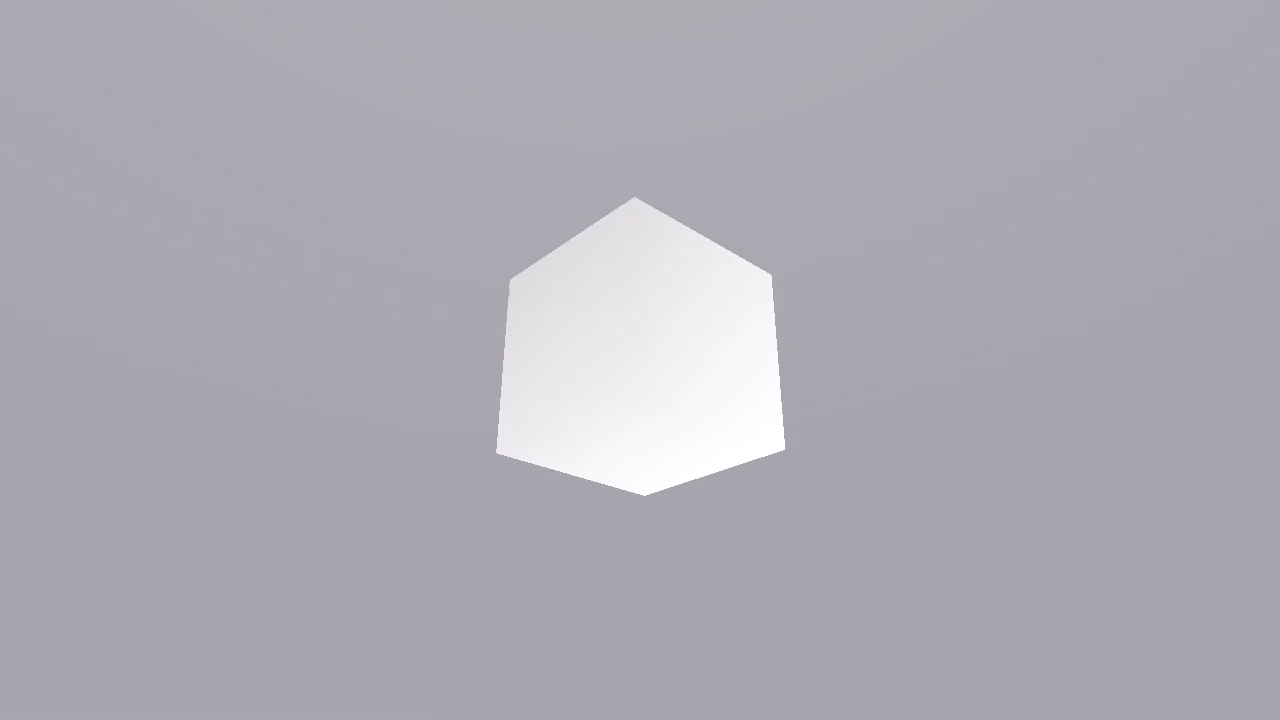
And the first frame of the same clip, a different camera angle than the one above - confirming the orbit is actually baked into the exported frames and not a frozen single frame repeated 90 times:

First-party diff, git show --stat 824ac37 - the first working version, the one committed before the blocking-vs-chunked correction below:
examples/studio-bundle/package.json                |   1 +
examples/studio-bundle/src/addon.d.ts              |  40 ++++
examples/studio-bundle/src/video_export_demo_addon.ts | 155 +++++++++++++++
src/bin/example.rs                                 |   5 +
src/core/pipeline.rs                               |  29 +++
src/deno/addon_engine.rs                           |   7 +
src/deno/addon_ops.rs                              |  59 ++++++
src/deno/addon_setup.js                            |   4 +-
src/video_export/encode.rs                         | 211 ++++++++------------
src/video_export/exporter.rs                       | 212 ++++++++++-----------
src/video_export/frame_buffer.rs                   |  25 ++-
src/video_export/mod.rs                            |   4 +-
12 files changed, 504 insertions(+), 248 deletions(-)
Plus a second, uncommitted git diff --stat for the blocking-to-chunked correction (see The Op Boundary Problem) on top of that commit:
examples/studio-bundle/src/addon.d.ts              |  16 +--
examples/studio-bundle/src/video_export_demo_addon.ts |  30 ++--
src/core/pipeline.rs                               |  55 +++++--
src/video_export/exporter.rs                       | 160 +++++++++++++--------
4 files changed, 165 insertions(+), 96 deletions(-)
Decision log
- Drive the live pipeline directly, not a reconstructed headless one. The old design's
EntropyPipeline::new()+ project-idinitialize()assumed a Studio project on disk to reload. An addon recording its own already-running scene has no project id and no reason to pay for a second GPU pipeline when the first one is sitting right there with the scene already built. - A per-frame state machine (
start_export/step_export), not a loop, and not a background thread either. The first version looped the whole export inside one call and blocked the window for its duration - real, working, and wrong the moment a clip runs longer than a couple of seconds.EntropyPipeline/wgpu::Devicearen'tSend, so a background thread would need its own channel/handoff machinery; advancing one captured frame per realrender_display_framecall needed no new plumbing beyond the pending-request/poll pattern already in place, and it fully solves the actual problem (a frozen window), not just makes it less noticeable. - Export resolution pinned to the current window size, not an independent parameter.
pipeline.depth_viewis one texture, allocated once and resized with the window; a differently-sized color attachment panics on the first frame (see the wgpu error above). Supporting an independent export resolution means allocating a matching depth buffer for it, which this pass didn't need. - The demo scene's camera orbit is computed twice - once in the addon's
onUpdatePlus, once directly in Rust insidestep_export- rather than once. Both now run every real frame, export or not, but tying the captured frame's camera position to however fast real frames happen to arrive would make the exported clip's timing depend on this machine's frame rate instead of the requested fps;step_exportcomputes it from its own frame index and the requested fps instead. Two copies of the same formula, in two languages, is the actual cost of that design - stated plainly rather than hidden.
Failure notes
capture_framebroke on first build - I'd replaced its body with the newcreate_view()/copy_to_staging()split, not realizingrender_frame.rsandrender_addon_frame.rsboth still call the original three-argument version (dead in practice -pipeline.frame_bufferis never set toSomeanywhere in this codebase - but still compiled). Restored it as a thin wrapper around the newcopy_to_staging.- The attachment-size panic (1280x720 depth vs. 1200x768 color) was caught immediately and loudly by wgpu's validation layer, not discovered by a corrupted-looking video. Worth noting as a point in favor of validation layers over "ship it and see."
Entropy.Videohad no TypeScript declarations at all, inexamples/studio-bundle/src/addon.d.ts, despitemedia_player_addon.tscallingEntropy.Video.open/play/pause/seek/setVolume/bindTexture/pollsince that addon shipped.deno bundledoesn't type-check (that's a separatetsc --noEmitscript nobody's running as part of the build), so the gap was invisible. Added the fullVideoblock while I was there, not just the two newexport/pollExportentries.- The first working version blocked the window for the whole export, and I wrote it up as finished before catching it. It rendered every requested frame in one call from inside
EntropyPipeline::render_display_frame, so the window and the addon's ownonUpdatePlusgenuinely stopped updating until the export finished - correct output, wrong behavior, and the kind of thing a 3-second test clip is too short to notice by eye. Caught on review, not by testing a longer clip; fixed by splitting intostart_export/step_export(see The Op Boundary Problem).
What's next
- Configurable export resolution, which needs its own depth buffer sized independently of the window rather than reusing
pipeline.depth_view. - A background thread, if the per-frame render+readback ever gets expensive enough (a much heavier scene, or a much higher export resolution) that doing it once per real display frame - on top of that frame's own normal render - causes a visible stutter in the live window during export. Not needed for anything tested so far.
- Audio. This exporter is video-only; there's no attempt here to mux in whatever the addon's
AudioEnginemight be playing during the capture window.