Entropy Engine's entire editor chrome - app shell, docking, panels, every widget, a hand-rolled video timeline, the JS-addon UI system - ran on egui + egui-wgpu + egui-winit + egui_dock, plus egui-snarl for a node-graph editor and egui_code_editor for script editing. All six of those crates are gone now, replaced by entropy_gui, an in-house immediate-mode kit living at src/entropy_gui/. This post covers what that migration actually involved, what it cost, and what still doesn't work.
Why rip out a working UI library
The short version: egui worked, but the team wanted a foundation they controlled - a specific dark theme ("Slate": warm-black surfaces, one teal accent, 6px corner radii throughout) and tighter integration with the engine's existing rendering primitives, rather than fighting egui's Style/Visuals system from outside. Two research passes catalogued every egui/egui_dock/egui-snarl/egui_code_editor API actually used across the 13 call-site files before a line of the new kit got written, and surveyed what the engine already had lying around that a GUI kit needs anyway: fontdue for glyph rasterization (already used per-widget in src/renderer_text/text_due.rs), lyon_tessellation for rounded-rect geometry (already feeding the engine's native Vertex format), and an existing 2D screen-space wgpu pipeline with the right bind-group layout.
The alias trick that made this a "safe" migration
The riskiest part of swapping out a UI library used across 13 files and ~239 call sites isn't the widget code - it's the import surface. entropy_gui was built as the real library, then src/lib.rs aliases the old crate names onto it:
pub mod entropy_gui;
pub use entropy_gui as egui;
pub use entropy_gui::backend::wgpu_renderer as egui_wgpu;
pub use entropy_gui::backend::winit_input as egui_winit;
pub use entropy_gui::dock as egui_dock;
This only works because the real egui crate is gone from Cargo.toml - no naming collision. I checked src/core/pipeline.rs against this claim directly rather than trusting the migration notes: it still imports crate::egui, crate::egui_wgpu, crate::egui_dock, still calls egui_ctx.run(raw_input, |ctx| {...}) and gets back something it treats as FullOutput, still calls egui_wgpu::ScreenDescriptor. None of that changed. The call sites that did change are exactly the two deferred widgets (below) plus src/core/egui_theme.rs, which needed its content - not its structure - rewritten with the Slate color tokens.
What's actually different under the alias
The alias makes the migration look invisible from the call sites, but the implementation underneath is not a clone of egui - it diverges in a few deliberate places. All of the following is copied verbatim from src/entropy_gui/ at 885bb6a, not reconstructed from memory.
Single-pass, not two-phase. egui's own docs describe the real integration loop: ctx.run(raw_input, |ctx| {...}) produces a FullOutput, and tessellation into triangles happens as a separate step - ctx.tessellate(full_output.shapes, pixels_per_point). That two-phase split exists so egui can do things like defer layout by a frame (the Grid widget uses Context::request_discard to hide first-frame misplacement). entropy_gui doesn't need any of that - one frame per redraw, no cross-frame shape retention. context.rs keeps the two calls signature-compatible but collapses them to bookends around an already-populated draw list:
// src/entropy_gui/context.rs
pub fn run(&self, raw_input: RawInput, add_contents: impl FnOnce(&Context)) -> FullOutput {
    self.begin_frame(raw_input);
    add_contents(self);
    self.end_frame()
}

/// Signature-compatible adapter for the old `ctx.tessellate(shapes, ppp)` call site -
/// geometry is already tessellated into the draw list by the time this is called, so
/// this just drains it.
pub fn tessellate(&self, _shapes: (), _pixels_per_point: f32) -> Vec<crate::entropy_gui::draw_list::DrawCommand> {
    std::mem::take(&mut self.0.borrow_mut().draw_list).commands
}
Note FullOutput.shapes is typed () - a placeholder that exists purely so ctx.tessellate(full_output.shapes, ...) still compiles at the old call site. There's nothing to hand back; by the time run() returns, every widget called during add_contents has already pushed triangles straight into ContextInner::draw_list via Painter::push (below). tessellate() doesn't tessellate anything - it just takes the list.
Id is a hashed u64, not Uuid. Deliberate divergence from the engine's dominant Uuid convention elsewhere. Widget ids need to be a deterministic function of a label/parent-path so the same logical widget resolves to the same id across frames - that's what Memory lookups (scroll offset, open/closed state, drag state, text-edit cursor) key off of:
// src/entropy_gui/id.rs
impl Id {
    pub fn new(source: impl Hash) -> Self {
        let mut hasher = std::collections::hash_map::DefaultHasher::new();
        0xE7_u64.hash(&mut hasher); // fixed seed so Id::new("") != a bare zero hash
        source.hash(&mut hasher);
        Id(hasher.finish())
    }

    pub fn with(&self, child: impl Hash) -> Self {
        let mut hasher = std::collections::hash_map::DefaultHasher::new();
        self.0.hash(&mut hasher);
        child.hash(&mut hasher);
        Id(hasher.finish())
    }
}
Id::new("side_panel").with("save_button") produces the same u64 every frame that path is walked. A Uuid::new_v4() generated fresh per call would not - every frame's button would look like a brand-new widget to Memory, and scroll offsets/open-state/drag-state would reset constantly.
Memory is a closed enum, not Any-boxed. The full stateful-widget set was known from the API catalog before any of this got written, so there's no speculative generic store:
// src/entropy_gui/memory.rs
#[derive(Clone, Debug)]
pub enum WidgetState {
    ScrollOffset(Vec2),
    Open(bool),
    TextEdit(TextEditState),
    WindowRect(Rect),
    PanelWidth(f32),
}

pub struct Memory {
    data: IdMap<WidgetState>,
    pub focused: Option<Id>,
    // ...
}

impl Memory {
    pub fn get_open(&self, id: Id, default: bool) -> bool {
        match self.data.get(&id) {
            Some(WidgetState::Open(b)) => *b,
            _ => default,
        }
    }
    pub fn set_open(&mut self, id: Id, open: bool) {
        self.data.insert(id, WidgetState::Open(open));
    }
}
Every stateful widget in the kit follows that same get_x(id, default) / set_x(id, value) shape against one IdMap<WidgetState> - a CollapsingHeader calling get_open/set_open is doing the exact same lookup a ScrollArea does for get_scroll/set_scroll, just against a different enum variant.
Docking is a hand-rolled arena tree that copies egui_dock's actual shape. I pulled egui_dock 0.18's own docs rather than going from memory: it represents docking as a binary tree where internal nodes are Split (storing a fraction) and terminal nodes are Leaf (holding tabs), addressed via NodeIndex. entropy_gui's dock/tree.rs reimplements exactly that shape:
// src/entropy_gui/dock/tree.rs
pub enum Node<Tab> {
    Leaf { tabs: Vec<Tab>, active: usize },
    Split { fraction: f32, orientation: Orientation, children: [NodeIndex; 2] },
}

/// `fraction` is always the *first* child's share (spatially first: left for horizontal
/// splits, top for vertical), regardless of which side receives the new tabs - this is a
/// real egui_dock semantic the app already depends on (see the comment in
/// `src/core/render_egui.rs` next to its `split_right` call), so it must be preserved
/// exactly: get it backwards and the app's already-tuned split fractions silently break.
fn split(&mut self, target: NodeIndex, orientation: Orientation, fraction: f32, new_tabs: Vec<Tab>, new_first: bool) -> [NodeIndex; 2] {
    let old_node = std::mem::replace(&mut self.nodes[target.0], Node::Leaf { tabs: Vec::new(), active: 0 });
    let old_idx = NodeIndex(self.nodes.len());
    self.nodes.push(old_node);
    let new_idx = NodeIndex(self.nodes.len());
    self.nodes.push(Node::Leaf { tabs: new_tabs, active: 0 });

    let children = if new_first { [new_idx, old_idx] } else { [old_idx, new_idx] };
    self.nodes[target.0] = Node::Split { fraction, orientation, children };
    children
}split_left/split_right/split_above/split_below are one-line wrappers around split() that differ only in orientation and new_first - split_left passes new_first: true (the new leaf becomes the spatially-first child, so fraction correctly reads as "the new leaf's share"), split_right passes false (the old leaf stays first, so the same fraction now means "the old content's share" - same field, opposite meaning, which is exactly the semantic the source comment is warning future editors about).
Clipping is scissor-rect based, matching the engine's existing convention elsewhere (render_addon_frame.rs's set_scissor_rect calls) rather than shader-based per-vertex clipping. In practice this means clip rects are just data riding along on Painter, intersected as you nest into child regions, and read back out by the renderer per draw call:
// src/entropy_gui/painter.rs
pub fn with_clip_rect(&self, clip_rect: Rect) -> Painter {
    Painter { ctx: self.ctx.clone(), clip_rect: self.clip_rect.intersect(clip_rect), target: self.target }
}

fn push(&self, texture: DrawTexture, vertices: Vec<Vertex>, indices: Vec<u32>) {
    if vertices.is_empty() || indices.is_empty() {
        return;
    }
    let mut inner = self.ctx.inner_mut();
    let list = match self.target {
        DrawTarget::Main => &mut inner.draw_list,
        DrawTarget::Overlay => &mut inner.overlay_draw_list,
    };
    list.push(self.clip_rect, texture, vertices, indices);
}
No shader branch ever asks "is this pixel inside the rect" - self.clip_rect just rides along with every vertex batch into DrawList, and the wgpu backend turns it into an actual set_scissor_rect call at draw time. One clipping model in the codebase, not two.
Glyph atlas is shared and evicting. The old per-widget atlas in text_due.rs was a non-evicting shelf packer - fine for a handful of large text blocks, not fine for a GUI with dozens of small widgets sharing space. entropy_gui adds etagere = "0.2" and ports the fontdue rasterization logic from text_due.rs almost verbatim, re-keyed to one shared cache.
The Slate theme is just data, not a rendering path. Every color a widget draws with comes from one function that builds a Style:
// src/entropy_gui/style.rs
pub fn slate_style() -> Style {
    let bg = Color32::from_rgb(0x14, 0x14, 0x14);
    let surface = Color32::from_rgb(0x1B, 0x1B, 0x1B);
    let surface_2 = Color32::from_rgb(0x22, 0x22, 0x22);
    let border = Color32::from_rgb(0x2C, 0x2C, 0x2C);
    let text = Color32::from_rgb(0xEC, 0xEC, 0xEC);
    let accent = Color32::from_rgb(0x3F, 0xD1, 0xC4);

    let mut style = Style::default();
    style.visuals = Visuals {
        dark_mode: true,
        override_text_color: Some(text),
        widgets: Widgets {
            inactive: WidgetVisuals {
                bg_fill: surface,
                weak_bg_fill: surface,
                bg_stroke: Stroke::new(1.0, border),
                corner_radius: CornerRadius::same(6),
                fg_stroke: Stroke::new(1.0, text),
                expansion: 0.0,
            },
            hovered: WidgetVisuals {
                bg_fill: surface_2,
                weak_bg_fill: surface_2,
                bg_stroke: Stroke::new(1.0, accent),
                corner_radius: CornerRadius::same(6),
                fg_stroke: Stroke::new(1.0, Color32::WHITE),
                expansion: 0.5,
            },
            active: WidgetVisuals {
                bg_fill: accent.linear_multiply(0.9),
                weak_bg_fill: accent.linear_multiply(0.16),
                bg_stroke: Stroke::new(1.0, accent),
                corner_radius: CornerRadius::same(6),
                fg_stroke: Stroke::new(1.0, Color32::WHITE),
                expansion: 0.5,
            },
            /* noninteractive, open: same shape, omitted here for length */
        },
        window_corner_radius: CornerRadius::same(6),
        panel_fill: bg,
        hyperlink_color: accent,
        /* remaining Visuals fields omitted for length */
    };
    /* style.spacing assignment omitted for length */
    style
}
Five WidgetVisuals states (noninteractive/inactive/hovered/active/open), each a plain struct of fill/stroke/corner-radius/expansion. Nothing in painter.rs or the widgets knows the word "Slate" - a widget just asks its Ui for the current WidgetVisuals for its interaction state and draws with those fields. Retheming the whole app is writing a different function with this same shape, not touching render code.
Evidence
I built --bin editor --release against this repo's pinned toolchain (wgpu 27.0.1, winit 0.30.12, edition = "2024") and ran it. The release build finished clean (one unrelated unused-import warning in src/bin/editor.rs), producing a 71.25 MiB editor.exe.
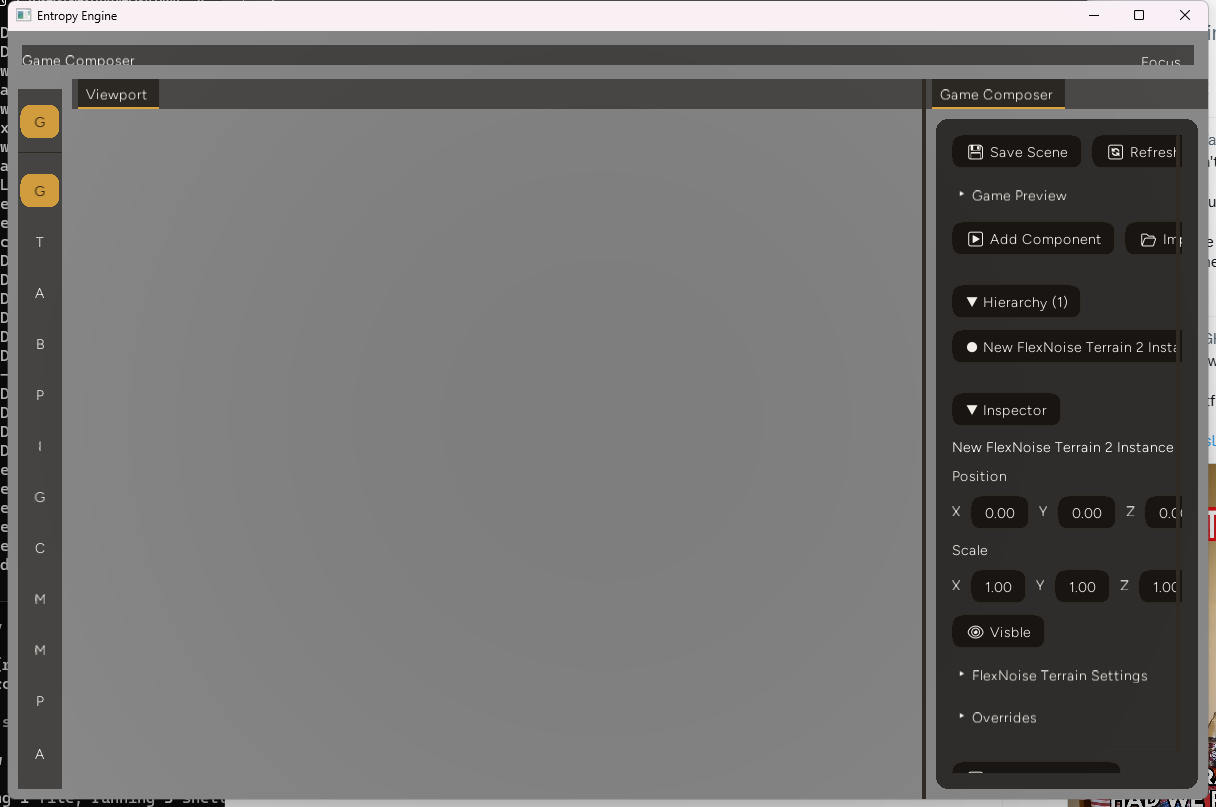
Running it and opening a project gets you this - docked Viewport/Game Composer tabs, a scrollable Inspector panel with collapsing headers, drag-value fields for position/scale, a checkbox - all entropy_gui widgets, Slate theme, screenshotted from the actual running window this session, not a mockup:
First-party numbers, all pulled from this repo directly:
- Size of the replacement:
entropy_guiis 4,734 lines across 39 files (find src/entropy_gui -name "*.rs" | xargs wc -l). - Dependency delta: comparing
Cargo.lockat the commit right beforeentropy_guiwork started (37f642b) againstHEAD, the resolved package count went from 1,110 to 1,099. 13 packages dropped out entirely - the 7 egui-family crates (egui,egui-scale,egui-snarl,egui-wgpu,egui-winit,egui_code_editor,egui_dock) plus 6 packages that existed only to support them transitively (smithay-clipboard,wayland-protocols-experimental,wayland-protocols-misc,webbrowser,proc-macro2-diagnostics,duplicate). 5 packages came in to support the replacement (etagere,arboard'schunked_transfer/asciitransitive deps,svg_fmt,tiny_http- the last unrelated, added the same period for the addon MCP server). Still a ton of work ahead to reduce our dependency count. - Binary: 71.25 MiB release
editor.exe, this session, this machine.
Decision log
- Scope was locked to "replace the whole core shell, defer the two hardest widgets."
egui,egui-wgpu,egui-winit,egui_dockgot a full from-scratch replacement.egui-snarl(node-graph editor) andegui_code_editordid not - they got placeholder widgets instead. The real tradeoff: once panels and docking run onentropy_gui::Uiinstead ofegui::Ui, the actualegui-snarl/egui_code_editorwidgets - which need a real&mut egui::Ui- can't be invoked in place anymore without building a whole separate offscreen-egui bridge just to keep two of the twenty-some widgets. That's more engineering than the payoff justified for this pass, so both got simplified stand-ins instead, documented as an accepted regression rather than something quietly dropped. Idas a hashedu64overUuidcost API-consistency with the rest of the codebase (which isUuid-heavy) in exchange for the actual property the widget system needs: determinism across frames from a label/path, which a random id can't give you.- A closed
WidgetStateenum overAny-boxed storage trades extensibility (a future exotic stateful widget needs a new enum variant, not just a new type) for not needing a generic store at all when the full set was already known.
Failure notes
- Text-edit is a documented v1 stand-in, straight from the source comment in
widgets/text_edit.rs: typing, backspace/delete, arrow nav, home/end, and Enter (multiline) all work. Click-to-place cursor does not - a click always jumps the caret to the end of the text. No drag-to-select. No IME composition despite key events being captured. No clipboard cut/copy/paste despitearboardalready being a dependency for exactly that. - Code editor and node graph are exactly what the plan called them: placeholders.
widgets_code_editor.rsis 41 lines - a plain multiline text edit with a line-number gutter, no syntax highlighting.widgets_node_graph.rsis 50 lines - a read-only scrollable list of nodes and their connections, with an explicit doc comment: "Nothing here lets a user draw new connections - an accepted, documented regression until a real graph editor is built as a follow-up."