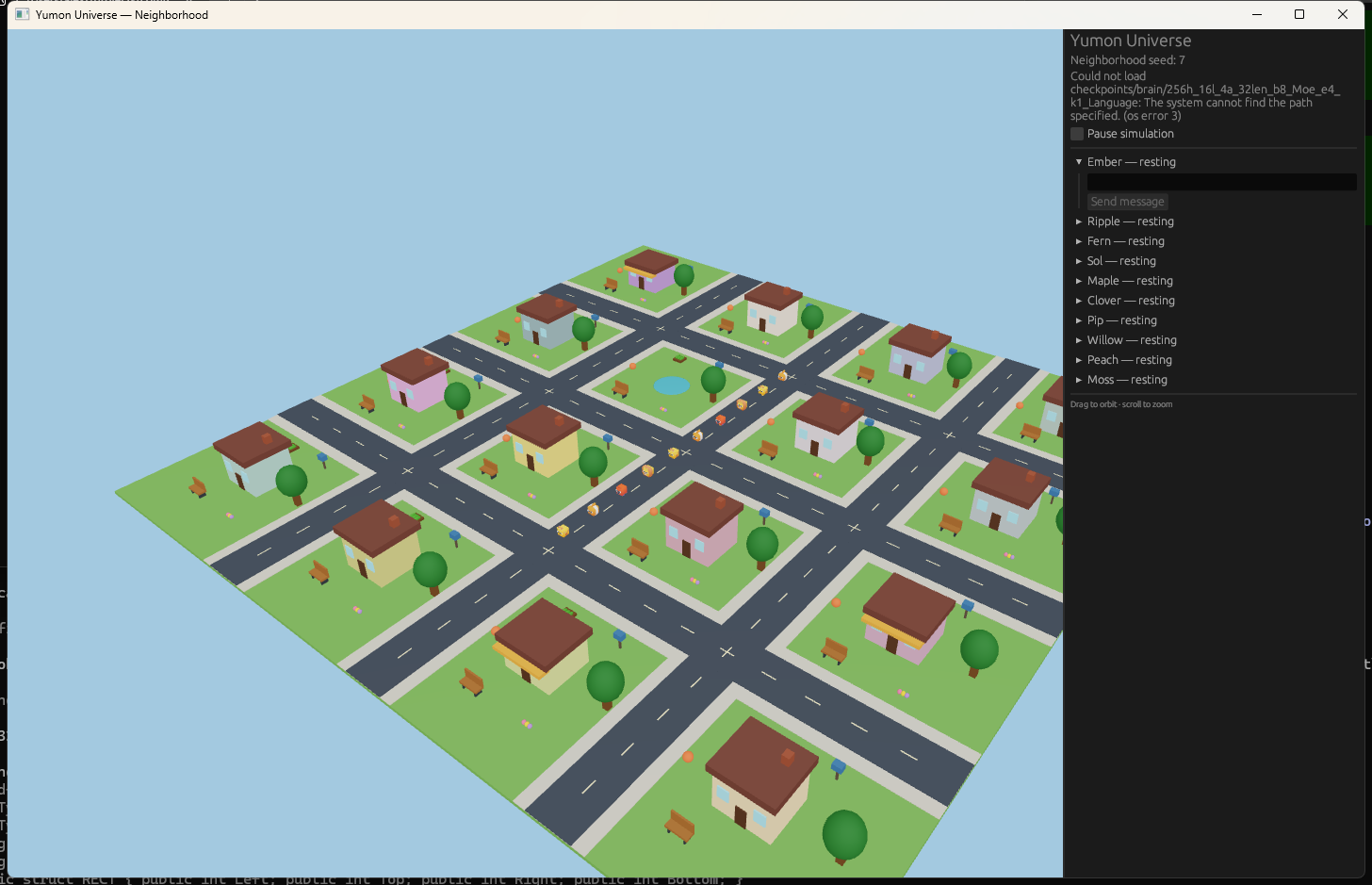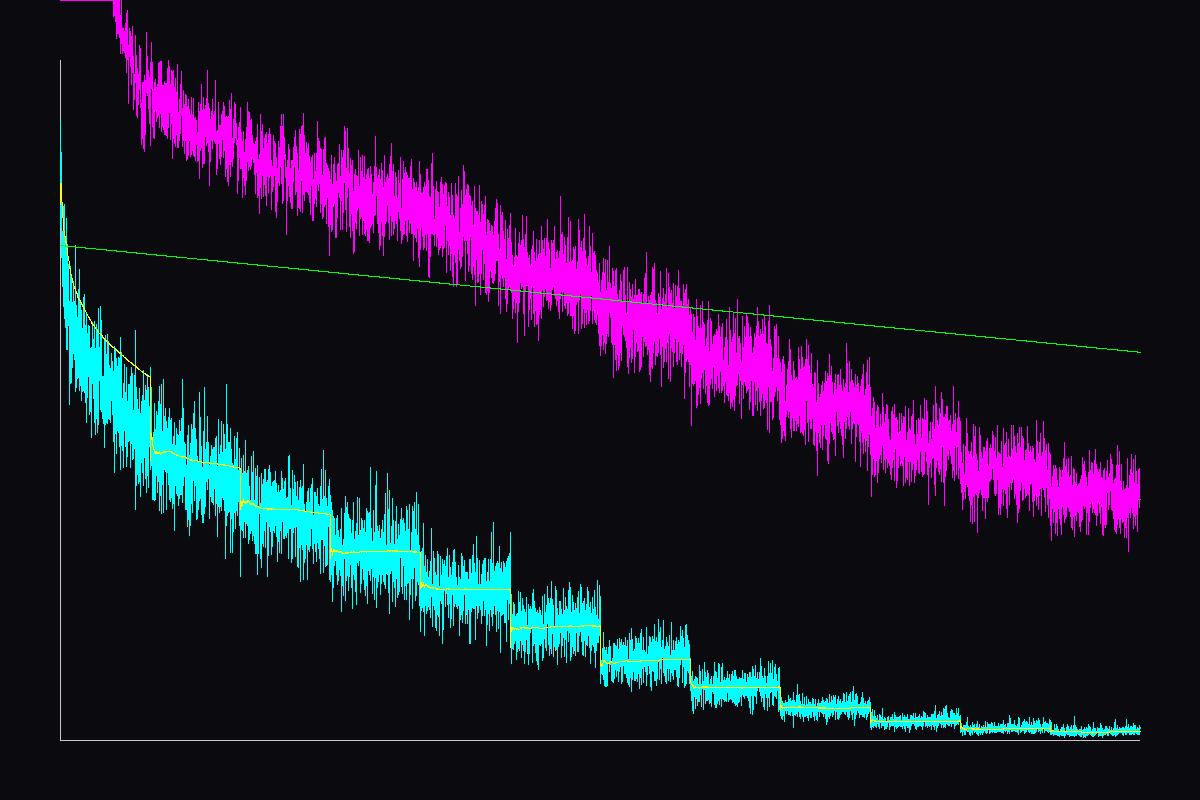
Yumon Pet trains a small decoder-only transformer from scratch in Rust, using burn for the model and cubecl's Wgpu runtime for the flash-attention kernel. The repo has been through a dozen training runs at different capacities, sequence lengths, and data mixes, and every run leaves behind a metadata.json with a final training loss. The obvious move is to pick the checkpoint with the lowest number and call it the best model. I ran three of those checkpoints - small, medium, large, same data recipe, same prompt - to check whether that's actually true.
It isn't. The checkpoint with the lowest loss in the entire checkpoints/ tree produced the worst prose of the three.
The three checkpoints
All three are DecoderOnly architecture (src/brain/decoder_model.rs, single causal stack, prompt and reply concatenated into one sequence - as opposed to the older EncoderDecoder architecture in src/brain/model.rs, cross-attention over a separate encoder stack), trained on the Structured stage, where the model learns to emit JSON ({"action": ..., "emotion": ..., "reply": ...}) rather than free text.
| Checkpoint | embed/hidden | layers | heads | ff_dim | max_seq_len | batch_size | epochs trained | final loss | model.bin |
|---|---|---|---|---|---|---|---|---|---|
brain-all-dec-only/128h_2l_2a_220len_6e | 128 | 2 | 2 | 512 | 220 | 32 | 4 | 0.578 | 6.02 MiB |
brain/256h_3l_4a_512len_b2_DecoderOnly_Structured | 256 | 3 | 4 | 1024 | 512 | 2 | 3 | 0.622 | 20.02 MiB |
brain/512h_6l_4a_512len_b2_DecoderOnly_Structured | 512 | 6 | 4 | 2048 | 512 | 2 | 1 | 0.165 | 112.05 MiB |
That last row is the one to notice before reading any generated text: it has less than half the loss of the other two, and it got there in a single epoch. The run config for it in src/brain/train.rs asks for 15 epochs at that batch size; it stopped at 1.
Getting real output out of them
cargo run -- chat in src/main.rs looks like the headless inference path - it loads the vision model, loads the brain checkpoint, prints the detected emote - and then does nothing with the model. The actual generation call is commented out:
// src/main.rs, run_chat()
// let result = brain_model.generate(
//     &tokenizer,
//     &class_probs,
//     &emote_probs,
//     user_emote_idx,
//     prompt,
//     80,   // max tokens
//     &device,
// );

// println!("\n┌─ Yumon says ──────────────────────────────────────────┐");
// println!("│ {}", result.reply);
// println!("└───────────────────────────────────────────────────────┘");

Ok(())
The real generation path lives in chat_ui.rs, but that binary pulls in the desktop feature (tao, wry, three-d) for its terminal UI shell, which is unrelated to running a model. So there's no way to get a checkpoint's actual output from the command line without either building the full desktop stack or writing a thin wrapper. I added src/bin/headless_compare.rs - no GUI deps, just YumonDecBrain::load + generate_unmasked_parsed, with the same prompt-wrapping chat_ui.rs uses for the Structured stage:
// src/bin/headless_compare.rs
fn wrap_prompt(stage: TrainingStage, prompt: &str) -> String {
    if stage == TrainingStage::Structured {
        serde_json::to_string_pretty(&serde_json::json!({
            "memories": Vec::<serde_json::Value>::new(),
            "message": prompt,
        }))
        .unwrap()
    } else {
        prompt.to_string()
    }
}

let (model, tokenizer, config) = YumonDecBrain::<Wgpu>::load(checkpoint, &device)?;
let wrapped = wrap_prompt(config.training_stage, prompt);
let result = model.generate_unmasked_parsed::<WgpuRuntime>(
    &tokenizer,
    &wrapped,
    config.max_seq_len,
    &device,
);
Built headless with cargo build --no-default-features --bin headless_compare - --no-default-features drops the desktop feature, so no GTK/WebKit/udev equivalents are needed on this platform either.
Evidence
Same prompt against all three, this session, this machine:
cargo run --no-default-features --bin headless_compare -- dec <checkpoint> "how are you feeling today"
Small (128h/2l/2a, loss 0.578):
{
 focusedec"
}
 focused estate
{
 mix" attack":ec" portfol",
 mix" ingace":ec" entrepreneurs vide",
 mix" happeningment":ec" peiter shly br studentated0"
}
Not valid JSON. No reply field the schema parser could even extract - result.reply came back empty.
Medium (256h/3l/4a, loss 0.622):
{
  " action": " get help",
  " emotion": " happy",
  " reply": " you're looking for the following command in this case, and it is in the context of the text."
}
Valid schema, grammatical, but non-responsive - "how are you feeling today" gets an answer that reads like tech-support boilerplate.
Large (512h/6l/4a, loss 0.165 - the lowest of any checkpoint in the repo):
{
   " action": " follow",
  " emotion": " fearful",
  " reply": " that can use and the company's better to work in the future-s of their own ticers as a single."
}
Valid schema, but worse grammar than the medium checkpoint - "future-s," "ticers" aren't words, and the sentence doesn't parse. This is the checkpoint with the best loss number in the whole repo.
Test hardware, this machine, this session:
| GPU | Intel(R) UHD Graphics 770 (integrated, driver 32.0.101.7085) |
| CPU | 12th Gen Intel(R) Core(TM) i5-12500, 6 cores / 12 threads |
| RAM | 32 GB |
| OS | Windows 11 Pro (64-bit), build 10.0.26200 |
Loss-to-quality ranking across the three: by loss, large (0.165) < small (0.578) < medium (0.622). By actual output quality: medium > large > small. The two orderings don't agree at any position. Loss here is a training-stability signal (did the schema's fixed punctuation and keys get learned) more than a content-quality signal, and it's not comparable across runs with different batch sizes and wildly different epoch counts without controlling for those first - which none of these three do.
Decision log
- DecoderOnly over EncoderDecoder.
src/brain/model.rs(YumonBrain- separate encoder/decoder stacks with cross-attention) is still in the repo and still compiles, but everyRunConfigcurrently queued intrain.rs'srunsvec usesArchitecture::DecoderOnly(src/brain/decoder_model.rs,YumonDecBrain- one causal stack, prompt and reply as a single sequence). I didn't run the encoder-decoder path this session, so I can't compare it directly; what's verifiable is that it's the abandoned branch of an explicit fork in the code (commita33e6e4, "choose decoder only vs enc-dec arch"), not something still being actively trained toward. - Synthetic Q&A over raw Bible CSV.
load_stage_dataintrain.rshasbible_bbe.csv/bible_asv.csv(loaded viaFileKind::BibleCsv) commented out, replaced bydata/synthetic/bible.txtloaded asFileKind::Chats. The comment directly above the swap: "LLM-generated Q&A pairs... proper message/reply splits instead of BibleCsv's arbitrary mid-sentence cuts." A CSV-row cut that lands mid-verse produces a sample where the "reply" isn't a complete thought, which is a worse training signal than a clean split, regardless of topic. creative_stories.txtis loaded but disabled. Same function, commented out with// good but gets split. The loader's fixedmax_seq_lenchunking doesn't know where a story's natural boundaries are, so long-form narrative gets cut at arbitrary token positions the same way the raw Bible CSV did. It's sitting indata/unused for that reason, not because the content is bad.- Wgpu over a CUDA-only path, even though
cudais an enabled feature on bothburnandcubecl. Burn's own docs describe Wgpu as a "cross-platform GPU backend," and the framework is "generic over theBackendtrait, which allows us to build Burn with swappable backends" - which is the actual reasonheadless_compare.rsabove runs unmodified on this machine's integrated Intel graphics with no CUDA installed at all.
Failure notes
- Capacity has a hard floor for this schema, and it's above 128h/2l/2a. The small checkpoint doesn't produce degraded JSON, it produces no JSON - the FSM/schema structure collapses entirely, despite having a lower loss than the medium checkpoint that gets the schema right every time.
- Loss isn't comparable across these three runs without more controls than exist today. Batch size, epoch count, and architecture size all vary simultaneously between checkpoints. The
final_lossfield inmetadata.jsonis useful for watching one run converge, not for ranking runs against each other the way I initially reached for it. - The headless
chatcommand inmain.rsdoesn't generate anything. This isn't a runtime bug - it builds and runs cleanly, prints the vision output, then returnsOk(())- it's dead code left over from before the vision/brain split, and the only path that actually callsgenerate_unmasked_parsedtoday is inside thedesktop-feature terminal UI.
What's next
None of these three checkpoints is what Yumon Pet should ship with - that's the point of running them side by side rather than picking one. The large checkpoint is one epoch into a fifteen-epoch plan; finishing that run, or the medium one, with loss tracked but not treated as the finish line, is the next concrete step before there's a checkpoint worth writing a "here's what Yumon says" post about.