Yumon Universe (src/universe.rs, src/bin/yumon_universe.rs) drops ten Yumons into a seeded procedural world and lets them decide what to do next from a plain-text reply their own checkpoint generates. No prior post has covered it, so this one does two things: explains why it works the way it does, and covers today's addition - a second, business-district variation of the same world, --theme urban.
The world, and why it only needs a Language checkpoint
Every object in the world - a house, a tree, a bench - is a Place with a Kind. Each tick, a Yumon standing near one gets asked something like:
The ball is east. Would you like to play with it?
That string goes straight to the checkpoint as a prompt. Whatever comes back - "Yes, let's play!", "No thanks", "I'll water it" - gets parsed by infer_reply (src/universe.rs), a hand-written phrase matcher: a fixed list of refusal words returns rest immediately, a fixed list of verbs maps to a Behavior, and the target Place has to be both nearby and compatible with that behavior (Play only ever resolves against a Kind::Ball, Tend only against a Kind::Garden, and so on). No target, no compatible verb, or any hint of refusal, and the Yumon just rests. This is a heuristic bridge, not a trained classifier - the repo's TrainingStage::Language checkpoints were never trained on this schema at all, they just generate plain sentences (src/brain/samples.rs: Language, // phase 1: plain sentence -> sentence).
That's the interesting part. This repo already has a second stage, Structured (// phase 2: sentence -> JSON), built for exactly this kind of use case - the previous post ran checkpoints trained on it, generating {"action": ..., "emotion": ..., "reply": ...}. Universe doesn't use it. Every question and reply in Universe stays plain text, and the "structure" - which object, which verb, whether it's grounded in something actually nearby - happens entirely in Rust after generation, not in the model's output.
The reason is context length. I measured it directly rather than assuming it: encoding the same message and reply as a Structured-shaped JSON blob versus as plain Language-stage text, with the repository's own tokenizer (yumon_bpe, loaded via BpeTokenizer::load):
let structured = serde_json::to_string(&serde_json::json!({
    "memories": Vec::<serde_json::Value>::new(),
    "message": "The budget is east. Would you like to maintain it?",
    "action": "maintain",
    "emotion": "content",
    "reply": "Sure, I'll maintain it.",
}))?;
let language = "The budget is east. Would you like to maintain it? Sure, I'll maintain it.";
Run as a throwaway test this session (cargo test --lib universe::tests::temp_measure_structured_vs_language_token_cost -- --nocapture, then deleted - it isn't part of the repo, just how the number below was produced):
structured tokens: 61 | language tokens: 20
Same message, same reply, same intent - three times the tokens once it's wrapped in {"memories":[],"message":...,"action":...,"emotion":...,"reply":...} quoting and keys. Universe's default checkpoint (256h_16l_4a_32len_b8_Moe_e4_k1_Language) has a 32-token context window; at the Structured stage's overhead, that budget mostly goes to punctuation before it reaches any actual content. Getting the same downstream benefit - a concrete action, tied to a concrete object, out of a short context window - by parsing plain language on the Rust side instead of training the model to emit a schema is the whole design bet Universe makes, and it's why it can only load TrainingStage::Language checkpoints (brain_worker in yumon_universe.rs rejects anything else with an explanation in the sidebar).
Two towns, one world model
Today's work was a second theme for the same simulation: --theme urban, a downtown business district standing next to the existing suburban neighborhood. The constraint going in was that it be thematic all the way through - not just re-skinned buildings, but the actual nouns and verbs sent to the Yumon as prompts.
The world has nine Kinds, and every suburban object maps onto exactly one downtown counterpart:
| Slot | Suburban | Urban | Verb offered |
|---|---|---|---|
| House (anchor) | house | business | visit |
| Shop (anchor) | shop | market | visit |
| Tree | tree | debt | look at |
| Flowers | flowers | money | collect |
| Bench | bench | coffee | rest by |
| Ball | ball | product | play with |
| Garden | garden | budget | maintain (was: tend) |
| Mailbox | mailbox | deal | look at |
| Pond | pond | brand | look at |
Kind::radius, the layout algorithm, and infer_reply's behavior-compatibility rules (Play only resolves against Kind::Ball, etc.) never change between themes - only Kind::noun and, for one slot, the verb, differ. A test (urban_theme_renames_every_kind_without_changing_behavior) confirms every Kind gets a distinct urban noun and that the Garden/budget slot still resolves to Behavior::Tend even with a different verb; another (seeded_world_is_varied_and_safe) diffs a suburban and an urban world generated from the same seed and asserts they produce the identical sequence of Kinds - same town, two labels.
The urban nouns aren't invented office vocabulary. They're picked by literal word frequency in archive/synthetic/business.txt - the actual file this checkpoint's Language stage trains on (load_stage_data in src/brain/train.rs loads it directly, alongside bible.txt and, confusingly, a file named universe.txt that's generic astronomy Q&A and has nothing to do with this simulation despite the name):
business: 613 occurrences   budget: 48
market:   126               deal:    31
debt:     132                brand:  115
money:    141                coffee:  3
product:  142
coffee is the one outlier - three occurrences against everything else in the 31-613 range - kept anyway because nothing else in the corpus fits "rest by" as well as a coffee break does; the yumon-universe-coffee-noun-frequency backlog card tracks re-checking that call once a checkpoint exists to test against. Every other pick is both the behaviorally-correct noun for its slot (money for "collect", budget for "maintain") and one of the most common nouns in the file the model was actually trained on. A permanent test, urban_nouns_are_present_in_the_training_corpus, reads business.txt at test time and fails if any urban noun stops appearing in it - so a future rename can't quietly drift back to a word the checkpoint has no real grounding in.
Evidence
Same seed (--seed 7), same layout, two themes, both actually launched and screenshotted on this machine:
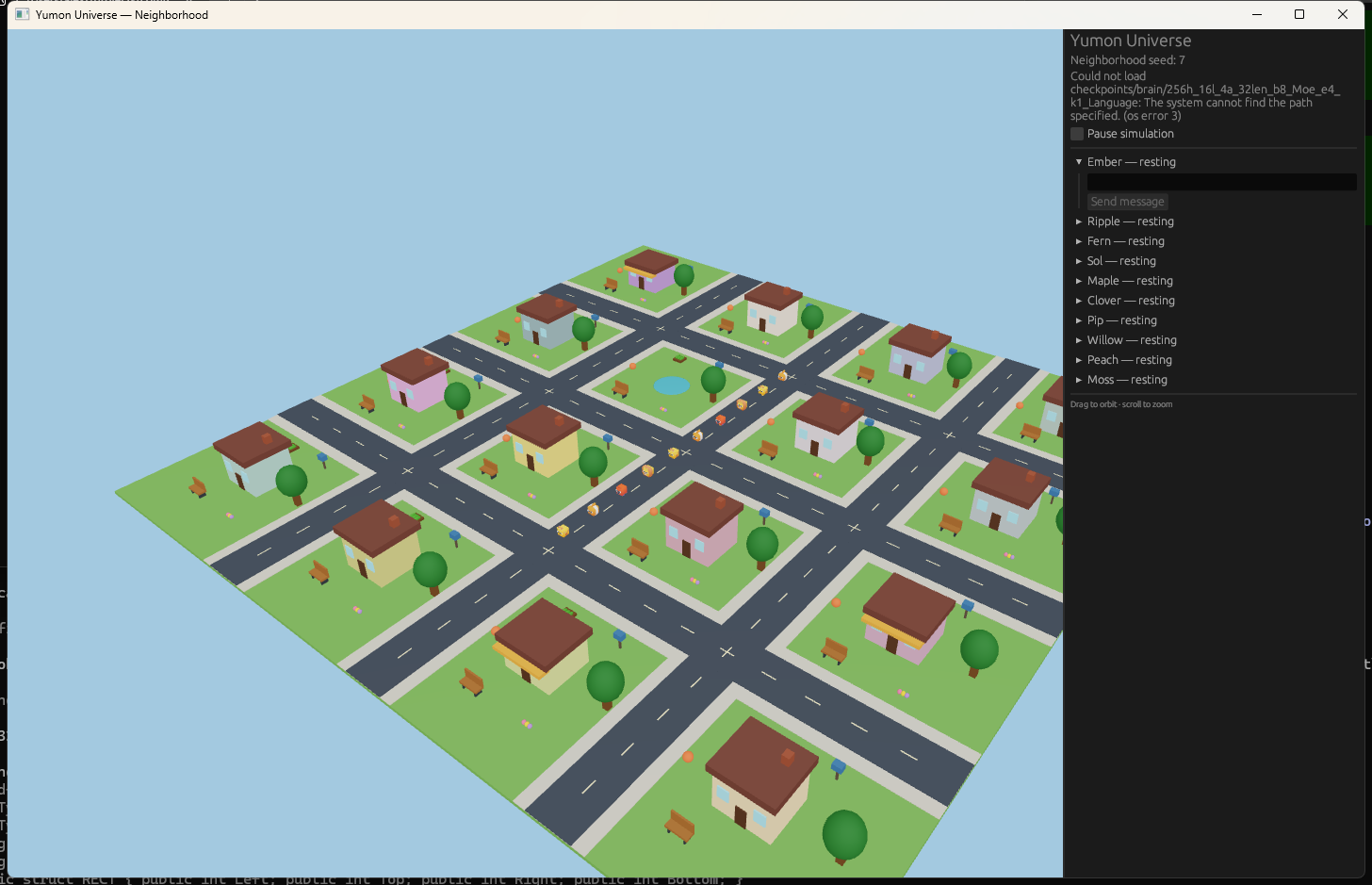
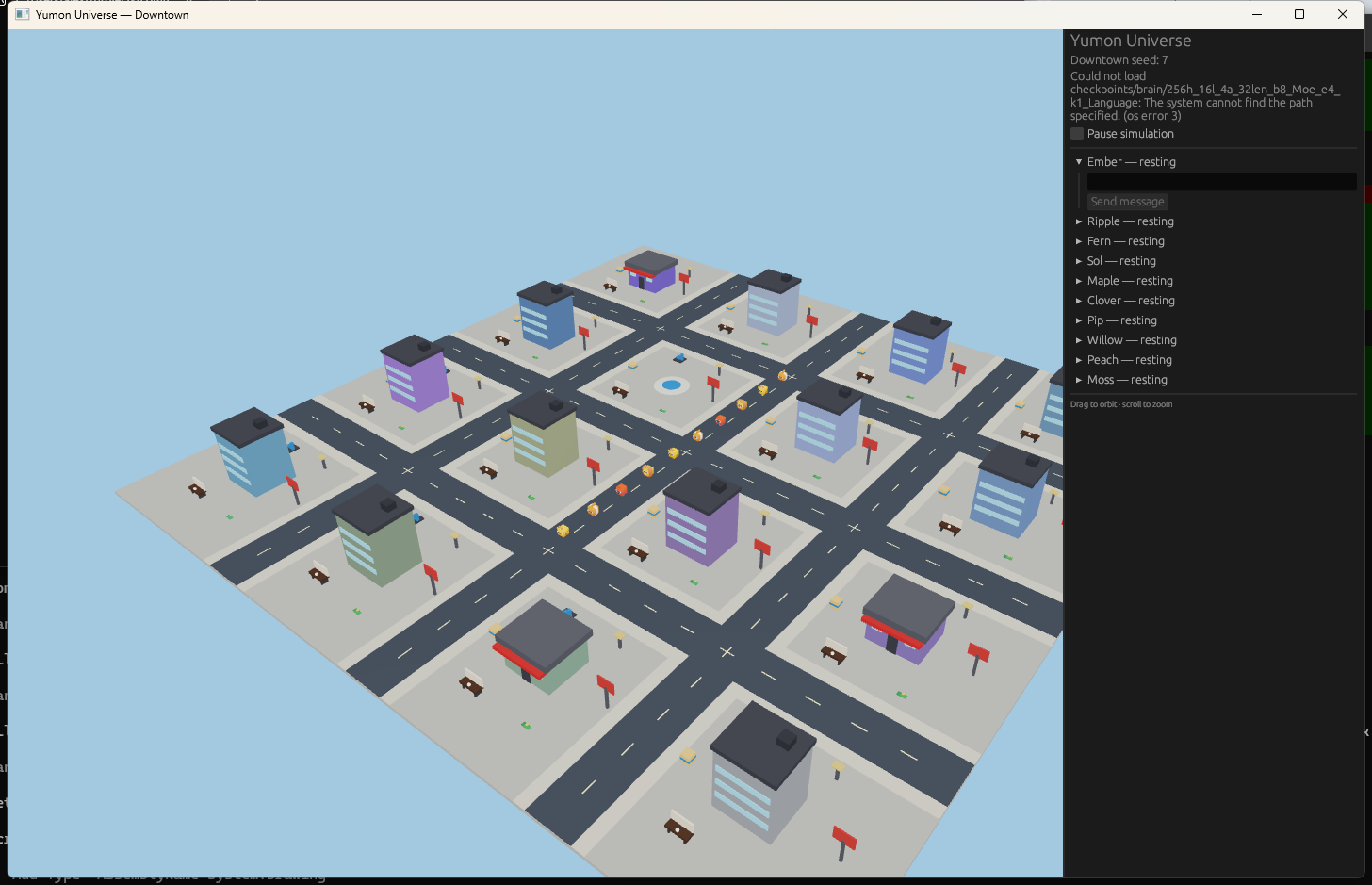
The sidebar in both shots shows Could not load checkpoints/brain/256h_16l_4a_32len_b8_Moe_e4_k1_Language: The system cannot find the path specified. (os error 3). That's the documented fallback, not a bug - no trained Language checkpoint is installed in this environment, and Universe is built to still render and let you look around without one; only autonomous decisions need a working checkpoint. Every Yumon in both screenshots is idle ("resting") for that reason. The layout match between the two screenshots - same tower/stall positions, same plaza-medallion/pond placement - is the visual confirmation that only the skin changed, matching what seeded_world_is_varied_and_safe checks in code.
scenery() (src/bin/yumon_universe.rs) gives each urban slot its own primitives rather than recoloring the suburban ones: a flat-roofed glass tower with window bands and a rooftop utility block for business; the shop's exact awning shape, just cooler-toned, for market (a market stall's awning already reads correctly, no new geometry needed); a red notice board on a post for debt; two stacked bills and a coin for money; the bench's own counter shape recolored with a cup on top for coffee; a labeled crate for product; three ascending bars on a base plate for budget; a signing-podium folder for deal; and two concentric discs standing in for a plaza logo medallion where the pond was.
Decision log
- One
Kindenum, not a theme-specific object model. Adding a second, parallel enum of urban-only object types would have doubled the surface area ofinfer_reply's compatibility rules and the layout algorithm for no real benefit - the slots are structurally identical between themes, only their labels and rendering differ.Kind::noun(self, theme)and a smallverb_and_behaviormatch keep both themes on one tested code path. - Frequency in the actual training file, not semantic guessing. A checkpoint has no real representation for a word it has near-zero exposure to during training. Picking urban nouns by their count in
business.txt- the fileload_stage_dataactually feeds the Language stage - checks that grounding directly instead of assuming a plausible-sounding office word would work just as well. marketreuses the shop's exact geometry. A market stall and a small retail shop share a real-world silhouette (a low building with a visible awning); building a second bespoke shape would have been pure duplication for a slot where the existing one was already correct.- Theme lives in
universe.rs, not the CLI layer.Neighborhood::generateneeds to know the theme to pick tints and nouns during generation itself, soThemederivesclap::ValueEnumdirectly in the world-model module (clapis already an unconditional dependency of this crate) rather than being a bin-only wrapper type that gets translated at the CLI boundary.