Part 4 left Canvas Surfaces as a set of independent, paintable primitives: plane, box, cylinder, sphere, each with its own bend, its own cut mask, no relationship to any other surface in the scene. A hand-drawn character was still a pile of unrelated boxes. There was no way to say "this hand belongs to this arm," and nothing that could move over time at all.
This pass adds an addon-owned hierarchy - groups, pivots, parenting - and named animation clips that key any node's transform or any stroke's reveal progress. None of it touches the engine. It is TypeScript matrix math plus a JSON scene format, sitting entirely inside examples/studio-bundle/src/apps/canvas_surfaces/.
What changed
- A
Groupis just an id, a name, a parent, and a pivot-awareTransform. Surfaces and groups both parent onto groups. canvas_animation.ts(102 lines, no dependencies) owns the math: 4x4 row-major matrices,transformMatrix,groupWorld(walks a node's ancestors and composes their matrices), andanimatedTransform(samples a clip's keyframe tracks on top of a node's base transform).- Reparenting a node preserves its exact world-space pose, including shear inherited from a scaled ancestor, by solving for a correction matrix rather than decomposing and reapplying position/rotation/scale.
- A
ClipholdsTracks keyed by(targetId, channel). A target is either a group/surface (position, rotation, scale channels) or an individual retained stroke (progress,visible). - Strokes are now retained as replayable stamp lists, not just baked pixels, so a stroke's own reveal can be keyframed independently of everything else on its surface.
- The scene format bumps to version 3: groups, clips, and per-stroke identity round-trip through save/load.
validateScenegainedvalidateAnimation, which rejects parent cycles, dangling target ids, and out-of-range keys before any of it reaches the live scene. - Preview (scrubbing or playing a clip) never touches editing state. Stopping playback restores the exact pre-preview pixels and pose, and the scene's dirty flag is untouched by scrubbing alone.
Build and run it:
cd examples/studio-bundle
npm run build-canvas-surfaces
cd ../..
cargo run --bin example -- canvas-surface-demo
The hierarchy is four functions, not a scene graph
canvas_animation.ts doesn't introduce a scene graph type on the engine side. Entropy.Model.createMesh still has no transform of its own; every surface is still repositioned by recomputing world-space vertices and pushing them with Entropy.Mesh.updateVertices, exactly as it has since Part 1. What's new is that "the surface's own transform" is now composed with its ancestors' transforms before that push happens:
export function transformMatrix(t: Transform): Matrix {
    const [x, y, z] = t.rotation, [cx, cy, cz] = [Math.cos(x), Math.cos(y), Math.cos(z)], [sx, sy, sz] = [Math.sin(x), Math.sin(y), Math.sin(z)];
    const rx = [1,0,0,0, 0,cx,-sx,0, 0,sx,cx,0, 0,0,0,1];
    const ry = [cy,0,sy,0, 0,1,0,0, -sy,0,cy,0, 0,0,0,1];
    const rz = [cz,-sz,0,0, sz,cz,0,0, 0,0,1,0, 0,0,0,1];
    const scale = identity(); scale[0] = t.scale[0]; scale[5] = t.scale[1]; scale[10] = t.scale[2];
    const m = multiply(multiply(multiply(ry, rx), rz), scale);
    const offset = point(m, t.pivot);
    for (let i = 0; i < 3; i++) m[i * 4 + 3] = t.position[i] + t.pivot[i] - offset[i];
    return m;
}

export function groupWorld(groups: Group[], id: string | null, clip: Clip | null = null, time = 0, seen = new Set<string>()): Matrix {
    if (!id) return identity();
    if (seen.has(id)) throw new Error("Groups cannot contain themselves.");
    seen.add(id);
    const g = groups.find(g => g.id === id);
    if (!g) throw new Error("Parent group is missing.");
    return multiply(groupWorld(groups, g.parentId, clip, time, seen), multiply(g.frame, transformMatrix(animatedTransform(g, g.id, clip, time))));
}
A surface's final world matrix is groupWorld(parent) * frame * transformMatrix(animatedTransform(self)) - the addon computes this fresh every time geometry needs rebuilding:
function surfaceMatrix(s: Surface): Matrix {
    const clip = preview ? currentClip() : null;
    return multiply(groupWorld(groups, s.parentId, clip, playhead), multiply(s.frame, transformMatrix(animatedTransform(surfaceTransform(s), s.id, clip, playhead))));
}
clip is only non-null while preview is true. Outside of preview, animatedTransform samples nothing and every surface renders its plain editing-pose transform. That single ternary is the entire boundary between "animation system" and "editor."
A pivot move that doesn't visually move the object
Setting a pivot changes where rotation happens, but an artist doesn't want the object to jump when they drag the pivot slider. The fix is to measure the position delta a pivot change would introduce and cancel it out immediately:
slider(`node_pivot_${axis}`, `Pivot ${axis}`, node.pivot[index], -20, 20, value => {
    beginEdit("Set pivot");
    const before = transformMatrix("yaw" in node ? surfaceTransform(node) : node);
    node.pivot[index] = value;
    const after = transformMatrix("yaw" in node ? surfaceTransform(node) : node);
    for (let i = 0; i < 3; i++) node.position[i] += before[i * 4 + 3] - after[i * 4 + 3];
    refreshGeometry();
});transformMatrix's own pivot-offset math (m[i*4+3] = position[i] + pivot[i] - offset[i]) already guarantees the object doesn't move when the pivot is set fresh on an object at rest; this slider handler just applies the same correction on every incremental drag so the object stays visually anchored while the pivot point itself walks across it.
Reparenting without decomposing
The one function in this file I was most careful about is reparentFrame. Grouping and ungrouping mid-scene must not visibly move anything, even when an ancestor is scaled (a plain "recompute local transform from new-parent-relative position/rotation" approach loses shear introduced by a non-uniform-scaled ancestor). So reparentFrame doesn't decompose anything - it solves for a raw correction matrix that makes new_parent_world * frame == old_world hold exactly:
export function reparentFrame(groups: Group[], id: string, oldParent: string | null, parent: string | null, frame: Matrix): Matrix {
    let cursor = parent;
    while (cursor) {
        if (cursor === id) throw new Error("Groups cannot contain themselves.");
        const g = groups.find(g => g.id === cursor);
        if (!g) throw new Error("Parent group is missing.");
        cursor = g.parentId;
    }
    return multiply(inverse(groupWorld(groups, parent)), multiply(groupWorld(groups, oldParent), frame));
}
The cycle check walks the candidate parent's own ancestor chain first and throws before any matrix work happens, which is what makes "a parent cannot become a child of its descendant" a caught, recoverable error (surfaced to the artist as a status label) instead of infinite recursion inside groupWorld.
Visibility is a hold, not a fade
Track.channel includes "visible", used to key a stroke fully on or off (a smile that shouldn't exist until a character opens its eyes, for instance). Every other channel interpolates linearly between keys; visible deliberately does not:
export function sample(track: Track, time: number): number {
    const keys = track.keys;
    if (!keys.length) throw new Error("Animation track has no keys.");
    if (time <= keys[0].time) return keys[0].value;
    for (let i = 1; i < keys.length; i++) if (time < keys[i].time) {
        const a = keys[i - 1], b = keys[i];
        return track.channel === "visible" ? a.value : a.value + (b.value - a.value) * (time - a.time) / (b.time - a.time);
    }
    return keys[keys.length - 1].value;
}
A stroke's progress channel still interpolates (it drives how many of its recorded stamps get replayed, giving a stroke that draws itself in over time), but visible holds the previous key's value until the next one, exactly the behavior a boolean-shaped property should have. This one branch is the entire distinction, and it's covered directly by a BDD scenario ("Stroke visibility holds until its next key instead of fading") rather than left as an assumption.
Preview reuses the exact production render path, and never writes back
The riskiest property of this feature is also the one most worth getting right: scrubbing a clip must never leave the scene in a different state than before scrubbing started. previewAt snapshots every layer's pixels once, on entry into preview, then replays strokes into that same buffer at whatever progress/visibility the sampled tracks say for the current playhead:
function previewAt(time: number): void {
    finishStroke(); resetGesture(); history.commit();
    if (!preview) for (const s of surfaces) for (const layer of s.layers) editingPixels.set(layer.id, layer.pixels);
    preview = true; playhead = Math.max(0, Math.min(currentClip()?.duration ?? 1, time));
    if (activeGizmoId) { Entropy.Gizmo.hide(activeGizmoId); activeGizmoId = null; }
    for (const s of surfaces) {
        const tracks = (currentClip()?.tracks ?? []).filter(t => s.strokes.some(st => st.id === t.targetId));
        if (!tracks.length) continue;
        const key = JSON.stringify(tracks.map(t => [t.targetId, t.channel, sample(t, playhead)]));
        if (previewArtworkKeys.get(s.id) === key) continue;
        previewArtworkKeys.set(s.id, key); replayArtwork(s);
    }
    refreshGeometry();
}

function stopPreview(): void {
    if (!preview) return;
    preview = false; playing = false; previousTime = null;
    for (const s of surfaces) {
        let changed = false;
        for (const layer of s.layers) if (editingPixels.has(layer.id)) {
            changed ||= layer.pixels !== editingPixels.get(layer.id);
            layer.pixels = editingPixels.get(layer.id)!;
        }
        if (changed) composeSurface(s);
    }
    editingPixels.clear(); previewArtworkKeys.clear(); refreshGeometry();
}
No group, surface, or stroke field is ever mutated by preview. surfaceMatrix and replayArtwork only read yaw/pitch/roll/position/progress through animatedTransform/sample, which take a clip and a time and return a new value without writing it anywhere. stopPreview restores the exact pre-preview Uint8Array references. This is also why scrubbing doesn't dirty the scene (sceneIsDirty compares saved state against live state, and live state literally hasn't changed) - a real, load-bearing consequence of the read-only design, not a separate flag someone has to remember to clear.
Testing: two tiers, one of them reused wholesale from the browser BDD work
The browser BDD post built a BrowserBddDriver in src/startup.rs that parses a .feature file with the gherkin crate and replays each step as a widget-level event string onto the real running app, capturing composited-frame PNGs along the way. This pass needed the same capability for the canvas demo (cargo run --bin example -- canvas-surface-demo) and reused that driver directly rather than writing a second one. The change is small: a canvas: bool field selects which environment variable, which embedded .feature file, and which timeout to use.
fn browser_bdd_actions_from_feature(source: &str) -> VecDeque<BrowserBddAction> {
    let feature = gherkin::Feature::parse(source, gherkin::GherkinEnv::default())
        .expect("tests/features/browser_live.feature must be valid Gherkin");
    // ...
}
gherkin::Feature::parse<S: AsRef<str>>(input: S, env: GherkinEnv) -> Result<Feature, ParseError> is gherkin 0.16.0's own public signature (confirmed against the crate's source at ~/.cargo/registry/src/.../gherkin-0.16.0/src/lib.rs:233), and it doesn't care which feature file's text it's handed - the only reason this generalized so cleanly is that the driver was already parameterized on the parsed action queue rather than hardcoded to browser step text.
tests/features/canvas_live.feature drives an entire session against the real, on-screen app: name a scene, group a surface, set its pivot, key a rotation at two times, capture a screenshot, return to the editing pose, capture again, save, reload, scrub to the animated frame, capture again, then repeat the same save/load/scrub/capture sequence against the built-in "Drawn character" example. tests/canvas_bdd.rs spawns the compiled binary as a real subprocess, waits for it to exit, then asserts on both the six resulting PNGs and the actual JSON the addon persisted to disk - not just that the driver's queued events all ran.
The second tier, examples/studio-bundle/tests/canvas_animation_bdd.test.ts, is a fast, no-window vitest suite that parses tests/features/canvas_animation.feature with a small hand-rolled Gherkin-subset reader and drives the addon's real, unmodified onInit/onRender/onUpdatePlus callbacks against a fake Entropy global (in-memory meshes, textures, buffers, UI widgets, Entropy.IO/Entropy.GameState persistence). Eleven scenarios cover grouping, pivots, reparenting, cycle rejection, stroke identity across save/load, undo/redo of every action above, and the "preview is not an edit" property directly:
"the scene is still saved": () => { render(); expect(labels).toContain("Untitled scene"); expect(labels).not.toContain("Untitled scene *"); },
"the preview advances to its end": () => { update(10); update(11); update(12); render(); expect(sliders.get("clip_time")!.value).toBe(2); expect(captions.get("clip_play")).toBe("Play"); },
Ran this session, against the pinned toolchain, with no edits to the tests:
$ tsc --project tsconfig.canvas.json --noEmit
(clean)

$ vitest run tests/canvas_animation_bdd.test.ts --pool=threads
 Test Files  1 passed (1)
      Tests  11 passed (11)
   Duration  4.26s

$ cargo test --release --test canvas_bdd
test canvas_live_feature ... ok
test result: ok. 1 passed; 0 failed; finished in 6.95s
Evidence
The live-tier test writes its six captured PNGs and the addon's actual persisted GlobalGameState_*.json files to test-artifacts/canvas-bdd-<pid>/. I inspected both this session.
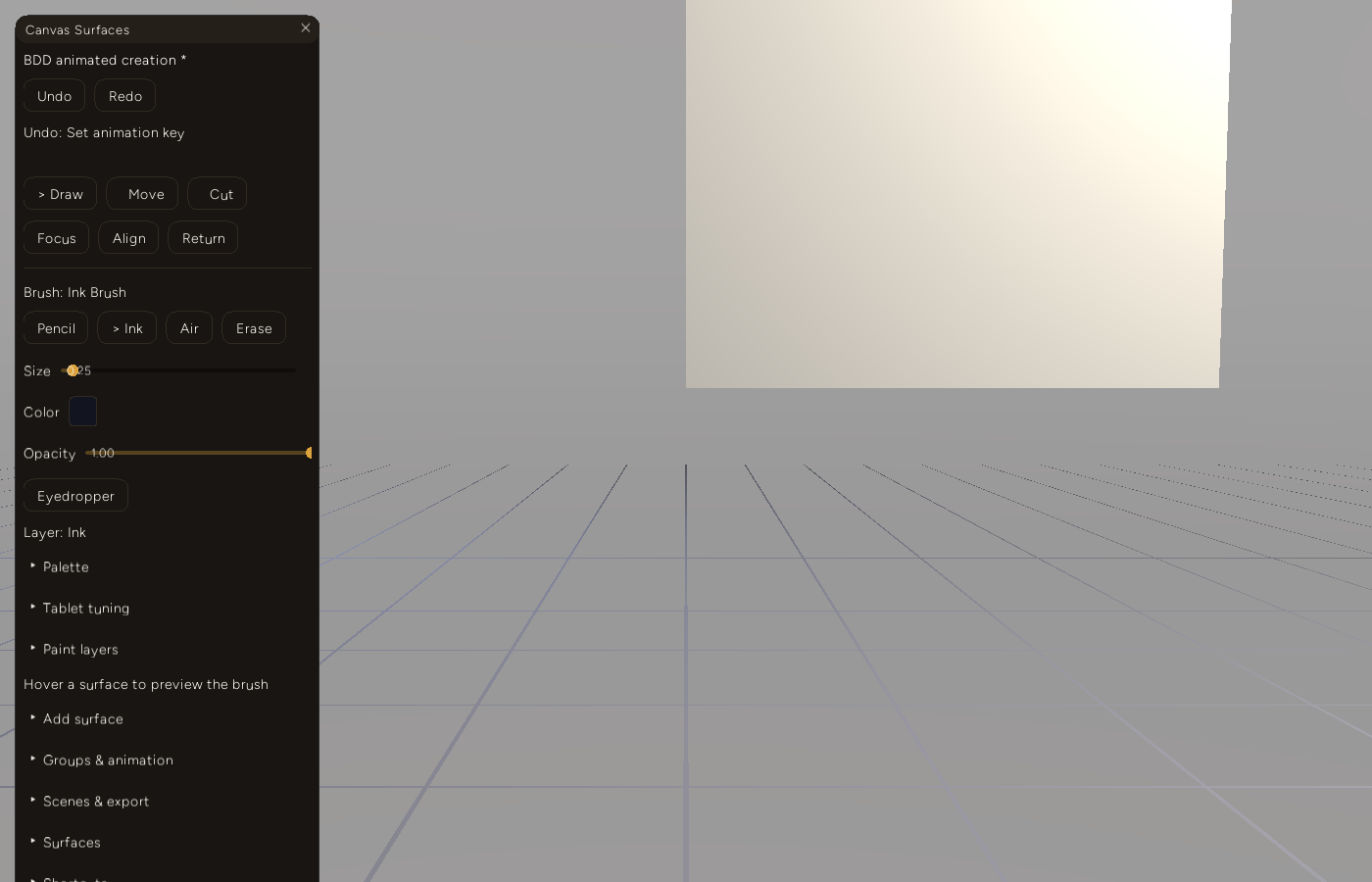
Playhead at the keyed rotation, the single grouped plane swung up around its pivot:
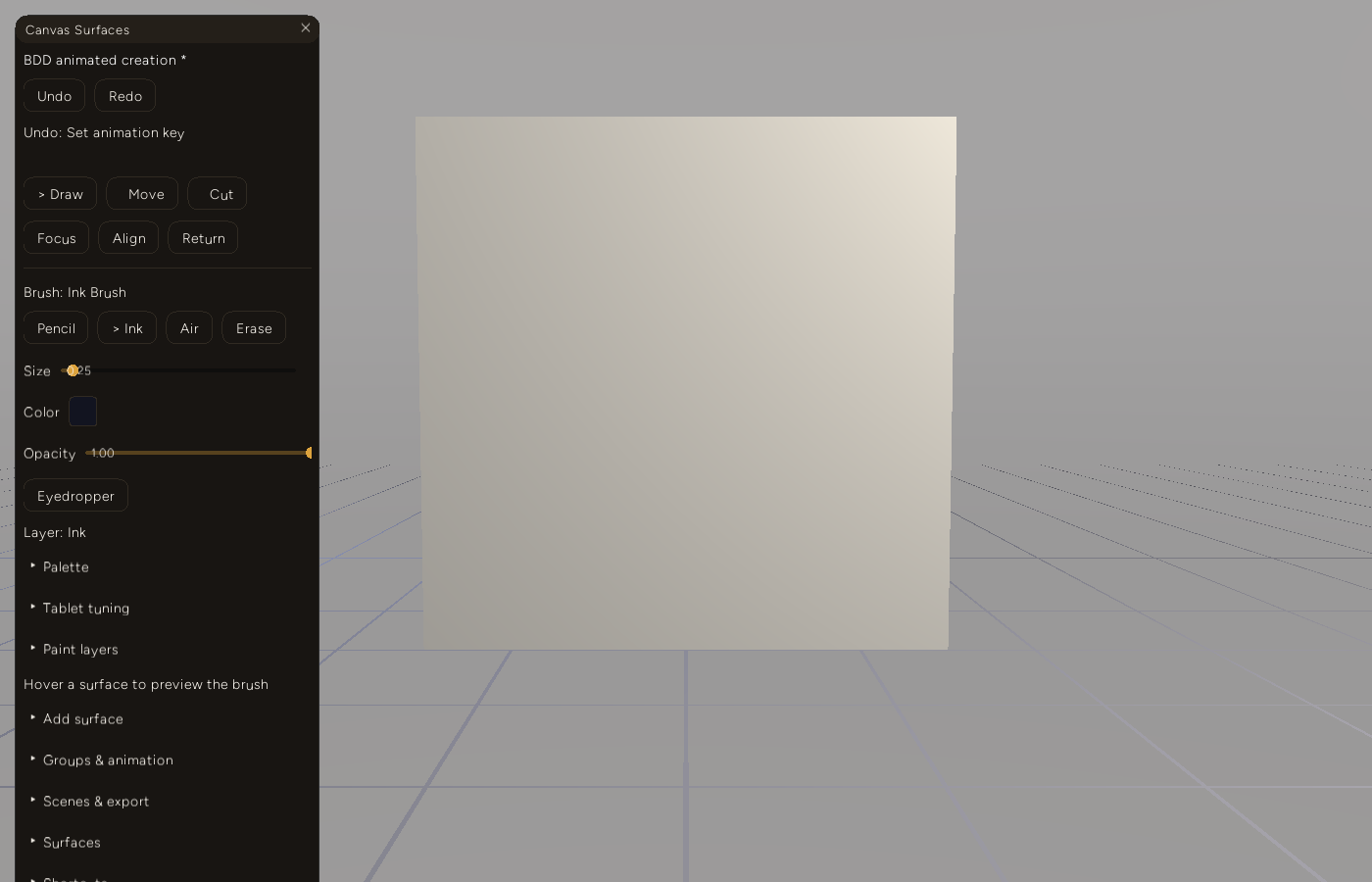
Clicking "Return to editing pose" lands the same surface back at the identical flat, unrotated position - the exact geometry check tests/canvas_bdd.rs makes in code (group["rotation"] == [0, 0, 0] after animation_stop, with the comment "preview must not overwrite the editing pose") is visible directly in the screenshot pair:
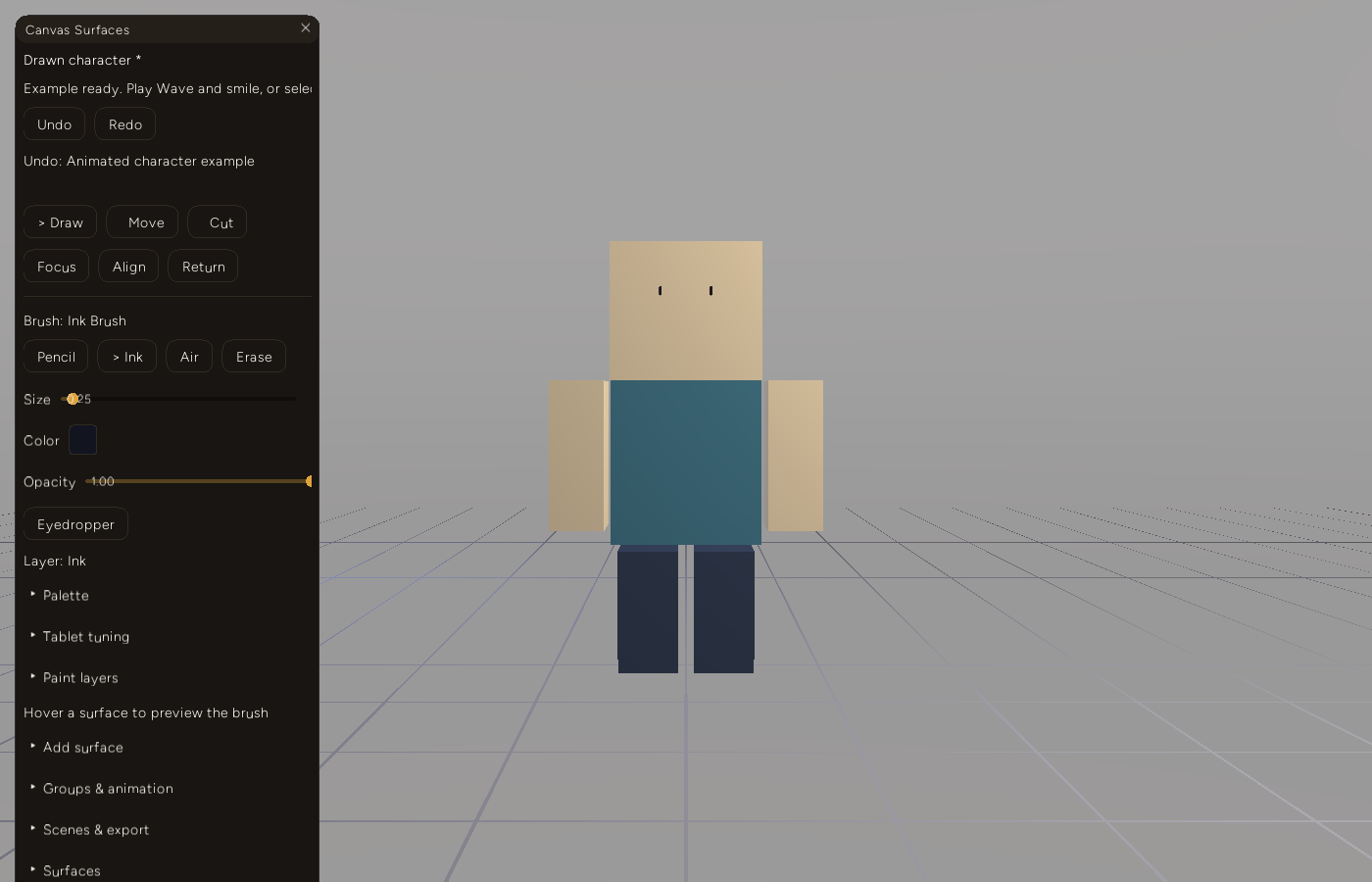
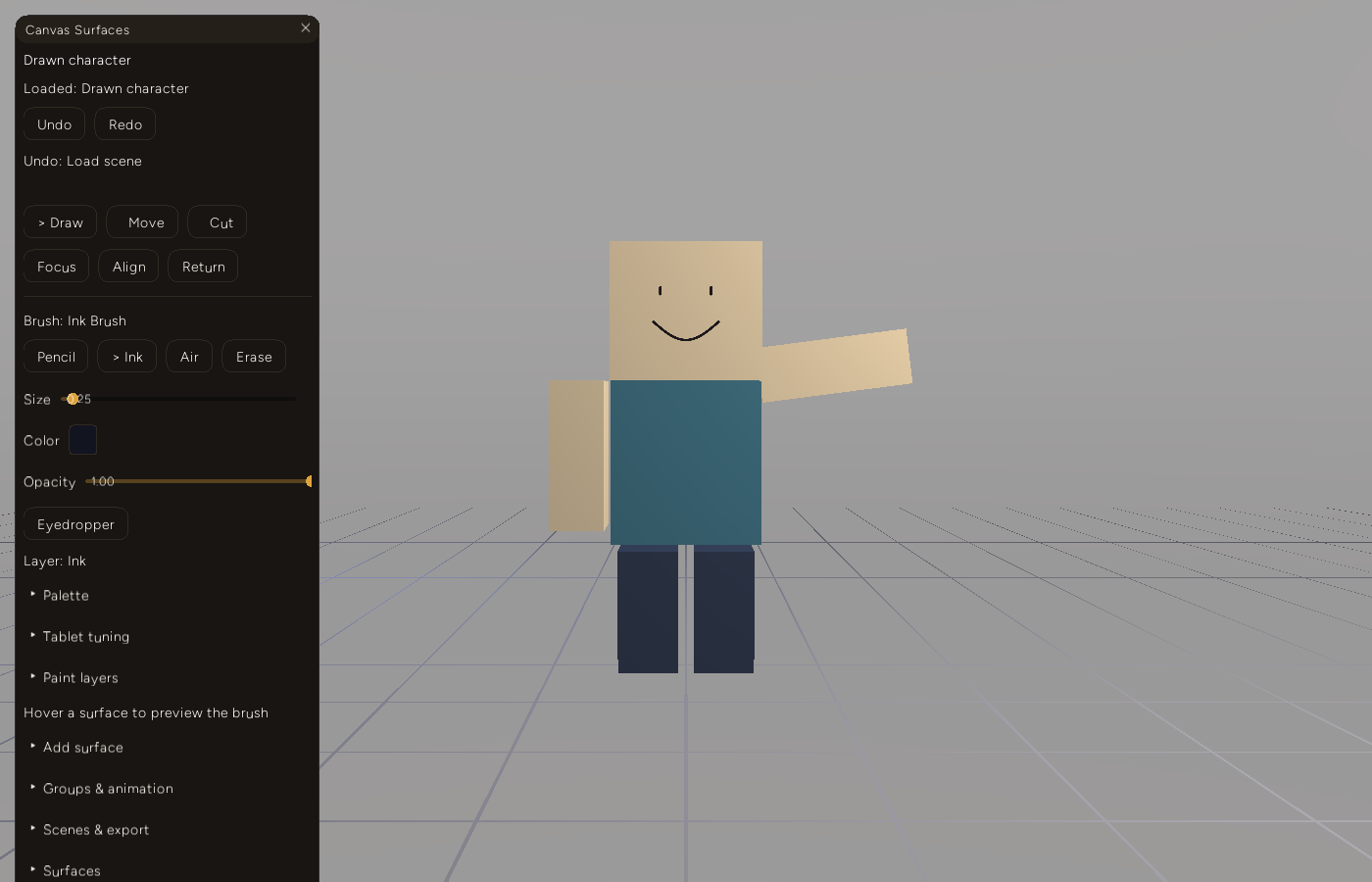
The built-in "Drawn character" example at clip_time = 0: a blank face, a resting arm overlapping the torso.
At clip_time = 1, the arm has swung up and the smile and eyes are now inked in. Two independent tracks - arm.roll and smile.progress - driven by one clip, changing two unrelated things (a rigid rotation and a stroke reveal) at once, which is the entire point of keying a group's transform and a stroke's progress off the same timeline:
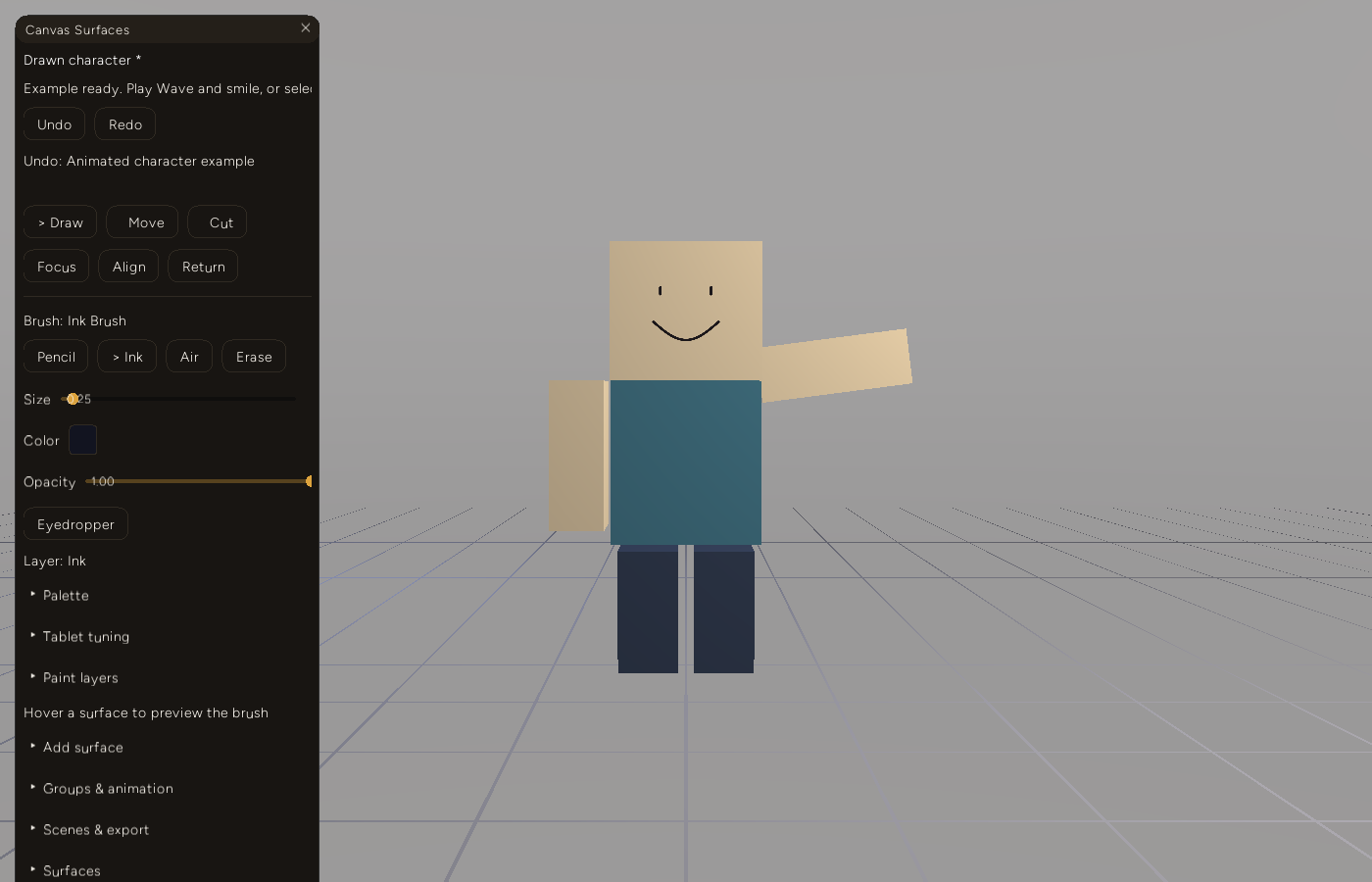
After Save Scene, Load Scene, and setting clip_time back to 1, the reloaded scene reproduces the identical waving-and-smiling pose:
The persisted JSON backs this up directly - tests/canvas_bdd.rs asserts the reloaded Drawn character scene has exactly 6 surfaces, 2 groups (with the second group's parentId pointing at the first), a clip named "Wave and smile" with 2 tracks, and a Face surface with 3 strokes (two eyes, one smile) - all read back from disk, not from the driver's own memory of what it queued.
Decision log
- Hand-rolled row-major matrices, no
glam/nalgebra. The rest of Canvas Surfaces (raycasting, patch geometry, quaternion bridge toEntropy.Gizmo) already works this way; a second math convention living only in the animation module would be a worse trade than 102 dependency-free lines. - A correction matrix for reparenting instead of decompose/recompose. Decomposing a matrix into position/rotation/scale and rebuilding it loses shear from a non-uniformly-scaled ancestor. Solving
inverse(newParentWorld) * oldWorldpreserves whatever the old pose actually was, sheared or not, with no special case. visibleholds, everything else lerps. A boolean-shaped property that fades has no well-defined "half true" state a renderer can act on; holding avoids inventing one.- Preview never writes to live state. The alternative - apply sampled values directly to
s.yaw/s.position/etc. and restore them on stop - needs a second, parallel "what was it before preview" tracking mechanism that duplicates what a snapshot already gives for free, and it risks a lost restore on a crash or an early return leaving the scene silently animated. - Reused the browser BDD driver instead of writing a canvas-specific one. The driver's actual behavior (spawn the compiled example, feed the JS runtime widget-event strings, request composited PNG captures, write a
result.json) has nothing browser-specific about it once the step-to-action mapping and the feature source are parameters. Two demos now share one proven, already-debugged event-injection path instead of two paths that could silently drift apart.
Failure notes
Both tiers passed on the first run this session, and the diff introducing this feature carries no leftover debug println!/console.log calls or reverted instrumentation, unlike several earlier phases of this series. The one real, load-bearing rough edge is visible directly in the code rather than caught by an assertion: Entropy.Gizmo's translate handles only understand a flat position field, so syncGizmoToSelection explicitly disables the gizmo for any surface that is grouped or has a non-identity frame (s.parentId || JSON.stringify(s.frame) !== JSON.stringify(identity())), and for edge-snapping the same guard applies to setSurfacePosition. A grouped part is repositioned with the Local x/y/z sliders under "Groups & animation," not the 3D gizmo, until the gizmo is taught to drag through a parent's world matrix.
Limits
- The gizmo/snapping gap above is real and currently permanent, not a TODO with no owner - it's an explicit
ifguard, not a missing feature that silently misbehaves. - Bend and the cut mask (Part 2 and Part 4) are still per-surface state, not animatable. A cut hole or a bend amount can't be keyed on a clip's timeline.
- A clip's tracks are flat: there's no clip-within-clip composition or blending between two clips.
playCanvasClipswitches a single active clip outright. validateAnimationcaps groups, clips, and tracks per scene at 128 each and strokes per surface at 10,000 - generous for a hand-authored scene, but a hard ceiling, not a soft warning.
What's next
Canvas Surfaces now has paint, layers, four primitive shapes, bend, a cut tool, and an addon-owned hierarchy with keyframed clips - everything the original Part 1 backlog named except the gizmo/hierarchy gap noted above. The next candidate is closing that gap: teaching the gizmo to drag a grouped or reparented node through its accumulated parent matrix instead of only ever writing a flat position.