Every Canvas Surface so far has been a flat rectangle, bent or not. Part 2 closed the bend/raycast gap the epic's own backlog named, but it left the shape itself alone - a page, still. This post adds three more: box, cylinder, sphere. The interesting part isn't any one shape's geometry, which is textbook - it's that all four kinds (plane included) now share exactly one mesh-building path, one raycast, and one AABB implementation, with no per-shape branch anywhere except "which patches does this kind produce."
What we're building
- A surface's
kindis now"plane" | "box" | "cylinder" | "sphere", chosen at spawn time via a cycling Shape button, with per-kind dimension sliders (Width/Height/Depth for a box, Radius/Height for a cylinder, Radius for a sphere). - All four kinds paint and raycast identically - draw on a box's face, a cylinder's curved side, or a sphere, and the stroke lands exactly where the cursor is, same as a plane.
- All four kinds share one texture per surface. A box's 6 faces, a cylinder's side + 2 caps, and a sphere's single equirectangular wrap are all just different regions (an atlas) of the same canvas buffer this addon has used since Part 1.
- Bend stays plane-only - it isn't a supported operation on the other three kinds, and their UI simply doesn't show bend controls.
Same demo, same repo location: examples/studio-bundle/src/apps/canvas_surface_addon.ts, cargo run --bin example -- canvas-surface-demo.
The abstraction: a Patch is just a grid, wherever it bends
Part 2's plane was a row/col grid of local-space points plus a matching grid of UVs. Nothing about that idea is plane-specific - a Patch interface says so directly:
interface Patch {
    rows: number;
    cols: number;
    localPoint(row: number, col: number): Vec3;
    outwardAt(row: number, col: number): Vec3;
    uvAt(row: number, col: number): { u: number; v: number };
}
A shape is just one or more of these. A plane and a sphere are one patch each; a box is 6 face patches; a cylinder is a side patch plus two cap patches:
function shapePatches(s: Surface): Patch[] {
    switch (s.kind) {
        case "plane": return [planePatch(s)];
        case "box": return boxPatches(s);
        case "cylinder": return cylinderPatches(s);
        case "sphere": return [spherePatch(s)];
    }
}
The cylinder's side patch is a good example of how little actually changes per shape - it's the same row/col grid shape as a plane, just with a different localPoint:
const side: Patch = {
    rows: H + 1, cols: R + 1,
    localPoint: (row, col) => {
        const y = hh - (2 * hh * row) / H;
        const angle = (col / R) * Math.PI * 2;
        return [radius * Math.cos(angle), y, radius * Math.sin(angle)];
    },
    outwardAt: (_row, col) => {
        const angle = (col / R) * Math.PI * 2;
        return [Math.cos(angle), 0, Math.sin(angle)];
    },
    uvAt: (row, col) => ({ u: col / R, v: (row / H) * CYL_SIDE_V_FRACTION }),
};
The circumference seam (angle wrapping from 2π back to 0) isn't a modular-index special case anywhere in the triangulation code - it's just a duplicated column of vertices at the same world position with a different U (0 vs 1), the standard mesh-generation trick. That's what keeps every patch, cylinder and sphere included, a plain non-wrapping grid: mesh-building and raycasting never need to know a shape wraps at all.
Winding, derived once, not hand-derived six times
Getting a plane's triangle winding right (which diagonal makes the two triangles face the intended direction) took real by-hand cross-product algebra in Part 2 and again for the ground-reference grid. Doing that by hand for 6 box faces plus a cylinder's side and 2 caps is exactly the kind of repeated, error-prone work worth automating instead:
function patchWinding(patch: Patch): [number, number, number, number, number, number] {
    const row = Math.min(1, patch.rows - 2);
    const col = Math.min(1, patch.cols - 2);
    const p00 = patch.localPoint(row, col);
    const p01 = patch.localPoint(row, col + 1);
    const p11 = patch.localPoint(row + 1, col + 1);
    const outward = patch.outwardAt(row, col);
    const nCandidate = crossV(subV(p11, p00), subV(p01, p00));
    return dotV(nCandidate, outward) >= 0
        ? [0, 3, 1, 0, 2, 3]
        : [0, 1, 3, 0, 3, 2];
}
Every patch just declares its own outwardAt (a box face's constant normal, a cylinder's radial direction, a sphere's radial direction), and this picks the correct diagonal automatically at one representative interior cell - never row/col 0, which is degenerate at a sphere's pole or a cap's center point. It's safe to test only once and reuse for the whole patch because every patch here has a globally consistent row/col orientation, and because both rotation and this addon's bend are orientation-preserving, so a winding computed in local, undeformed space stays correct once a surface is rotated or (for a plane) bent.
Painting and raycasting don't know shapes exist
raycastSurfaceMesh - the function stylus and mouse input both go through to turn a screen point into a canvas pixel - iterates a surface's cached world-space patches and asks each patch for its own winding instead of assuming one:
function raycastSurfaceMesh(s: Surface, origin: Vec3, dir: Vec3): SurfaceHit | null {
    let best: { t: number; u: number; v: number } | null = null;
    for (const patch of s.worldPatches) {
        const [i0, i1, i2, i3, i4, i5] = patch.winding;
        for (let row = 0; row < patch.rows - 1; row++) {
            for (let col = 0; col < patch.cols - 1; col++) {
                const cornerV = [patch.verts[row][col], patch.verts[row][col + 1], patch.verts[row + 1][col], patch.verts[row + 1][col + 1]];
                const cornerUV = [patch.uv[row][col], patch.uv[row][col + 1], patch.uv[row + 1][col], patch.uv[row + 1][col + 1]];
                // ... Moller-Trumbore against cornerV[i0..i2] and cornerV[i3..i5], same as Part 2
            }
        }
    }
    // ...
}
Nothing here says "plane" or "box." A box's 6 faces just mean this loop runs over 6 patches instead of 1 - 3072 triangle tests total at this demo's grid resolution, still comfortably sub-millisecond with no bounding-volume pre-check, the same "deliberately simple, cheap enough at this scale" call Part 2 made for the plane.
surfaceAABB (what edge/center snapping compares) got simpler, not more complex, from supporting four shapes: instead of a plane's 4 special-cased corners, it just scans every cached vertex across every patch:
function surfaceAABB(s: Surface): AABB {
    const min: Vec3 = [Infinity, Infinity, Infinity];
    const max: Vec3 = [-Infinity, -Infinity, -Infinity];
    for (const patch of s.worldPatches) {
        for (const row of patch.verts) {
            for (const p of row) {
                for (let axis = 0; axis < 3; axis++) {
                    min[axis] = Math.min(min[axis], p[axis]);
                    max[axis] = Math.max(max[axis], p[axis]);
                }
            }
        }
    }
    return { min, max };
}
A box or cylinder doesn't have a small fixed corner set the way a flat quad does, so this is the one implementation that just works for all four kinds - worldCorner and the old CORNERS constant are gone entirely.
One texture, four atlases
Every shape still gets exactly one Entropy.Texture.create canvas - the per-surface machinery (one buffer, one textureId, one dirty flag) from Part 1 never had to change. What changed is how a patch's UV maps into that texture. A plane and a sphere use the whole 0..1 square (a sphere with a standard equirectangular wrap). A box packs its 6 faces into a 3x2 grid of cells:
const BOX_ATLAS_COLS = 3, BOX_ATLAS_ROWS = 2;
// ...
uvAt: (row, col) => ({ u: face.cellCol * cellW + (col / N) * cellW, v: face.cellRow * cellH + (row / N) * cellH }),
A cylinder gives its side the top 66% of the texture (so a label wraps naturally around the circumference) and splits the bottom third between the two caps, each mapped from its own polar coordinate into a small circular region of the atlas.
Evidence
Same machine as recent Entropy posts: 12th Gen Intel Core i5-12500, Windows 11 Pro 10.0.26200. rustc 1.94.1, cargo 1.94.1, deno 2.6.7.
cd examples/studio-bundle && npm run build-canvas-surfaces   # deno bundle -> dist/canvas_surfaces.js
cargo build --bin example
cargo run --bin example -- canvas-surface-demo
cargo build --bin example clean (no Rust changed this session). npm run build-canvas-surfaces (deno bundle) clean. tsc --noEmit reports no new errors in canvas_surface_addon.ts.
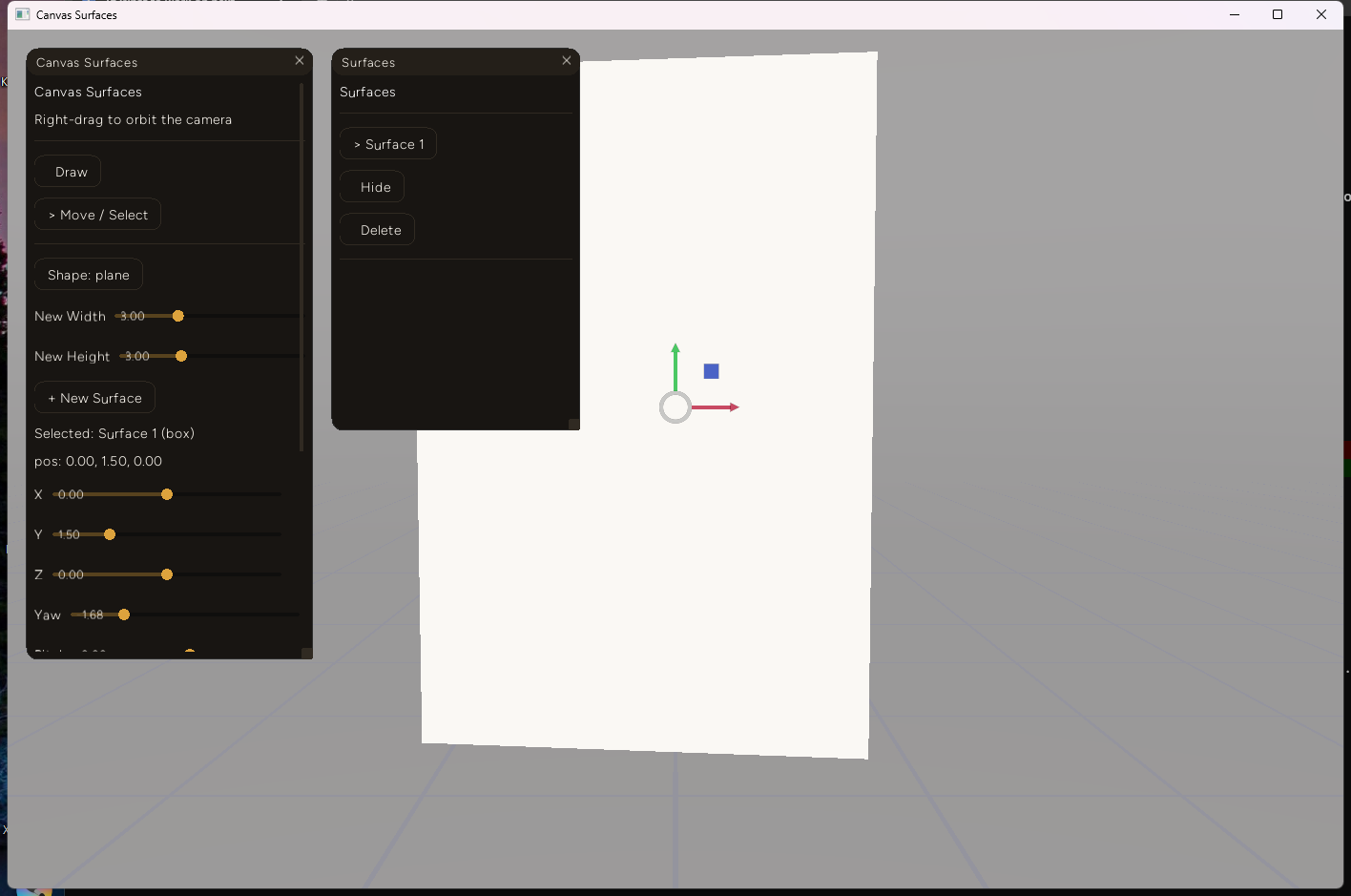
A box, rotated via its Yaw slider - the diagonal cut at bottom-left and the slanted top edge are the front face meeting a receding side face, not a flat card:
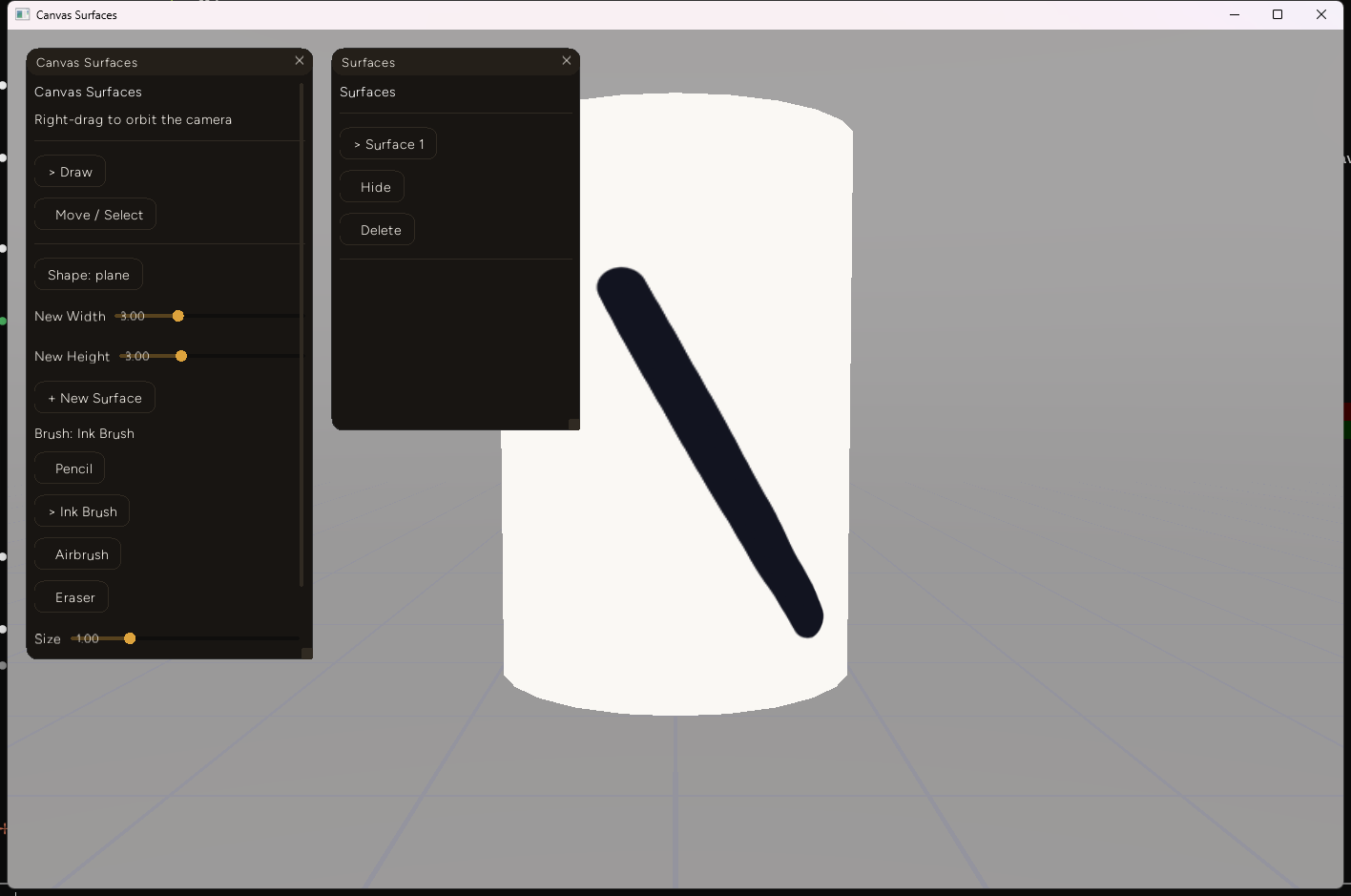
A diagonal ink stroke drawn with a synthetic mouse drag directly on a cylinder's curved side - continuous and undistorted, confirming the raycast tracks correctly across curved geometry:
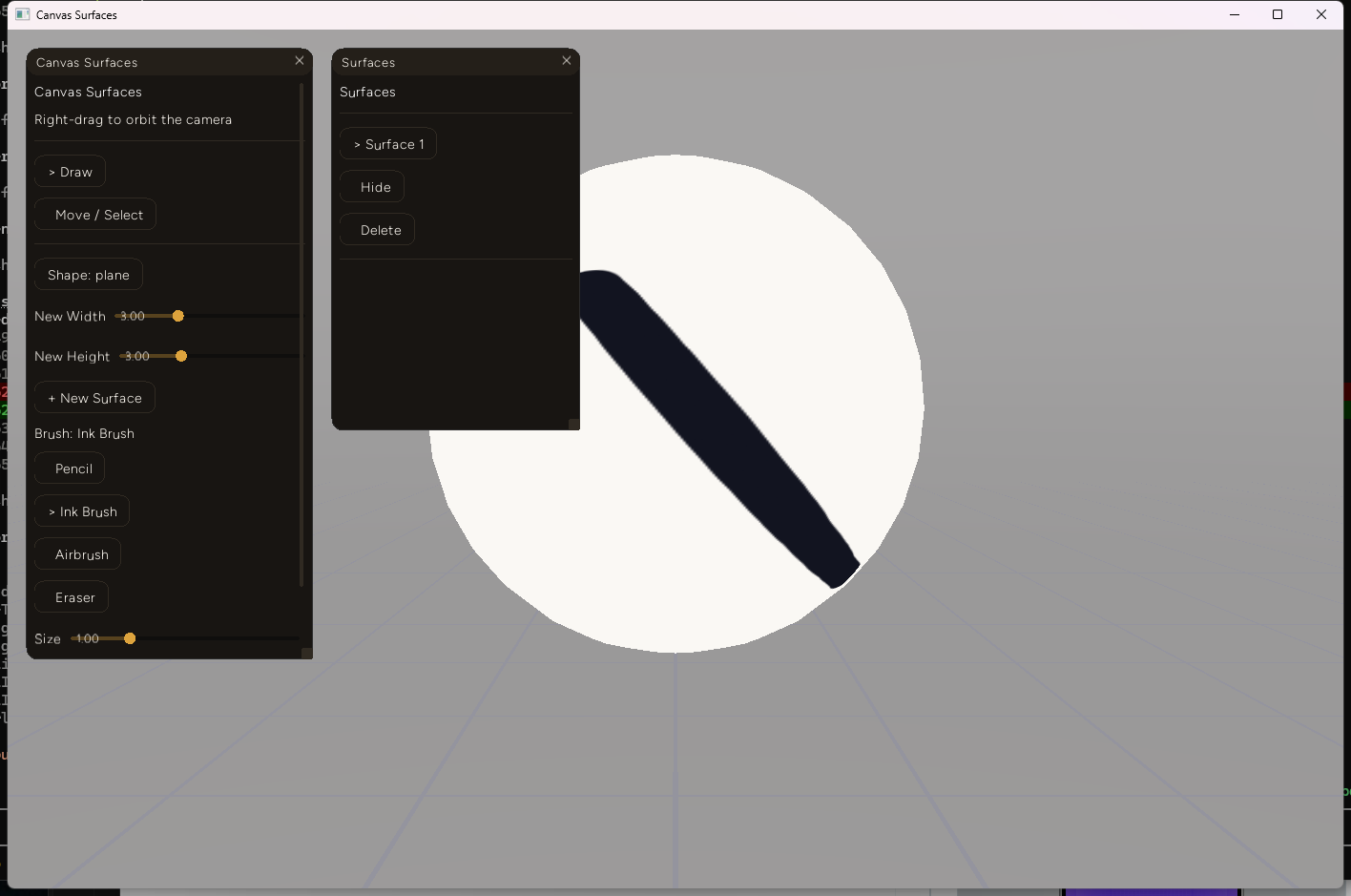
The same test on a sphere:
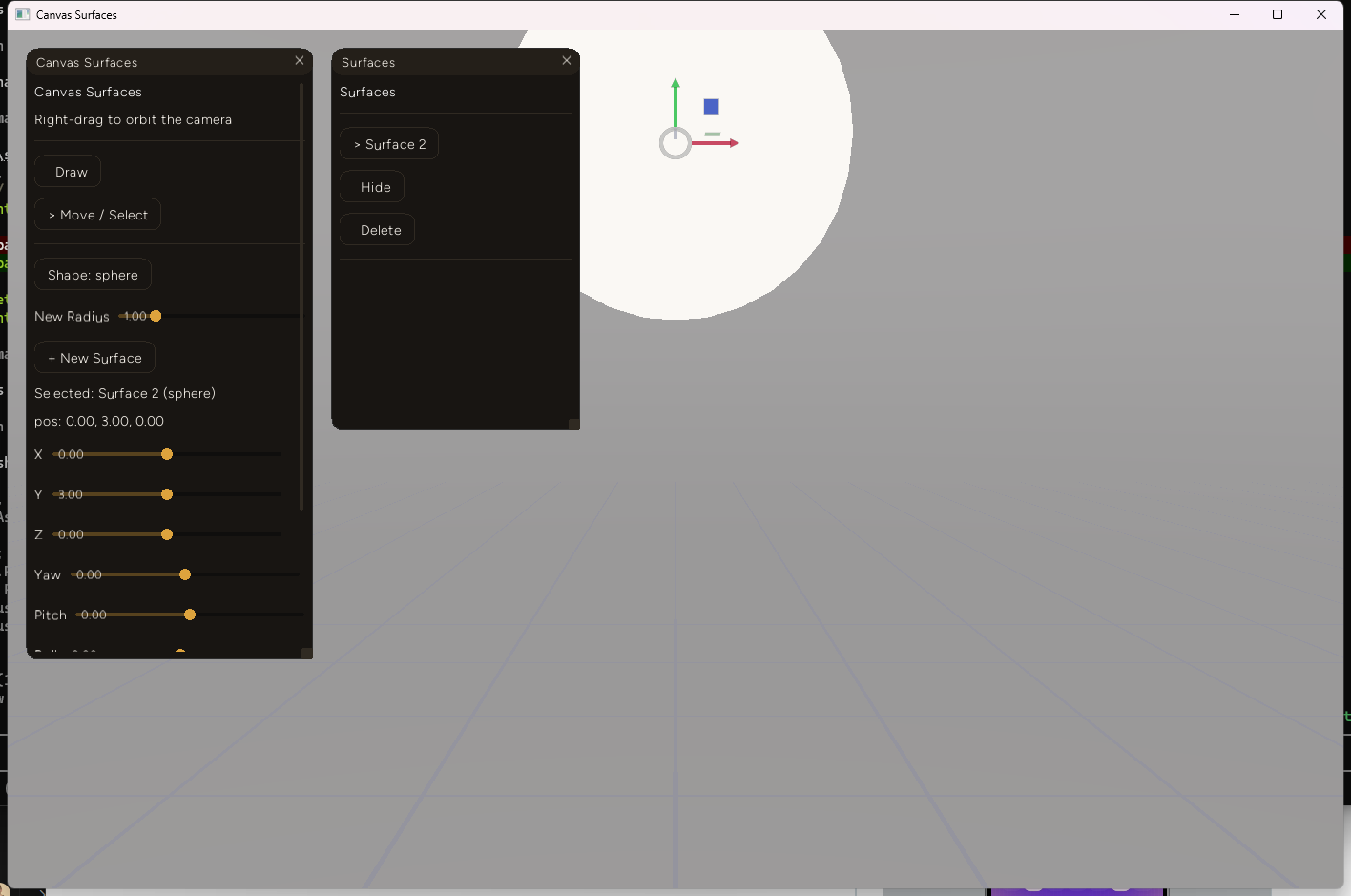
The full production path, not a direct function call: Shape cycled to "sphere" via its button, spawned with "+ New Surface," selected, and repositioned with the ordinary X/Y/Z sliders - gizmo attached and everything:
Decision log
- One shared
Patchabstraction over four separate mesh builders. The alternative - aswitchonkindinsidesurfaceMeshData,pushSurfaceTransform, andraycastSurfaceMesh- would have meant three copies of triangle-index math and three copies of the raycast loop, one per new shape, plus the plane's existing one. WritingPatchonce meant every one of those functions needed exactly zero new branches to support box/cylinder/sphere. - Automatic winding instead of hand-derived per shape. Deriving a triangle's correct diagonal by hand already produced a real (if caught) mistake once this session, for the ground-reference grid's own two triangles. Doing that by hand six more times (one per box face) for a feature this size wasn't worth the risk -
patchWindingtrades a few extra cross-product calls at mesh-creation time for zero chance of a silently-inverted face. - An atlas, not a texture per patch. Giving a box 6 separate textures (or a cylinder 3) would have meant multiplying every piece of per-surface state - canvas buffer, textureId, dirty flag - by however many patches a shape happens to have. Packing them into one shared texture kept every one of those exactly single, unchanged since Part 1.
- Bend stays plane-only. Cylindrically bending an already-curved shape (a box's flat face, sure, but a cylinder or sphere?) isn't a coherent operation the way it is for a flat plane, so it's simply not offered - the UI only shows Bend controls when
s.kind === "plane".
Failure notes
- A synthetic right-drag orbit near the camera's target washed the whole viewport out to near-white, repeatably, regardless of drag direction - not a shape bug. The orbit target sits at
[0, 1.2, 0], right next to a freshly spawned surface at[0, 1.5, 0]; a right-drag apparently moves the camera close enough to (or inside) that geometry that the screen fills with the surface's own blank canvas background color ([250, 248, 244], itself an off-white) seen at point-blank range. Verified by switching to rotating the object via its Yaw slider instead of orbiting the camera, which produced a normal, correctly framed view immediately - an orbit-versus-object-rotation distinction worth remembering for any future verification pass in this addon, not a defect in this session's actual feature work. - The demo's existing "+ New Surface" auto-layout positioned the second surface exactly on top of the first (
n=1mapped to the same[0, 1.5, 0]slot the very first plane already occupies) - a pre-existing quirk from Part 1, not introduced here, but it's what produced an apparently-blank viewport the first time a box was spawned via the real UI button in this session. Root-caused by deleting the first surface before spawning the second and by repositioning via the X/Y/Z sliders afterward, then fixed properly: the stagger grid now starts one slot ahead (surfaces.length + 1), so the first-ever click lands on a genuinely empty spot instead of silently overlapping the initial surface.
What's next
- Stroke/surface grouping, including nested groups (
canvas-surfaces-phase3-groupingon the project's task board - an unrelated numbering collision with this post's "Part 3," tracked before shapes were on the roadmap) - still blocked on the same fact as before: no native parent/child transform system for addon-spawned meshes. - Everything here is Windows-only, like the rest of this series - untested on any other platform.