When entropy_gui replaced egui/egui-snarl as the editor UI's foundation, one widget didn't survive the move: the node graph editor. egui-snarl's SnarlViewer needs a real &mut egui::Ui to draw pin-dragging, bezier-curve connections, and there was no way to hand it one once panels and docking moved onto entropy_gui::Ui instead. What shipped in its place was widgets_node_graph.rs's honest placeholder: a scrollable list of node names and from -> to connection strings, with a comment on it saying plainly that drawing new connections wasn't possible and that a real editor was follow-up work.
This post is that follow-up. entropy_gui now has a real node graph editor - pan, zoom, drag nodes, drag a link out of a pin and drop it on another, click a wire to delete it, embed actual interactive widgets inside a node's body - built generically enough that Studio's existing behavior-graph editor and a from-scratch nocode app can both use it. To prove it's not just box-drawing, the second half of this post is a small but genuine visual-scripting calculator built on it: drag a number, watch every downstream node recompute live.
What we're building
entropy_gui::NodeGraphEditor(src/entropy_gui/widgets_node_graph.rs, full rewrite) - a self-contained immediate-mode widget:GraphNode/GraphPin/GraphLinkare plain, domain-agnostic structs,show()returns aVec<NodeGraphEvent>instead of mutating anything, and a node can host real widgets in its body via a callback.- Two new
Memoryfields (node_drag,link_drag) plus aNodeGraphViewpan/zoom slot, so drags stay perfectly smooth even when the caller's node data isn't something the widget can hold a&mutinto (see below - this is the load-bearing design decision in the whole file). src/deno/addon_engine.rs'sUiWidget::Snarlarm rewired onto the new editor - and, while wiring it up, a real bug found and fixed insrc/deno/addon_setup.js's event router that had madeSnarlConfig.onNodeMovedsilently unreachable since the day it was declared.example_node_graph.rs+node_graph_addon.ts- "Nocode Calculator," a small visual-scripting demo (Number / Add / Multiply / Output nodes) proving the editor end to end: drag, connect, disconnect, zoom, and edit a value, and watch the whole downstream graph recompute.
The core design problem: who owns a node's position
Every other widget in this kit that drags something (Window's title bar, a timeline clip) works the same way: the caller hands over a &mut to its own data, the widget mutates it directly, and there's zero lag because paint and interaction read the same live value. That doesn't work here, because the Studio call site - UiWidget::Snarl { graph: BehaviorGraph, .. } - rebuilds its entire node list from JS-owned state fresh, every single frame. There's no persistent &mut Vec<Node> for the widget to hold onto between frames; by the time show() is called again, the caller has thrown away whatever it had before and handed over a brand new BehaviorGraph.
So NodeGraphEditor::show() takes nodes: &[GraphNode] - read-only - and returns events instead:
pub enum NodeGraphEvent {
    NodeMoved { node: String, pos: Pos2 },
    NodeClicked(String),
    BackgroundClicked,
    LinkCreated(GraphLink),
    LinkRemoved(usize),
    DeleteRequested(String),
}
The caller applies whichever ones it wants after the call. That alone would mean every drag frame lags one frame behind the mouse - a NodeMoved this frame only reaches the caller's own state on the next show() call, and if the caller never applies it at all (which, it turns out, was true for the pre-existing Studio call site until this session - more below), the node would appear to not move at all.
The fix is the same trick a lot of immediate-mode widgets use for exactly this problem: keep a transient, self-owned override during the drag, keyed by the dragging node's own interact id, and prefer it over the caller's node.pos for rendering:
pub struct Memory {
    // ...
    pub node_drag: Option<(Id, Pos2)>,
    pub link_drag: Option<LinkDrag>,
}
let title_id = editor_id.with(("node_title", &node.id));
let live_override = ctx.memory(|m| m.node_drag.clone()).filter(|(id, _)| *id == title_id).map(|(_, p)| p);
let effective_pos = live_override.unwrap_or(node.pos);
// ...
if title_resp.drag_started() {
ctx.memory_mut(|m| m.node_drag = Some((title_id, node.pos)));
} else if title_resp.dragged() {
let d = title_resp.drag_delta();
let new_pos = pos2(effective_pos.x + d.x / zoom, effective_pos.y + d.y / zoom);
ctx.memory_mut(|m| m.node_drag = Some((title_id, new_pos)));
events.push(NodeGraphEvent::NodeMoved { node: node.id.clone(), pos: new_pos });
}
if title_resp.drag_stopped() {
ctx.memory_mut(|m| m.node_drag = None);
}The override is cleared the instant the drag stops, so a cooperative caller that applies NodeMoved every frame sees zero snap-back (node.pos has already caught up by the time the override disappears), and an uncooperative one just gets a smooth drag that resets on release - correct-by-construction either way, instead of correct only if the caller behaves. Link-dragging uses the same shape of trick (Memory::link_drag, keyed by the source pin, holding just enough state to draw the live preview curve and check the drop target), for the same reason: creating a link mutates a Vec<GraphLink> the widget doesn't own either.
Connections are cubic beziers, sampled into a 20-segment polyline (this kit has no dedicated bezier-stroke primitive, just Painter::line_segment), and a click within 7px of any segment marks that link for removal:
fn bezier_points(p0: Pos2, p1: Pos2) -> Vec<Pos2> {
    let dx = (p1.x - p0.x).abs().max(40.0) * 0.5;
    let c0 = pos2(p0.x + dx, p0.y);
    let c1 = pos2(p1.x - dx, p1.y);
    const SEGMENTS: usize = 20;
    (0..=SEGMENTS).map(|i| {
        let t = i as f32 / SEGMENTS as f32;
        let mt = 1.0 - t;
        pos2(
            mt*mt*mt*p0.x + 3.0*mt*mt*t*c0.x + 3.0*mt*t*t*c1.x + t*t*t*p1.x,
            mt*mt*mt*p0.y + 3.0*mt*mt*t*c0.y + 3.0*mt*t*t*c1.y + t*t*t*p1.y,
        )
    }).collect()
}
Because the whole canvas is just pan/zoom-transformed screen coordinates - to_screen(p) = canvas_rect.min + pan + p * zoom - a node's optional body content is drawn by handing the caller's closure a completely ordinary Ui rooted at the node's already-transformed screen rect (Ui::child_ui_at). No special-casing was needed for that to work: a real DragValue or ComboBox dropped into a node body just works, hit-testing and all, because by the time any widget code runs, "where is this on screen" has already been resolved to real pixels. That's what lets the demo below put an actual editable number field inside a node instead of a static label.
The bug the demo found: a dead JS event handler that had never been reachable
examples/studio-bundle/src/addon.d.ts's SnarlConfig already declared onConnect, onDisconnect, and onNodeMoved callbacks, and addon_setup.js's snarl() binding already had the parsing logic to call them:
snarl: (windowId, config) => {
    // ...
    bindListener('_entropy_event_listeners', id, (eventData) => {
        const parts = eventData.split('|');
        const type = parts[0];
        if (type === "SNARL_CONNECT" && config.onConnect) { config.onConnect(parts.slice(2)); }
        else if (type === "SNARL_DISCONNECT" && config.onDisconnect) { config.onDisconnect(parts.slice(2)); }
        else if (type === "SNARL_NODE_MOVED" && config.onNodeMoved) {
            config.onNodeMoved(parts[2], [parseFloat(parts[3].split(',')[0]), parseFloat(parts[3].split(',')[1])]);
        }
    });
},
All of that was already there before this session, presumably written at the same time the read-only placeholder was - an API contract for a feature that didn't exist yet. None of it could ever run, because Rust never pushed a SNARL_* event for the read-only widget to have fired one.
Once I made the editor actually push these events, dragging a node in the demo app did... nothing. The window's own title bar dragged fine (proving the underlying active_drag mechanism and the mouse-simulation harness I was testing with both worked), but a graph node's title bar wouldn't move even after confirming (via a separate isolated test) that the click really was landing inside its rect. The node_drag preview override was working - I could tell because other interactions elsewhere in the same graph were unaffected - so the actual position update, onNodeMoved, wasn't reaching my addon's callback at all.
The cause was in the generic event router, addon_setup.js's _process_events, one level up from snarl():
} else if (event.startsWith("SNARL_CONNECT|") || event.startsWith("SNARL_DISCONNECT|")) {
    const parts = event.split("|");
    id = parts[1]; // snarl_id
    payload = event;
    isRaw = true;
} else if (event.startsWith("PIANOROLL_")) {
    // ...
} else if (event.includes("|")) {
    const parts = event.split("|");
    id = parts[0];
    payload = parts[1];
}
SNARL_CONNECT| and SNARL_DISCONNECT| get their own branch, routing on parts[1] (the actual snarl widget id). SNARL_NODE_MOVED| has no branch, so it falls through to the generic event.includes("|") case, which reads id = parts[0] - the literal string "SNARL_NODE_MOVED", not any widget's real id. No listener is ever registered under that key, so the event is dropped on the floor, silently, every time. onNodeMoved had been dead code since it was written, waiting for the one caller that would actually exercise it. Fixed by adding SNARL_NODE_MOVED| to the same branch as the other two.
This is the kind of bug that's structurally impossible to catch by reading the code carefully - both halves of it (the parser inside snarl(), the router in _process_events) look individually correct, and the mismatch only surfaces when something actually drives the whole path end to end. It's also exactly why the compile/run gate in this pipeline says "you have actually executed it," not "you've read it and it looks right."
Evidence
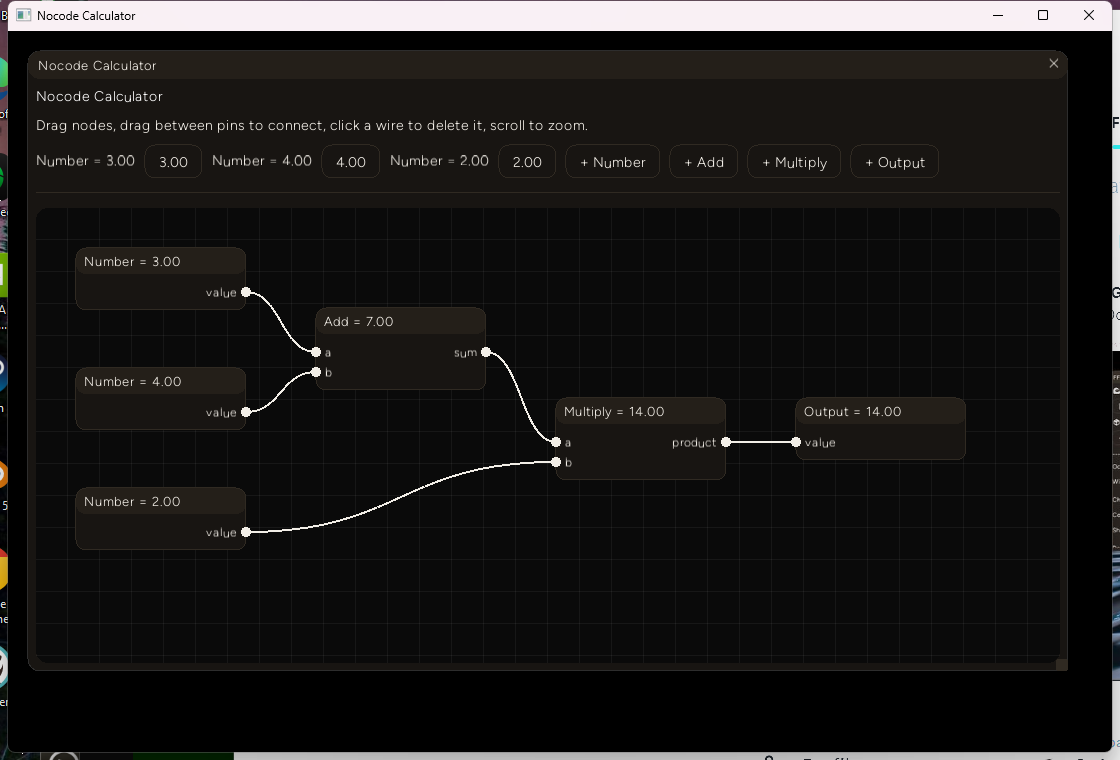
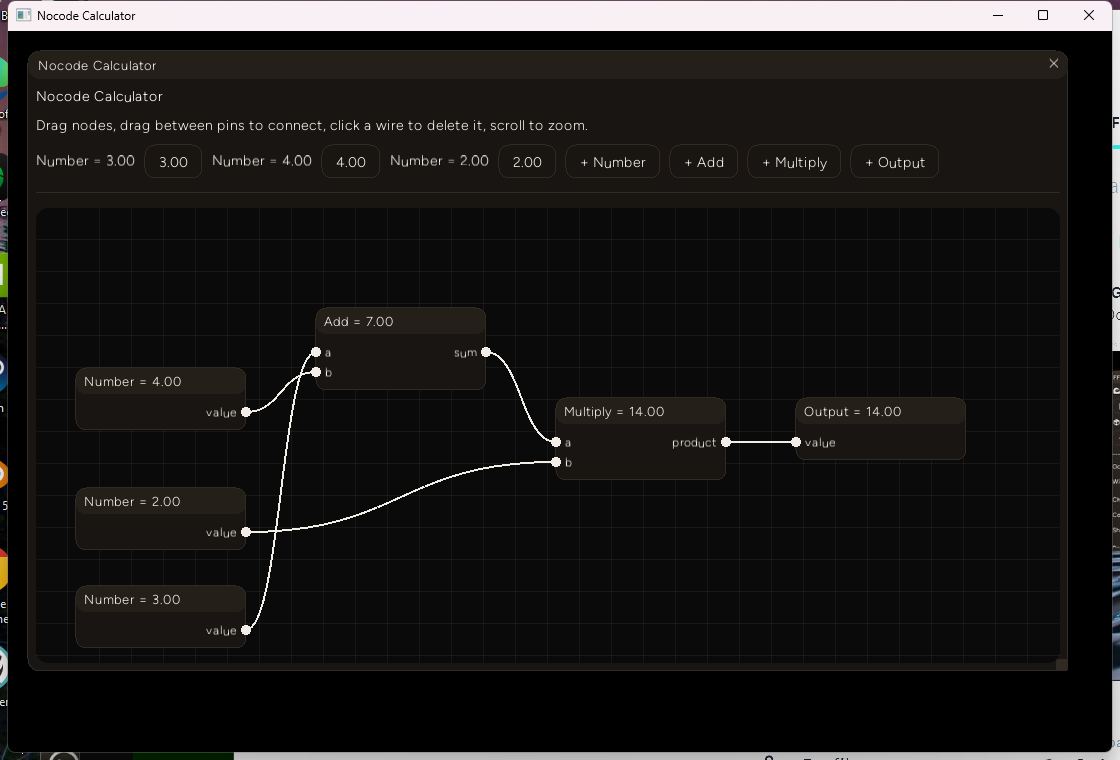
The demo - "Nocode Calculator" - wires three Number nodes through an Add, a Multiply, and an Output node. Node titles show live-computed values (node.name is just a plain string the addon controls, no special "value" field needed on the Rust side), and three numericInput widgets above the canvas edit the Number nodes directly.
Initial state, (3 + 4) * 2 = 14:
Dragging a node's title bar - the bottom Number = 3.00 node moved from the top of the column to the bottom, its wire following it, values unchanged:
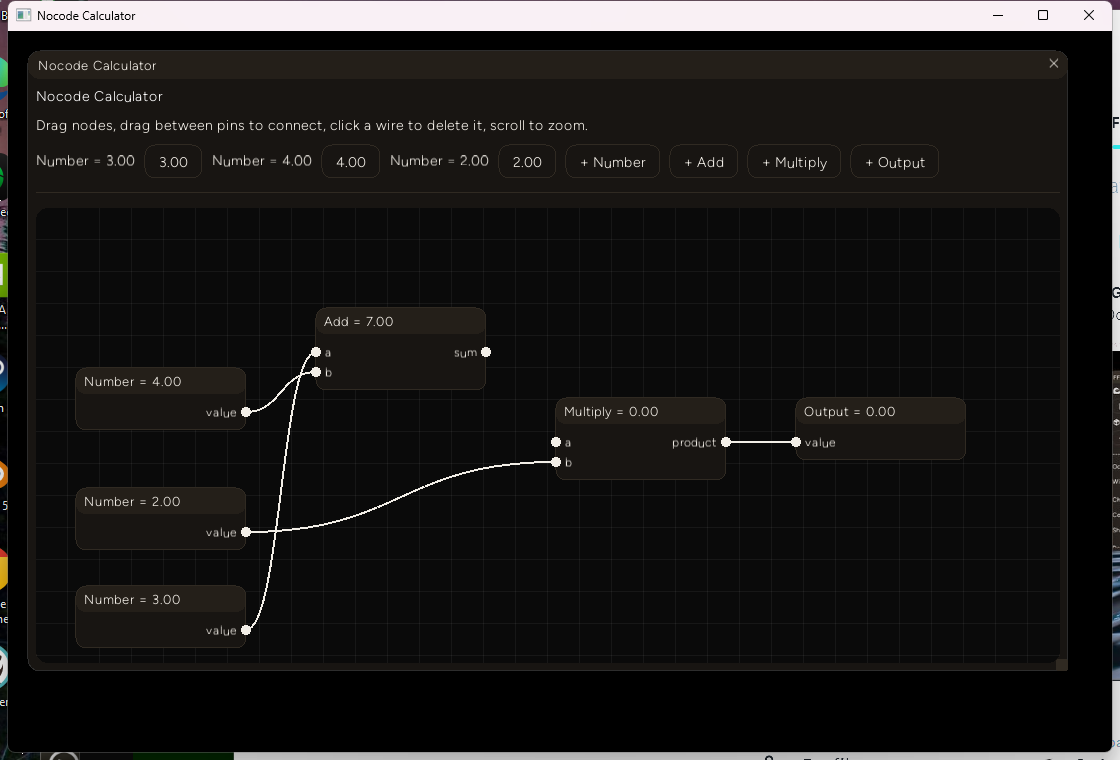
Clicking the Add -> Multiply wire deletes it - Multiply and Output both drop to 0.00 since Multiply.a lost its input:
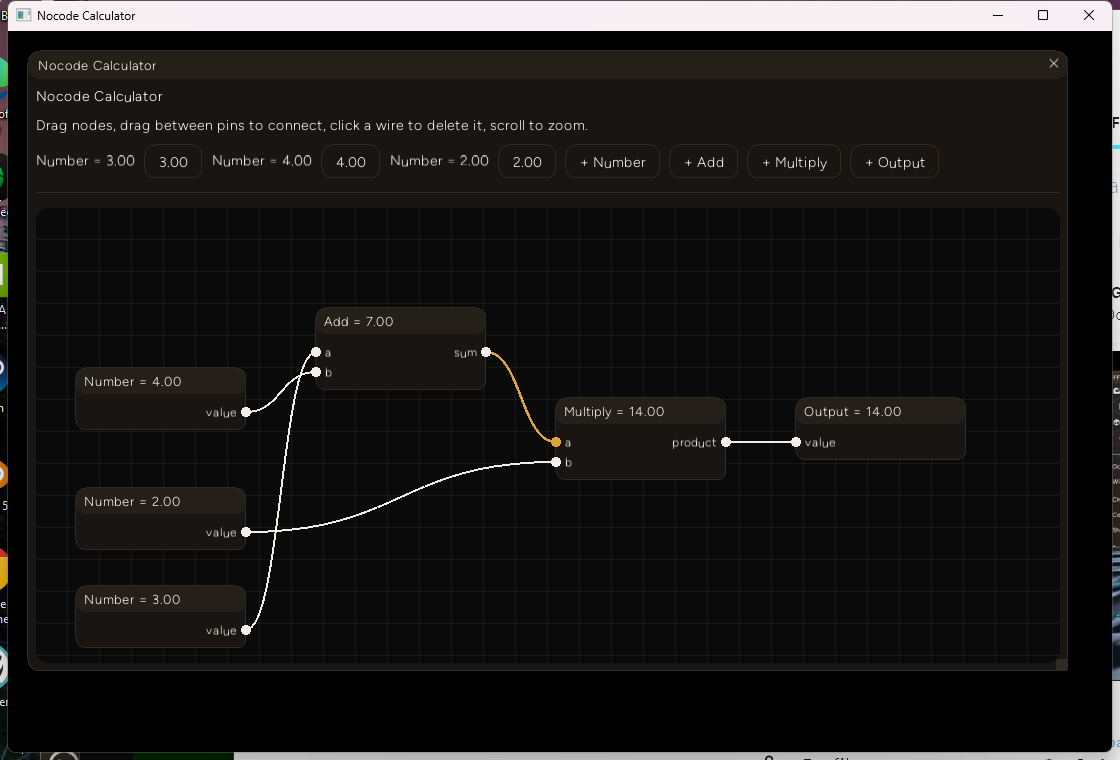
Dragging from Add's sum output pin back onto Multiply's a input pin reconnects it - the pin under the cursor is highlighted, and the graph recomputes back to 14.00:
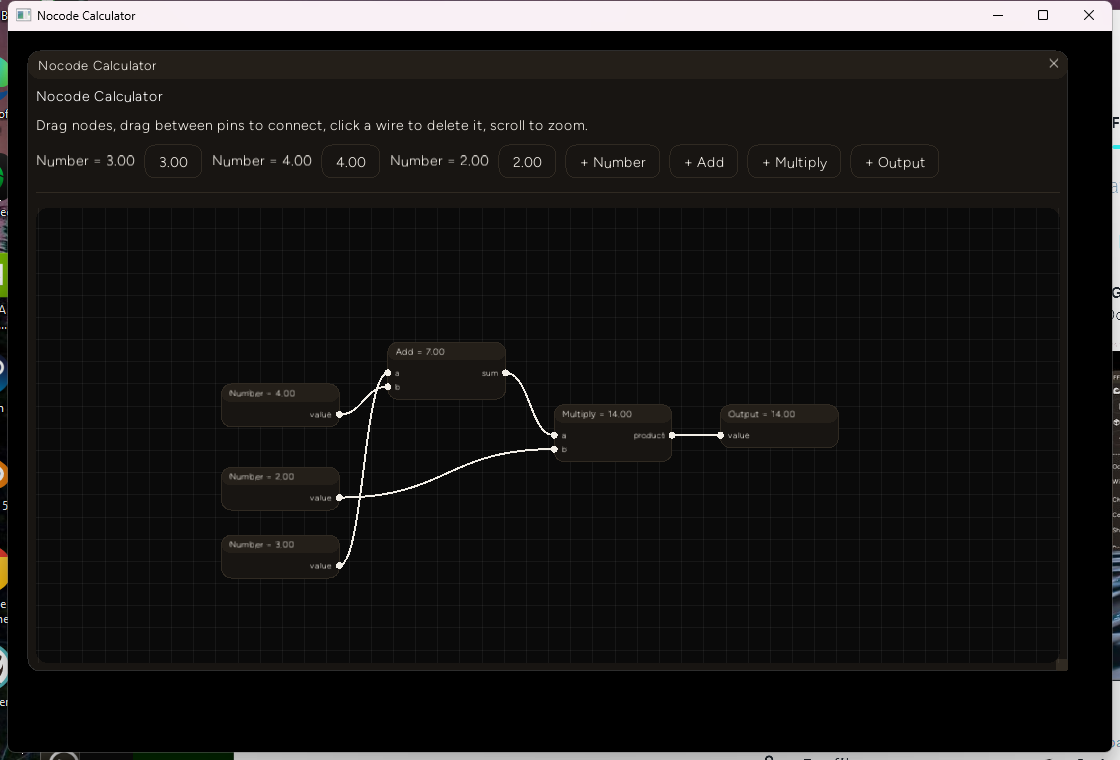
Scrolling to zoom out, anchored under the cursor - nodes, pins, wires, and the background grid all scale together, text included:
And dragging the Number node's own numeric input field (a real DragValue-style widget embedded in the toolbar, editing the same node data the graph reads) from 4.00 to 204.00 - Add, Multiply, and Output all recompute to 207.00 / 414.00 / 414.00:
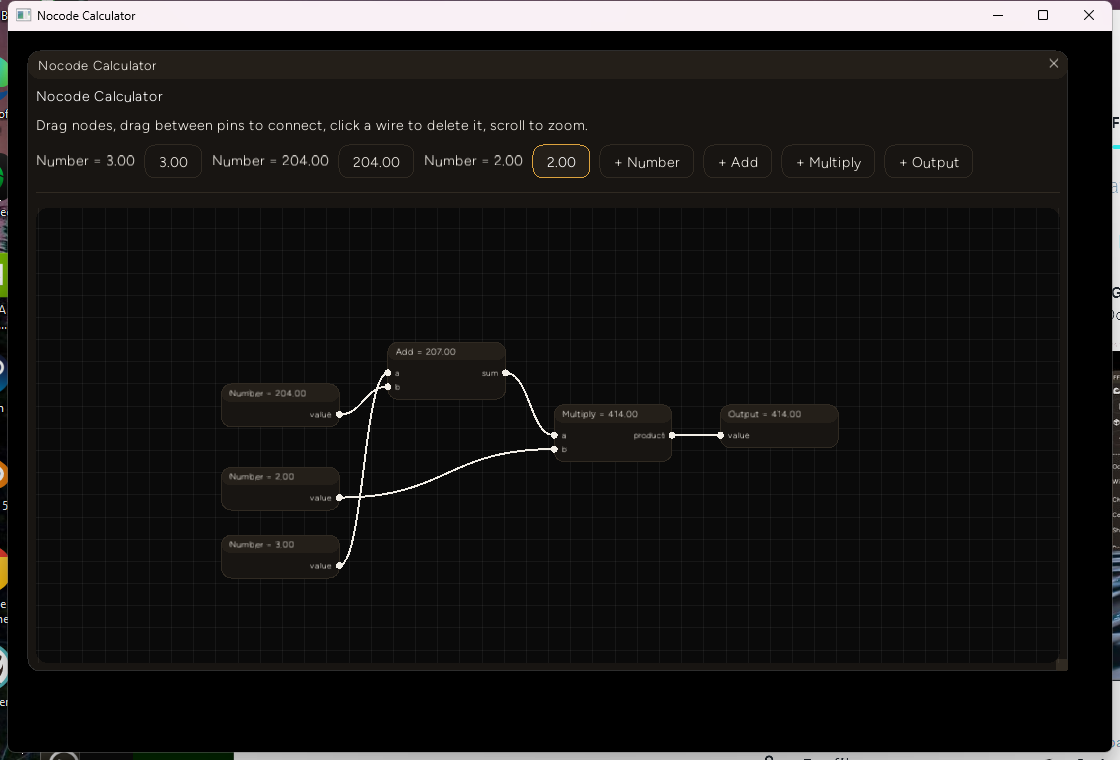
All six screenshots were captured against the actual running example_node_graph.exe, driven by synthetic SetCursorPos/mouse_event input (not just static renders) - each one is the real result of an actual click, drag, or scroll.
Decision log
Events out, not a &mut, even though it costs a frame of raw mutation. Covered above - the Studio call site genuinely can't hand over persistent ownership, so this was the only design that works for both callers. The node_drag/link_drag self-correcting overrides are what make the cost of that decision (a frame of lag on raw position) invisible in practice.
Array-order hit-testing, not draw-order (topmost-wins). Overlapping node rects resolve interaction in the order they appear in the nodes slice, not by which one is visually on top - a real gap if two nodes are ever dragged into overlap, but not one worth a second interaction pass for a v1. Documented in the widget's own module docs, not silently left as a surprise.
Left-drag pans the canvas; no middle-mouse. entropy_gui's PointerState only tracks primary/secondary buttons at all (context.rs), so middle-mouse pan wasn't an option without extending the input backend - out of scope for this session, and left-drag-to-pan on empty canvas is a normal convention anyway.
Node body content isn't zoom-scaled, only repositioned/resized. A DragValue inside a node at 0.5x zoom gets a smaller hit rect but full-size text - this kit doesn't do sub-pixel font scaling anywhere else either, so this isn't a new gap, just an existing one inherited into a new widget.
Fix the dead router branch, don't route around it. Once SNARL_NODE_MOVED| turned out to be silently unreachable, the tempting quick fix was to just format the Rust-side event differently so it happened to match the generic id|payload fallback. Fixing the actual router instead means the onConnect/onDisconnect pattern this file already established stays the one true way Snarl-family raw events get routed, instead of growing a second, inconsistent convention next to it.
Failure notes
The generic-drag branch swallowing background-pan wasn't the first bug I suspected - but it also wasn't a real bug. My first hypothesis for why dragging didn't work was that resolving the canvas's own pan-drag before iterating nodes would let an empty-canvas drag claim active_drag ahead of whatever node the mouse happened to be over, since a node's rect is a subset of the canvas rect. That would have been a real bug, so I structured show() to resolve node/pin interactions first and the canvas's own pan-drag last, deliberately relying on this kit's single-active-drag arbitration (first interact() call each frame wins) to make nodes take priority. Verified this ordering is in fact what's implemented before moving on - it turned out not to be the cause of the drag failure I was chasing (that was the router bug above), but it's a real correctness property regardless and worth having gotten right on the way.
Synthetic input debugging needed an isolation step before the real bug was findable. The first two drag attempts against the demo app produced literally zero visible change - not even the window shifting - which made "is my synthetic input even reaching the app" a live question before "is my widget logic correct" was. Testing against the floating overlay window's own title bar (a completely different, already-working piece of code using the same underlying active_drag mechanism) and watching it move exactly as expected ruled out the input harness and the general drag mechanism in one step, narrowing the search to the node-specific path - which is what led to finding the router bug above rather than chasing a phantom problem in interact() itself.
What's next
- Wire the new
NodeGraphEditorinto Studio's actual Game Composer behavior-graph UI (this session only proved the addon-facingSnarlAPI works via the standalone demo's ownonConnect/onDisconnect/onNodeMovedhandlers - the in-Studio behavior-graph editing flow that originally motivatedBehaviorGraphhasn't been touched). - A second interaction pass so overlapping nodes hit-test by paint order, not array order.
- Selection state:
NodeClicked/BackgroundClicked/DeleteRequestedare all emitted (andDelete/Backspacewhile a node is selected firesDeleteRequested), but nothing consumes them yet in either call site - noSnarlConfigcallback exists for selection or deletion the wayonConnect/onDisconnect/onNodeMoveddo. - A minimap and marquee (drag-select multiple nodes) - reasonable next asks for a graph with more than a handful of nodes, not attempted this session.
- Cycle detection in a caller's own evaluator isn't the editor's job, but is worth calling out: the demo's
evaluate()would recurse forever on a cycle the editor happily lets you draw. Fine for a five-node demo graph, not fine for anything meant to be robust against user error.