entropy_gui, the in-house immediate-mode kit that replaced the whole egui family a couple posts back, already had a real Style/Visuals system (src/entropy_gui/style.rs) and a Context::set_style that swaps it at runtime. What it didn't have was any way for an addon - the TypeScript side, which is where every example in this series actually builds its scene and UI - to reach that system. The only themes that existed lived as hardcoded Rust: Style::default()'s plain gray, and a second, unused-by-default "Ember" theme in src/core/egui_theme.rs that nothing outside that one file ever called.
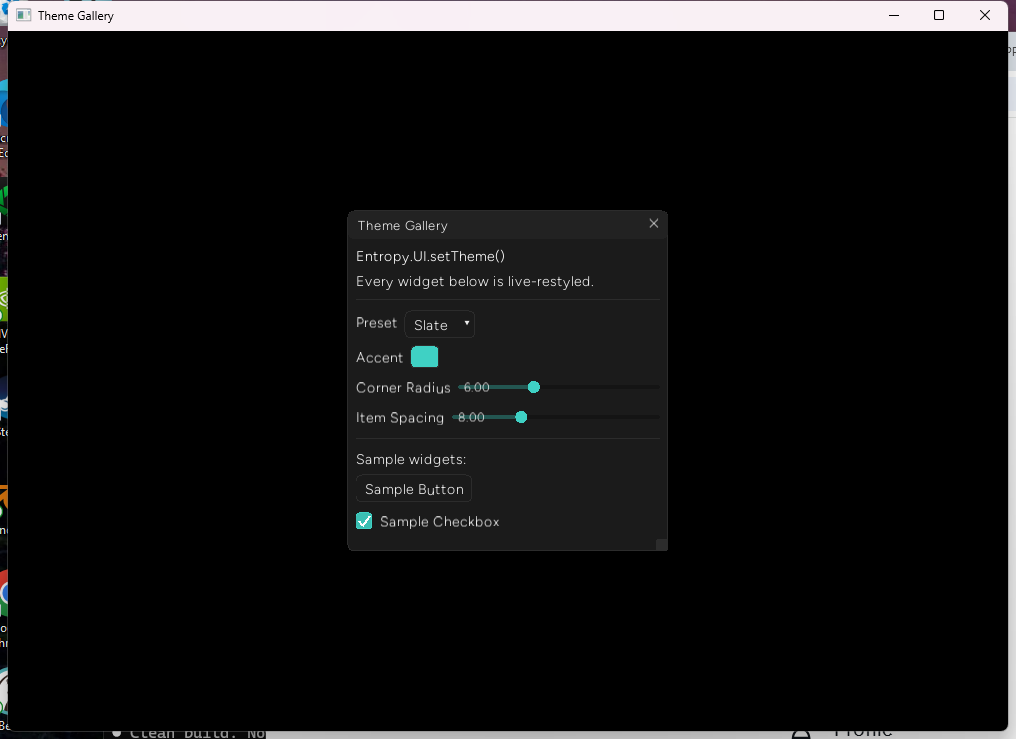
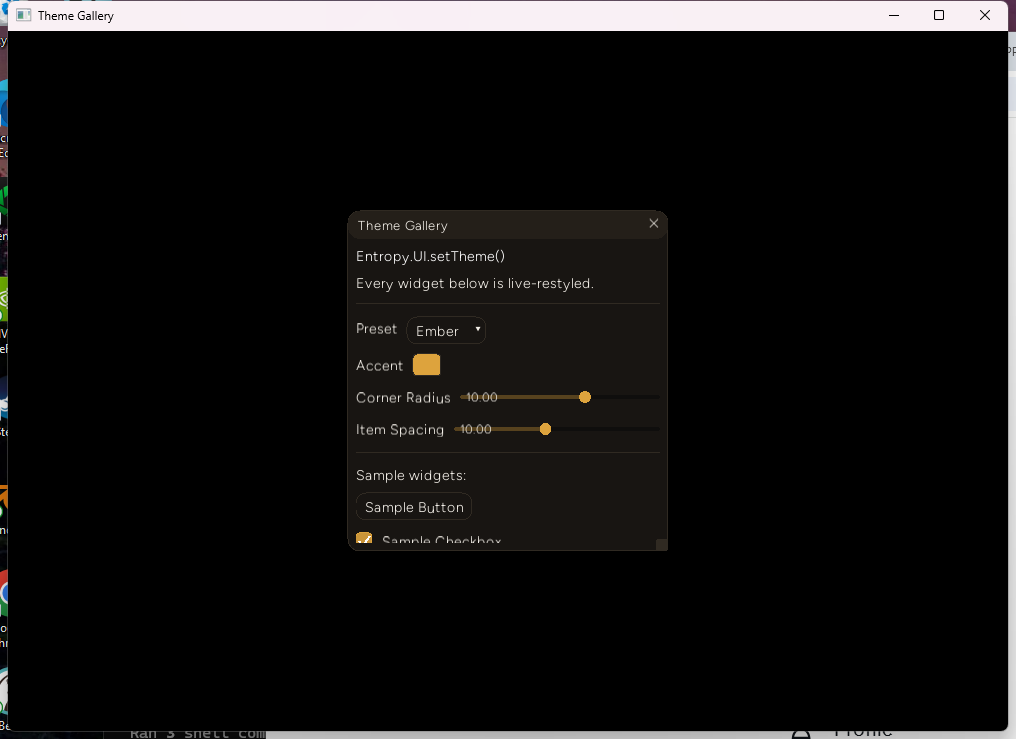
This post adds Entropy.UI.setTheme(...), an addon-facing op that describes a theme as data instead of Rust, and a small standalone example - a live theme gallery - that switches between presets (and tweaks individual colors/spacing) while the app is running, with every widget in the window, including the picker itself, restyling live.
What's out of scope here
No light-mode palette. Visuals hardcodes dark_mode: true throughout style_from_theme (inherited from the pre-existing slate_style() this replaces) - a light theme would need real light-mode contrast tuning per widget state, not just inverted colors, and nothing in this pass touches that. Also out of scope: persisting a chosen theme to disk. Entropy.UI.setTheme is a pure runtime call; an addon that wants a theme to survive a restart already has Entropy.Addon.saveData for that (used elsewhere in this series, e.g. the FFT ocean's currentParams) and can call setTheme again from its own saved state at onInit - no new persistence mechanism was needed or added.
Describing a theme as data
style_from_theme (src/entropy_gui/style.rs) takes a ThemeDescriptor - every field Option, so an addon only names what it wants to change - and fills in whatever's missing with the same values the old hardcoded slate_style() used:
#[derive(Debug, Clone, Default, Deserialize)]
#[serde(rename_all = "camelCase")]
pub struct ThemeDescriptor {
    pub background: Option<[f32; 4]>,
    pub surface: Option<[f32; 4]>,
    pub surface_hover: Option<[f32; 4]>,
    pub border: Option<[f32; 4]>,
    pub text: Option<[f32; 4]>,
    pub accent: Option<[f32; 4]>,
    pub corner_radius: Option<u8>,
    pub window_corner_radius: Option<u8>,
    pub item_spacing: Option<f32>,
    pub button_padding: Option<[f32; 2]>,
}

pub fn style_from_theme(theme: &ThemeDescriptor) -> Style {
    let bg = theme.background.map(Color32::from_rgba_f32).unwrap_or(Color32::from_rgb(0x14, 0x14, 0x14));
    let accent = theme.accent.map(Color32::from_rgba_f32).unwrap_or(Color32::from_rgb(0x3F, 0xD1, 0xC4));
    // ... same pattern for surface/border/text/corner_radius/item_spacing/button_padding
    // ... then the same Style{ visuals: Visuals{ widgets: Widgets{ ... } } } construction
    // slate_style() previously built inline, now built from these locals instead of literals
}

pub fn slate_style() -> Style {
    style_from_theme(&ThemeDescriptor::default())
}
slate_style() used to be the only place this color palette lived, and - a small surprise while reading the code - it turned out to already be dead code: Style::default() builds Visuals::dark() directly, so nothing was actually calling slate_style() before this change either. Rather than leave that as a second unused function, it's now style_from_theme fed an all-None descriptor - one palette, one place it's written down, whether an addon overrides anything or not.
Colors are [f32; 4] in 0..1, matching the convention Widget.colorInput already used - no separate hex-string format to support on the Rust side. (The example addon below adds a small hex() helper on the JS side for readability, but that's a convenience in TypeScript, not a second format the engine has to parse.)
Wiring it through the op layer
Addon ops don't touch entropy_gui::Context directly - every existing UI op (op_ui_create_window, op_ui_widget_slider, etc.) writes into AddonContext, a deno_core::OpState-resident struct that AddonEngine::render_ui/render_tabs reads back each frame. Theming follows the same shape:
// src/deno/addon_ops.rs
#[op2]
pub fn op_ui_set_theme(state: &mut OpState, #[serde] theme: crate::entropy_gui::style::ThemeDescriptor) {
    if let Some(ctx) = state.try_borrow_mut::<AddonContext>() {
        ctx.pending_theme = Some(theme);
    }
}
// src/deno/addon_engine.rs
fn apply_pending_theme(&mut self, ctx: &egui::Context) {
let theme = {
let mut op_state = self.runtime.op_state();
let op_state = op_state.borrow();
op_state.try_borrow::<AddonContext>().and_then(|c| c.pending_theme.clone())
};
if let Some(theme) = theme {
ctx.set_style(egui::style_from_theme(&theme));
}
}apply_pending_theme is called at the top of both render_ui (Studio's per-viewport docking path) and render_tabs (the generic full-window tab bar a standalone EntropyApp uses - every example bin in this series, including the new one below, goes through this path only). It re-applies every frame instead of draining pending_theme with .take(), because the normal call pattern is "call setTheme once, from a dropdown's onChange" - the style has to keep holding on every subsequent frame, not just the one right after the call. The cost is trivial: building a Style from a handful of Option<[f32; 4]>s every frame, not an allocation-heavy operation.
On the JS side, the wrapper is close to a pass-through:
// src/deno/addon_setup.js
setTheme: (theme) => {
    ops.op_ui_set_theme(theme || {});
},
The theme gallery example
examples/studio-bundle/src/theme_gallery_addon.ts + src/bin/example_theme_gallery.rs, following the same minimal-bin pattern as the media player example - all the logic lives in the addon, the bin is three lines:
// src/bin/example_theme_gallery.rs
entropy_engine::EntropyApp::new()
    .with_bundle("examples/studio-bundle/dist/theme_gallery.js")
    .with_hot_reload(true)
    .with_title("Theme Gallery")
    .with_window_size(1000.0, 700.0)
    .run()
    .expect("Couldn't run app");
Four presets, one of which is a straight port of egui_theme.rs's old "Ember" theme (previously ~90 lines of hardcoded WidgetVisuals structs, now nine lines of data) and one of which is "Nocturne" - that same file's docstring named it as a mocked-up-but-never-built third direction, so this is the first time it actually exists as a running theme:
function hex(h: string, a = 1): [number, number, number, number] {
    const v = parseInt(h.replace("#", ""), 16);
    return [((v >> 16) & 255) / 255, ((v >> 8) & 255) / 255, (v & 255) / 255, a];
}

const PRESETS: { name: string; theme: ThemeConfig }[] = [
    { name: "Slate", theme: {} }, // {} = every field falls back to setTheme's own default
    { name: "Ember", theme: {
        background: hex("#0F0E0D"), surface: hex("#181512"), surfaceHover: hex("#241F19"),
        border: hex("#302A22"), text: hex("#F2EEE7"), accent: hex("#DDA33D"),
        cornerRadius: 10, windowCornerRadius: 12, itemSpacing: 10,
    }},
    { name: "Nocturne", theme: {
        background: hex("#0B0D14"), surface: hex("#121621"), surfaceHover: hex("#1A2030"),
        border: hex("#242C3E"), text: hex("#E8ECF4"), accent: hex("#6C8EEF"),
        cornerRadius: 4, windowCornerRadius: 6, itemSpacing: 8,
    }},
    { name: "Verdant", theme: {
        background: hex("#0D120E"), surface: hex("#151D17"), surfaceHover: hex("#1E2921"),
        border: hex("#28362C"), text: hex("#E9F1EA"), accent: hex("#5CC87A"),
        cornerRadius: 8, windowCornerRadius: 10, itemSpacing: 9,
    }},
];
The window itself is built entirely from existing Entropy.UI.Widget calls - a preset dropdown, a live accent-color picker, two sliders, and a couple of sample widgets purely so more than one widget type is visibly reacting to the theme at once:
let selectedPreset = 0;
let currentTheme: ThemeConfig = { ...PRESETS[0].theme };

function applyTheme() {
    Entropy.UI.setTheme(currentTheme);
}

Entropy.UI.Widget.dropdown(win, {
    label: "Preset",
    options: PRESETS.map(p => p.name),
    selectedIndex: selectedPreset,
    onChange: (v) => {
        selectedPreset = parseInt(v as unknown as string, 10);
        currentTheme = { ...PRESETS[selectedPreset].theme };
        applyTheme();
    }
});

Entropy.UI.Widget.colorInput(win, {
    label: "Accent",
    color: currentTheme.accent || hex("#3FD1C4"),
    onChange: (c) => {
        currentTheme = { ...currentTheme, accent: c as [number, number, number, number] };
        applyTheme();
    }
});
Picking a preset resets currentTheme to that preset's fields; the accent picker and the two sliders then merge their own change on top of whatever preset is active, so "start from Ember, nudge the accent" works without extra plumbing.
Evidence
Same machine as the last few posts: Intel UHD Graphics 770 (integrated), i5-12500, 32GB RAM, Windows 11 Pro 10.0.26200.
cargo build --bin example_theme_gallery
cd examples/studio-bundle && deno bundle src/theme_gallery_addon.ts > dist/theme_gallery.js
./target/debug/example_theme_gallery.exe
Clean build (cargo check --lib and the full cargo build --bin example_theme_gallery both finished with no warnings on this diff), clean deno bundle run, clean startup log with no errors. Launched, screenshotted at the default "Slate" theme, then clicked the preset dropdown and selected "Ember" - live, no restart - and screenshotted again:
First-party diff, git diff --stat plus the two new files:
examples/studio-bundle/src/addon.d.ts | 18 ++++++++++
src/deno/addon_engine.rs              | 24 ++++++++++++-
src/deno/addon_ops.rs                 | 14 ++++++++
src/deno/addon_setup.js               |  7 ++++
src/entropy_gui/mod.rs                |  2 +-
src/entropy_gui/style.rs              | 66 ++++++++++++++++++++++++++---------
6 files changed, 112 insertions(+), 19 deletions(-)
 + examples/studio-bundle/src/theme_gallery_addon.ts (new)
 + src/bin/example_theme_gallery.rs (new)
Decision log
- Every
ThemeDescriptorfield isOption, filled from the existing default palette. An addon that only wants a different accent color shouldn't have to restate the whole theme to get it - and there's exactly one place (style_from_theme'sunwrap_orchain) where "what does an unset field mean" is decided, not one per call site. - Applied every frame, not drained with
.take().Entropy.UI.setThemeis normally called once, from a widget'sonChange. Ifapply_pending_themeconsumed the value, the style would revert to default the very next frame after the call that set it. - Colors stay
[f32; 4]in 0..1 on the Rust/op boundary, matchingWidget.colorInput's existing convention, rather than adding hex-string parsing to the engine. Hex convenience lives in the example addon's ownhex()helper, in TypeScript, where it costs nothing to add and doesn't grow the op's surface. slate_style()became a wrapper aroundstyle_from_theme(&ThemeDescriptor::default())instead of staying a separate hardcoded function next to the new parametrized one. It was already unused dead code before this change (Style::default()callsVisuals::dark()directly) - collapsing it removed a second copy of the same palette rather than adding a third.- No new addon-facing lifecycle hook. Unlike the hot-reload work a few posts back, this didn't need any callback-registry bookkeeping -
render_ui/render_tabsalready run every frame, so a plainOpStatefield plus a per-frame check was the whole mechanism.
Failure notes
Widget.dropdown'sonChangehands back the selected index as a string, not a number ((index: string) => voidinaddon.d.ts, unrelated to this change - the event bus that carries widget interactions back into JS passes every payload as a string, and dropdown never special-cased it). Nothing broke, but the preset picker neededparseInt(v as unknown as string, 10)where a plain number would have been the more obvious API - worth knowing before wiring another dropdown.- Only "Slate" and "Ember" were exercised against a running window this session. Both are what the two screenshots above show, confirmed live. "Nocturne" and "Verdant" go through the identical
style_from_themecode path with no special-casing per preset, but weren't independently screenshotted - said plainly rather than implied as equally verified.
What's next
- A light-mode palette, if a future embedder actually wants one - deliberately scoped out here since it needs real per-widget-state contrast tuning, not a color inversion.
- Screenshot "Nocturne" and "Verdant" directly, closing the gap in the failure notes above.
- Wire
setThemeintoEntropyAppitself (a.with_theme(ThemeDescriptor)builder method, mirroring.with_title()/.with_window_icon()from the window-config post), so an embedder can set a starting theme before any addon code runs, instead of every addon having to callsetThemefrom its ownonInit.