The FFT ocean addon generates its wave spectrum with Phillips - open-water physics, tuned for wind blowing across a large fetch. A river channel isn't that: the wind can only act on the water across the width of the channel, not for kilometers, so the spectrum should have a sharp, narrow peak around one dominant wavelength instead of Phillips' broad open-ocean spread. JONSWAP is the standard fetch-limited alternative, and fft_water_addon.ts already had it written - as dead code, commented out at the call site, left for "maybe for rivers" in a code comment.
This post is that maybe. fft_river_water_addon.ts is a new, standalone addon: JONSWAP-driven FFT water confined to a meandering channel carved into procedurally-generated terrain, with a texture-space scroll hack layered on top so the wave pattern visibly moves downstream. It's not a modification of the ocean addon - it's a fresh file that reuses the ocean's compute pipeline structure (spectrum init, time-evolution, FFT butterfly passes, displacement/derivatives) and replaces everything specific to "this is open water."
What we're building
examples/studio-bundle/src/fft_river_water_addon.ts(1,058 lines) - JONSWAP spectrum instead of Phillips, a sine-meandering channel carved into fbm-noise terrain via distance-to-centerline, a UV-scroll advection trick for downstream flow, and a procedural ground texture.src/bin/example_fft_river.rs- an 11-line standalone binary, same pattern as every other Entropy example app this series has built.- Terrain heightfield generated with the same noise stack (
simplex-noise'screateNoise2D, seeded throughalea) theflexnoise_v2.tsFlexNoise terrain addon already uses elsewhere in the repo - not a new terrain system, a reuse of an existing one.
JONSWAP vs. Phillips
The spectrum swap is the physical premise of the post, so it's worth being precise about what changed. Phillips (phillips_spectrum in the shader, kept in the file for reference but unused) models a fully-developed open sea: broad frequency spread, driven by wind speed and a damping term at high wavenumbers. JONSWAP adds a peak-enhancement factor (gamma = 5.3, per the standard fetch-limited formulation) on top of a Pierson-Moskowitz base shape, which narrows the spectrum around a dominant wave number tied to wind speed and gravity:
fn jonswap_spectrum(wave_vector: vec2<f32>) -> f32 {
    let wave_number = length(wave_vector);
    if (wave_number < 0.0001) {
        return 0.0;
    }

    let omega_p = 0.87 * params.gravity / params.wind_speed;
    let peak_wave_number = (omega_p * omega_p) / params.gravity;

    let alpha = 0.0081;
    let beta  = 1.25;
    let pm_shape = (alpha / (wave_number * wave_number * wave_number * wave_number))
                 * exp(-beta * pow(peak_wave_number / wave_number, 2.0));

    let gamma         = 5.3;
    let sigma         = select(0.09, 0.07, wave_number <= peak_wave_number);
    let peak_enhancement = pow(gamma, peak_exponent);
    // ... directional spreading + capillary damping, then combined below
}
Practically, this makes the river's wave field visually tighter and more ripple-like than the ocean's broad swell - which is the point: a channel a few dozen world-units wide shouldn't be generating ocean-scale wave trains.
Carving a channel into noise terrain
The channel center follows a sine wave in world-Z:
function channelCenterX(worldZ: number): number {
    return MEANDER_AMPLITUDE * Math.sin((2 * Math.PI * (worldZ + FIELD_SIZE / 2)) / MEANDER_WAVELENGTH);
}
The heightfield builder walks the landscape grid, computes each point's distance to the channel centerline at that row's world-Z, and picks one of two paths: inside CHANNEL_HALF_WIDTH it's a flat floor (height 0, so the FFT water ribbon sits in a clean flat bed); outside it, an fbm noise value (5 octaves, persistence 0.5, lacunarity 2.0, via simplex-noise seeded through alea) is blended in over BANK_WIDTH so the banks ramp smoothly from flat channel floor into rolling terrain instead of a hard plateau edge:
if (d <= CHANNEL_HALF_WIDTH) {
    h = 0.0;
} else {
    const terrainHeight = (fbm2D(noise2D, worldX, worldZ, TERRAIN_OCTAVES, TERRAIN_FREQUENCY, TERRAIN_PERSISTENCE, TERRAIN_LACUNARITY) + 1) / 2;
    const bankT = Math.min(1.0, (d - CHANNEL_HALF_WIDTH) / BANK_WIDTH);
    h = bankT * terrainHeight;
}
The water ribbon mesh uses the same channelCenterX function to place its own geometry, so the two never drift apart even though they're built independently.
The flow illusion
Rivers flow; a stationary FFT wave field doesn't. The fix here is a UV-scroll on the displacement/derivative textures in the render shader, driven by a flow_params uniform - and it works cleanly with zero seams specifically because an FFT-generated height field is periodic by construction. fract() on a scrolled UV just wraps into the next tile of the same seamless field; scrolling a normal photographed texture the same way would show a visible seam every wrap. But it's worth being direct about what this is not, because the file's own comment already says so and I'm not going to smooth it over: it's not a real flow or advection solve. No momentum, no interaction with the channel banks, no speedup through narrow sections. It's a texture-space trick on top of a stationary wave spectrum, and it reads correctly at a glance but wouldn't survive, say, a floating object actually needing to feel current.
Evidence
Built clean in release: cargo build --release --bin example_fft_river (86s, this session, this machine). Bundled via deno bundle src/fft_river_water_addon.ts > dist/fft_river.js, then ran example_fft_river.exe and screenshotted the live window:
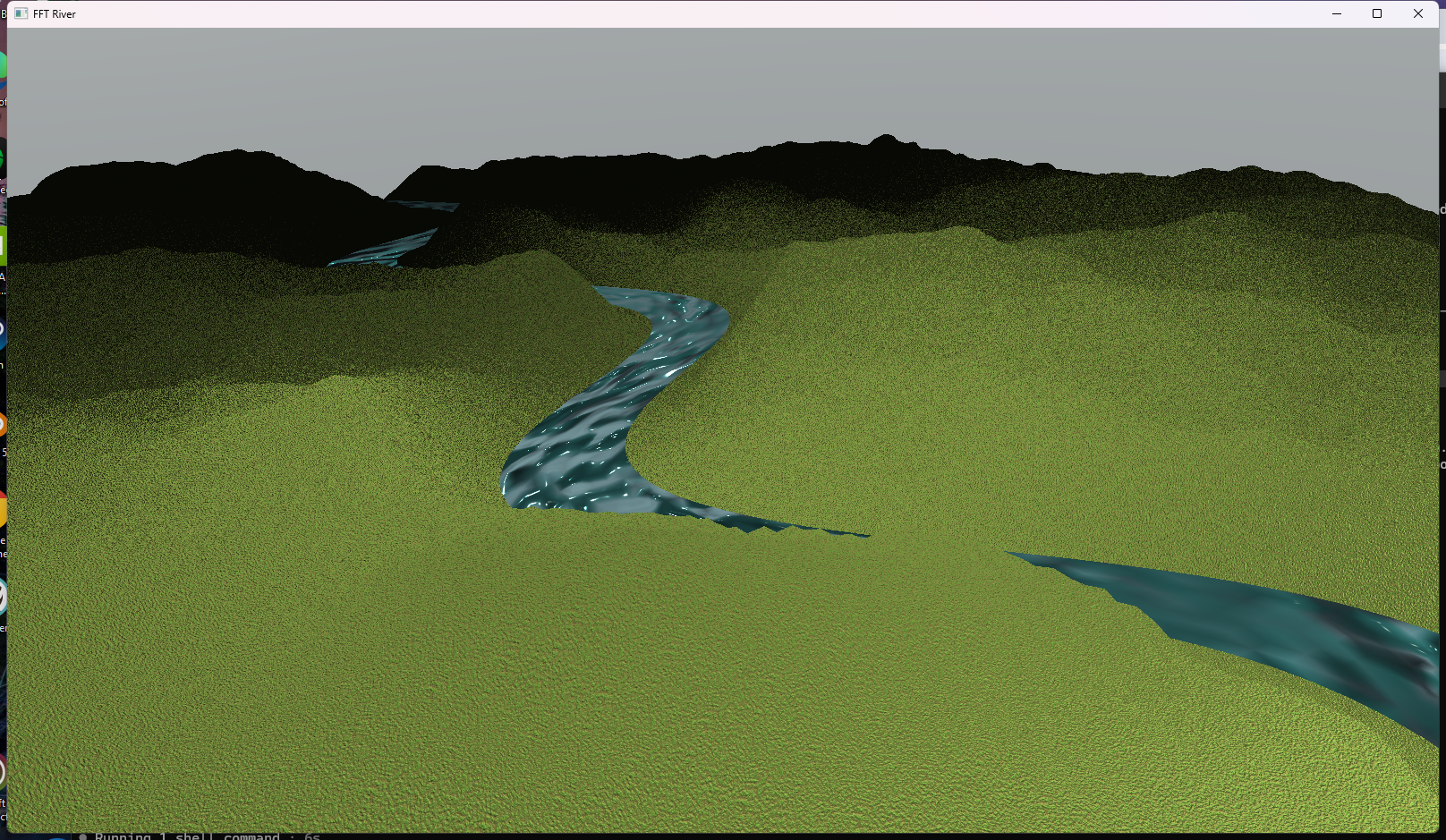
(Screenshot captured this session against the actual running binary, after fixing the bundling issue described below.)
Runtime log came up clean - no panics, no shader-compile errors, landscape collider and bind groups built successfully on the first real run after fixing the bundling issue below.
Decision log
- JONSWAP over Phillips for the spectrum, not a new spectrum model. The physical justification (fetch-limited vs. open-water) is real and the shader math was already sitting unused in the ocean addon - reusing it was strictly less work and more correct than inventing something channel-specific.
- UV-scroll advection over a real flow solve. A real flow field (velocity-driven advection, bank interaction, speedup in narrow sections) is a much larger problem - closer to the ripple simulation's leapfrog wave-equation work than a texture trick. The scroll hack was chosen because it's visually convincing for a screenshot/flythrough and because the FFT field's periodicity makes it seamless for free. It's flagged as a known simplification, not shipped as if it were physically accurate.
- Reuse
flexnoise_v2.ts's noise stack instead of a new terrain generator.simplex-noise+aleawas already proven elsewhere in the repo for exactly this kind of fbm terrain; there was no reason to pull in a different noise library or hand-roll one for a one-off channel carve. - A fresh standalone file, not a modification of the ocean addon.
fft_water_addon.tsstayed untouched. The river addon copies and adapts the compute-shader structure rather than parameterizing the ocean file to branch between "ocean mode" and "river mode" - simpler to reason about, and it means the still-actively-developed ocean addon (rivers, buoyancy, wakes all queued against it) doesn't carry river-specific branches it doesn't need.
Failure notes
The terrain rendered solid black on the first real attempt - not a lighting bug, a pipeline-bucketing bug already known from earlier sessions in this series. render_addon_frame.rs buckets every landscape into pbr_landscapes or non_pbr_landscapes before drawing (confirmed directly in the engine source, src/core/render_addon_frame.rs:404-476) based on whether pipelineId is set to "default" or omitted; only the PBR bucket goes through the geometry pipeline that samples the landscape's texture bind group and receives deferred lighting. Omitting pipelineId (or leaving it None) silently renders unlit and untextured - solid black, no error. The fix is one line (pipelineId: "default"), but it's a real footgun this series has now hit more than once with different symptoms.
What's next
This addon is now the base for two items already queued against the FFT water work: buoyancy (sampling the combined height field on the CPU/JS side for a floating object - the ripple session's displacement math already does the hard part) and object-driven wakes (reusing the mouse-ripple splat/step/render-copy plumbing with a non-mouse caller). Neither is river-specific, but the river's narrower, more turbulent-looking wave field is arguably a better test bed for both than the open ocean.
Not done here, and worth saying plainly rather than leaving implicit: the flow scroll is cosmetic only, there's no real current a floating object could feel yet.